The Journal / Articles & reviews
The Test Tracks That Reveal a Hi-Fi System, and Exactly What to Listen For
A spec sheet tells you nothing about how a system plays music; these recordings, played the same way every time, tell you almost everything.
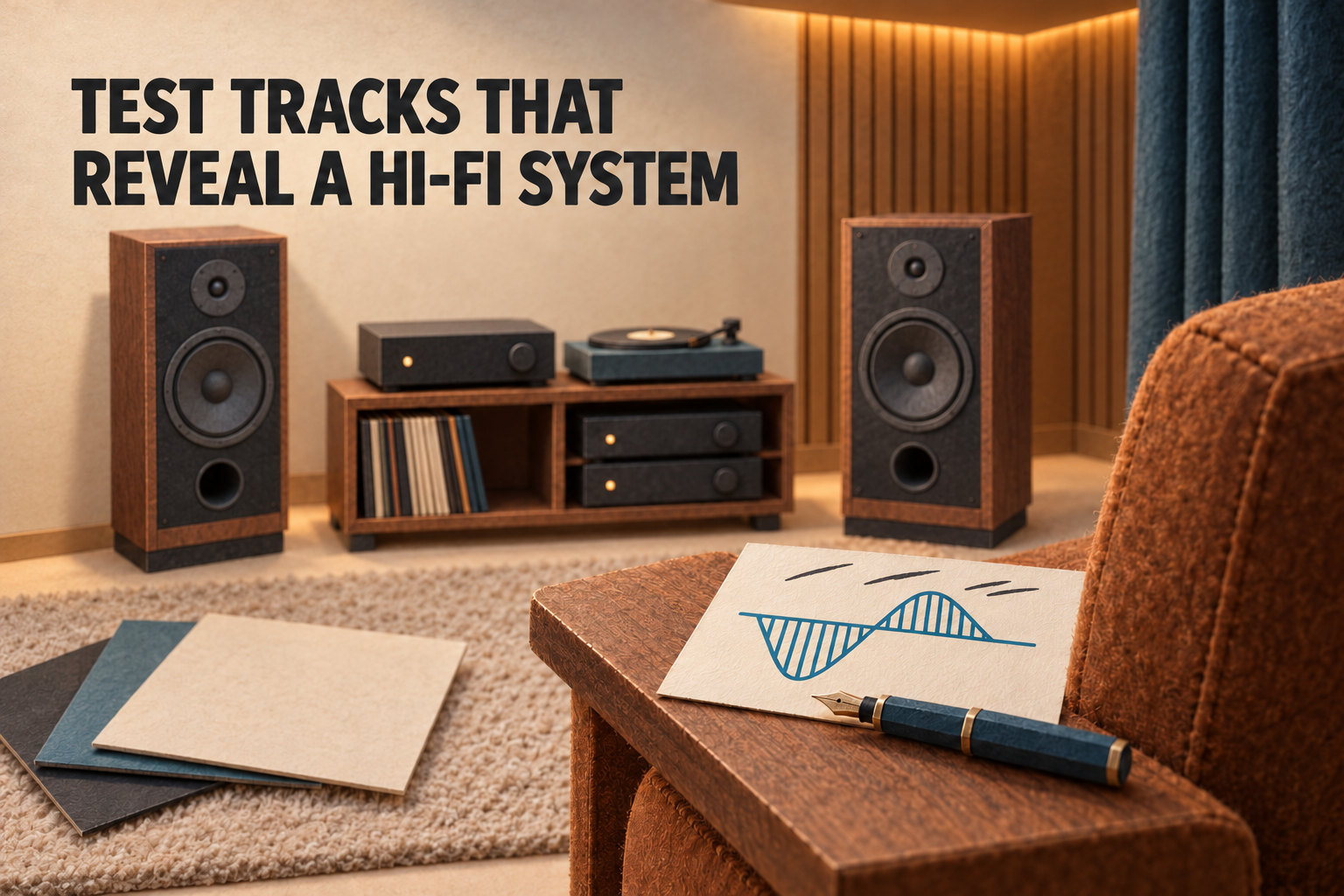
It took four people to carry the box in. Inside it was a second box, and inside that the McIntosh MA9500, bolted to a wooden base, every piece wrapped by hand. I stared at it for hours before I switched it on. Three songs later I was in tears, hugging my dealer, who is also my friend.
The best songs to test speakers are not showpieces; they are recordings you know so well that the system becomes the only thing that changes. Here are nine from my own sessions, with what each reveals and what good and bad sound like. We do not listen to specifications. We listen to music.
Three songs, one hug: the first listen on the MA9500
It starts with a mistake. I had bought Bowers & Wilkins 800-series Diamond floorstanders, my dream speakers, and connected them to my flagship Yamaha receiver in place of my Klipsch. More detailed than the Klipsch, yes. And hollow. Hollow on every song, even after I connected the Klipsch back to be sure. Thirty thousand dollars of speakers on the wrong amplifier, and I could not understand why.
I called my dealer yelling that the speakers were defective. He calmed me down, offered to take them back, and reminded me that he had warned me: my electronics were not a match. He was right. I had royally messed up.
The MA9500 was my answer. Driving the B&Ws at last, it was fed by my Eversolo A6 Master Edition over AudioQuest Yukon XLR cables. First song, "Giorgio by Moroder" by Daft Punk. Second, "What a Wonderful World" by Friend 'n Fellow. Third, "Birds" by Dominique Fils-Aimé. It was a revelation: music that surrounds you, music you can feel, music that carries you into the song, where every word in the lyric matters.
One of those three is still on my list: years later, when the bass test came in my first critical session in the new listening room, the track was "Giorgio by Moroder".
Same tracks, same level, same seat: how to use the best songs to test speakers
A test track is a ruler; move it and it measures nothing. When I compared the WiiM Ultra with the Eversolo A6 Master Edition, both bought with my own money, I ran them side by side for over three months, switching between them on identical Qobuz tracks from albums I know well. The tracks and the method are in my WiiM Ultra against Eversolo A6 Master Edition comparison. Four rules keep the ruler still:
- Same tracks. Choose them once and keep them for years. A new track teaches you about the track, not the system.
- Same level. Change the volume between A and B and you are comparing volumes, not components.
- Same seat. In my old room the seat sat 3.5 metres from the speakers with zero gap to the back wall, and every judgement I made belonged to that seat.
- One change at a time. When the system went into the new listening room, the chain stayed identical: same Yvettes, same C12000, same monoblocks, same Transparent cables, same sources. Only the room and the power changed.
Knowing what to listen for is the rest. On my revealing system I could tell the WiiM from the Eversolo ten times out of ten. In a $5,000 to $10,000 system, with the visual cues removed and long pauses, I am not convinced you could. Here is the card:
| Track | Artist | Album | What it tests | Good | Bad |
|---|---|---|---|---|---|
| "The Happiest Days of Our Lives" (helicopter) | Pink Floyd | The Wall (1979) | Height, movement | Starts high right, passes the seat, exits left, stays high | Stuck at tweeter height |
| "Mining for Gold" | Cowboy Junkies | The Trinity Session (1988) | Space, ambience | The church all around you | A singer and no building |
| "Take Five" | The Dave Brubeck Quartet | Time Out (1959) | Timing, scale, kick drum | Kick drum fills the room on the solo | A polite thud from a box |
| "This Town" | Patricia Barber | Clique! (2021) | Voice, layering, low-level detail | Black background, voice clear of the band | Grey background, voice glued to the band |
| "What a Wonderful World" | Friend 'n Fellow | Covered | Voice, lyric | Every word matters | The words arrive, the person does not |
| "Birds" | Dominique Fils-Aimé | Nameless (2018) | Voice, involvement | Carries you into the song | The voice stays in the speaker |
| "Giorgio by Moroder" | Daft Punk | Random Access Memories (2013) | Bass texture, room load | Textured bass from several angles | The room overloads, the imaging smears |
| "Bad Guy" | Billie Eilish | When We All Fall Asleep, Where Do We Go? (2019) | Deep bass at level | No compression, no distortion | Clipping, or no bass left to clip |
| "Six Blade Knife" | Dire Straits | Dire Straits (1978) | Detail you can live with, for hours | The next song, and the next | Impressive, then you need a break after 30 minutes |
Nine recordings from KD's own sessions: the album, what each tests, and what good and bad sound like.
Songs to test soundstage: The Wall's helicopter and The Trinity Session's church
The 24 seconds of rotor noise that open "The Happiest Days of Our Lives" on The Wall (1979) are real helicopters, recorded by engineer Jack Douglas on location at Edwards Air Force Base in California. In my old L-shaped room, one speaker exposed to an open area and the other pushed against a glass balcony wall, that helicopter never flew the way it should.
In my first critical session in the new listening room, done alone, it finally did. It came from high on the ceiling to the right, approached my listening position, then moved out to the left until it vanished. And it stayed high, because at the end of the day it is a helicopter, and it is flying. If the rotor sits at tweeter height between the speakers, you have a sound effect, not an aircraft. My note is The helicopter finally flew; the room story is in the film about the new listening room.
Read every label as live text
- START: high, right
- CLOSEST TO SEAT
- EXIT: left, vanishes
- STAYS HIGH
- FAIL: stuck at tweeter height
- 24-second helicopter, The Happiest Days of Our Lives, The Wall (1979)
Cowboy Junkies' The Trinity Session is the other half. It was recorded in Toronto's Church of the Holy Trinity on 27 November 1987, the band gathered around a single Calrec Ambisonic microphone. Start with "Mining for Gold", Margo Timmins singing a cappella, and listen past the voice for the building. In the new room I could hear the church: the ambient noises and background elements at the right size and position, everywhere around me. The sense of space was no longer a suggestion. It was a reality.
You are in the church.
That moment has its own Daily, You are in the church. A weak system gives you a woman singing in front of you. A good one gives you the woman and the church.
Timing and drums: Take Five's kick drum
"Take Five", composed by Paul Desmond, was recorded by the Dave Brubeck Quartet in 1959 for Time Out, in quintuple time: five beats to the bar. It was my jazz track in the streamer comparison, and the second track of my first session in the new room, straight after the helicopter. The quartet was more organic and alive than ever, with proper scale and position and perfect imaging. Then came Joe Morello's drum solo, and for the first time the kick drum was room-filling.
Count the five: piano and cymbal should lope, never plod, and four musicians should feel like four people, not miniatures on a shelf. On the solo the kick drum is the tell: a polite thud from inside a box in a room that fights the bass, a presence that fills the space in a proper one. Same recording, same chain. The difference was the room.
Voice and texture: This Town, What a Wonderful World and Birds
Listen to the background between phrases: black, not grey. In my streamer comparison the vocal track was Patricia Barber's "This Town", which opens her 2021 Impex album Clique!. Across that test the Eversolo gave me better imaging and layering, more low-level detail and a completely dark background; the WiiM Ultra was very vivid, airier at the top, warmer and more pleasing. In my treated room the Eversolo's advantage was real but subtle: the last 3 to 5% of performance.
That last few percent is made of small things: a voice standing clear of the band, a breath, the end of a word arriving without you reaching for the volume.
The other two voices come from the first night, and test what no measurement names. On the MA9500, every word in the lyric mattered, and every image the artist wants you to see was there. Played as tests, "What a Wonderful World" and "Birds" ask exactly that: is the song painting pictures in the room, or is the voice stuck inside the speaker?
Songs to test bass: Giorgio by Moroder, Bad Guy and the sound of clipping
"Giorgio by Moroder" is the third track on Daft Punk's Random Access Memories (2013): nine minutes and four seconds of Giorgio Moroder telling his story over a click track, with Nathan East and James Genus credited on bass. It is my bass test, and it tests more than the bottom end: whether the bass is three-dimensional, and whether it overloads the room and damages the imaging.
In the new room it passed: textured, dimensional bass arriving from multiple angles, the room controlling the low end and the speakers disappearing. For the first time I had the feeling of wearing headphones, but with the physical pressure of real bass that headphones cannot deliver; the Daily Headphone texture, with real pressure is about exactly that.
Billie Eilish's "Bad Guy", produced by Finneas O'Connell for When We All Fall Asleep, Where Do We Go? (2019), is built on almost nothing: synth bass, a kick drum, amplified finger snaps and 808 bass. My Bowers & Wilkins 800-series speakers would clip on it above about 95 dB. It had to be loud, but once you hear it, you cannot unhear it.
This clipping, you always remember.
The Wilson Yvette's 20 Hz extension is there; you do not hear it, you feel it in your chest. And when I auditioned the Yvette on "Bad Guy", the bottom end that had forced the B&Ws into clipping came through with no compression and no distortion. At a level you trust, listen for one thing: does the bass keep growing as the volume rises, or does it flatten and harden?
Then the trap. The Klipsch La Scala, in the same comparison, never clipped on my demanding songs. That was not control. The low frequencies were absent; the bass took a day off. A speaker that never clips on "Bad Guy" may simply not be playing the note.
Detail you can live with: Six Blade Knife and the long-session test
My classic rock track is "Six Blade Knife", from Dire Straits' self-titled 1978 album. In the streamer comparison the cheaper box held its own: the Eversolo was the more audiophile-oriented tool, but the WiiM Ultra's warmth made classic rock and lower-quality recordings easier to listen to for long stretches. Detail is one axis. Wanting to keep listening is the other.
The lesson came from a flagship: I auditioned D'Agostino electronics driving large Wilsons from a dCS Varese front end, considered by many the pinnacle of high-end audio. Spectacular. Technically flawless. After 30 minutes I needed a break. My brain was frosted. It was too much of everything: not fatiguing, but surgical, analytical, ultra detail. I have said on camera what I admire in D'Agostino, for different reasons. But that audition showed me what my McIntosh does best: it stays about the music. With my McIntosh separates, the only thing I care about is the next song, and the next song, and the next song, for hours.
So the last test is a clock, not a track. Play whole album sides at your normal level. If you need a break after half an hour, the system is impressing you. If all you want is the next song, it is playing music.
Build your own list: recordings you know by heart
Mine work because I know them. Build yours by job:
- Height and movement: something that flies, like the helicopter on The Wall.
- Space: a recording made in a real building.
- Timing and scale: a small acoustic group with a drum solo.
- Voice: two or three singers you love.
- Bass: one track for texture, one for pressure.
- One long album, played whole, for the clock.
- One badly recorded album you love. A speaker like the Yvette reveals everything, the good and the bad.
Use the same source every time. Do the first session alone and write down what you hear before anyone tells you theirs. Never buy because a reviewer told you to, or because the price suggests quality. Buy because you heard the difference in your own system, with the ability to return it if you did not.
Nine recordings, one seat, one level. The list does the measuring so the music can do the rest. Three songs once had me hugging my dealer in tears, and no specification has ever done that. At The Sound Lab, better means whatever is more convincing as live sound. The gear serves the music, not the other way around.
Frequently asked questions
What are the best songs to test bass?
"Giorgio by Moroder" by Daft Punk tests bass texture and how the room copes; Billie Eilish's "Bad Guy" tests pressure at level.
Which songs test soundstage?
The helicopter that opens "The Happiest Days of Our Lives" on The Wall tests height and movement. The Trinity Session tests whether you hear the church around the singer.
How do I use audiophile test tracks in an audition?
Play recordings you know well: same tracks, same volume, same seat, one change at a time. Listen alone first and write down what you hear.
More from the Journal
Keep exploring.
Loading articles…