The Journal / Articles & reviews
Qobuz vs Tidal vs Apple Music vs Spotify Lossless: Which Streaming Service for a Hi-Fi in 2026?
Every service is lossless on paper now; the differences that matter on a real system are formats, integration, catalogue and price.
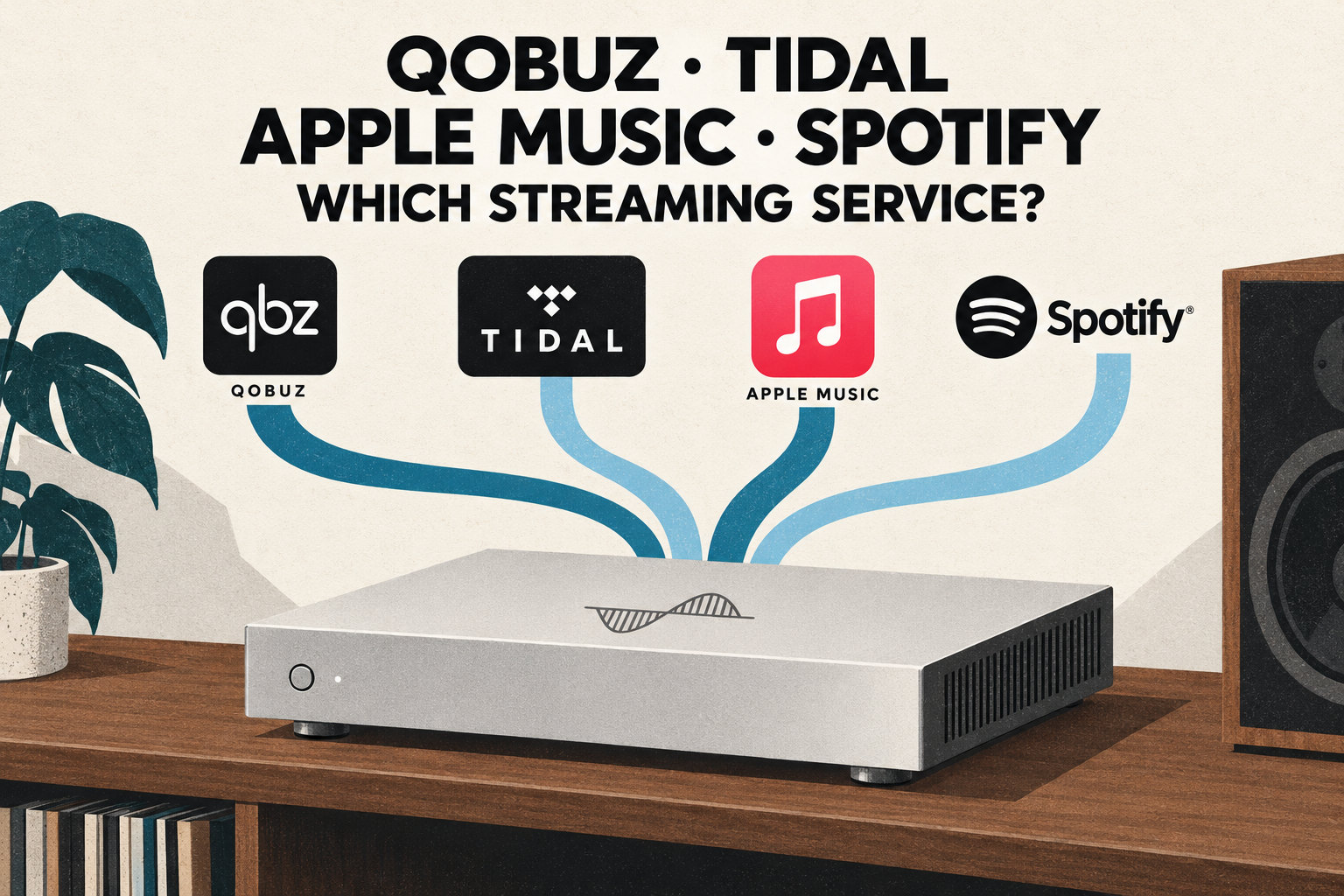
On 3 August 2026 Tidal's individual plan began rising from $10.99 to $11.99 a month, one billing date at a time, and with that last dollar hi-fi streaming settled into an odd truce. Qobuz, Tidal, Apple Music and Spotify all stream lossless audio now, and on a monthly plan all four charge between $11.99 and $12.99 in the United States. The old Qobuz vs Tidal argument, the one about MQA, folded files and whose stream was purer, is over. What decides the subscription now is less glamorous and more audible: the road the music takes into your streamer, the catalogue at the other end, and the version of the album you press play on.
The short answer, for a two-channel system with a network streamer: Qobuz is the strongest all-rounder for album listeners, jazz and classical collectors and anyone who still buys downloads. Tidal matches it on resolution, costs a dollar less on a monthly plan and claims the bigger library. Apple Music is superb on an iPhone and awkward on a hi-fi. Spotify Lossless is genuine lossless, capped at 44.1 kHz, and still the best at finding you something new. The evidence follows, along with why the channel's streaming comparisons are played from Qobuz.
Lossless everywhere: what changed when Spotify went lossless
Spotify switched on lossless for Premium subscribers on 10 September 2025, eight years after it was first rumoured. Stereophile reported FLAC at up to 24-bit/44.1 kHz, arriving first in twelve markets including the US and UK, with more than 50 planned. It cost nothing extra.
The other three had already cleared their decks. Tidal folded its $19.99 HiFi Plus tier into one cheaper plan in April 2024, then on 24 July 2024 replaced its MQA catalogue with FLAC files. Apple has offered lossless and Hi-Res Lossless in ALAC at no extra cost since its 2021 announcement. Qobuz had led the way: What Hi-Fi? credits it as the first to drop MP3 streaming entirely, going "all-in on CD quality and hi-res".
Then came the bills. Spotify's US Premium plan rose to $12.99 with February 2026 billing. Apple Music went to $11.99 in July 2026, its first rise in four years. Tidal's rise, announced at the start of July, took effect on 3 August; the company told subscribers it was "the first time we've adjusted our base plan pricing in three years". Price barely separates them; integration, catalogue and mastering do.
Spotify Lossless: genuine FLAC, capped at the CD sample rate
Nothing is discarded, so Spotify Lossless is genuinely lossless. The catch is the sample rate. As SoundStage! Simplifi pointed out, 44.1 kHz is the CD standard while Apple Music, Tidal, Qobuz and Amazon reach 192 kHz, so a 96 kHz master arrives at a Spotify listener as 44.1 kHz. Lossless must also be switched on device by device, Bluetooth cannot carry it, and older Spotify Connect products wait on firmware updates that may never come.
The four at a glance: resolution, format and price
On paper, Qobuz vs Tidal vs Apple Music is a dead heat at 24-bit/192 kHz, with Spotify a rung below. The last two columns are where they split.
| Service | Maximum resolution | Format | US individual price, August 2026 | Main route into a streamer | Roon |
|---|---|---|---|---|---|
| Qobuz (Solo) | 24-bit/192 kHz | FLAC | $12.99 a month, or $129.99 a year (about $10.83 a month) | Qobuz Connect | Yes |
| Tidal | 24-bit/192 kHz | FLAC | $11.99 a month from 3 August 2026 (was $10.99) | Tidal Connect | Yes |
| Apple Music | 24-bit/192 kHz (Hi-Res Lossless) | ALAC | $11.99 a month since July 2026 (was $10.99) | AirPlay 2 | No |
| Spotify Premium | 24-bit/44.1 kHz (Lossless) | FLAC | $12.99 a month since February 2026 | Spotify Connect | No |
Maximum resolution, format, US individual price as of August 2026, main route into a streamer and Roon support for Qobuz, Tidal, Apple Music and Spotify.
Sources: Qobuz, ecoustics, What Hi-Fi?, SoundGuys, Stereophile, Roon. Prices as of August 2026.
Read the resolution column as a ceiling, not an average. What Hi-Fi? notes that most of Tidal's hi-res streams are 24-bit/96 kHz, and SoundStage! Simplifi reminds readers that most tracks, even on Qobuz and Tidal, are not available at 24/192; many are CD quality or slightly better. Library size is a marketing number too: Tidal claims over 180 million tracks, Qobuz over 100 million, and neither figure tells you whether your albums exist in hi-res.
Getting it into a hi-fi: Connect, AirPlay, Google Cast and Roon
This is where the four stop being equal. The widest road in is a Connect protocol. When Qobuz Connect launched, What Hi-Fi? put it plainly: "all the streaming duties are handed off to the supporting hardware", and the phone is used "simply as a controller". Tidal Connect and Spotify Connect already worked that way. Qobuz Connect arrived last, at High End Munich in May 2025, on products from over 40 brands. By December 2025 Qobuz counted more than 100 partners and named its five busiest by streaming volume: WiiM, Marantz, Denon, Naim and Eversolo.
Apple Music's usual road into a hi-fi streamer is AirPlay 2, and that is its weak link. Stephen Dawson, writing for Australian Hi-Fi, captured what each casting protocol delivers and nulled it against the original file. AirPlay 2 failed the null test, which he read as lossy compression or some other alteration; Google Cast, launched from inside an app, left differences he called "utterly inaudible", and DLNA/UPnP was bit-perfect. Apple's support page adds that an iPhone needs an external DAC above 48 kHz and that Bluetooth connections "aren't lossless". What Hi-Fi? sums Apple Music up as a "no-brainer" for owners of Apple devices that "isn't very hi-fi friendly".
| Route | Test | Result |
|---|---|---|
| AirPlay 2 | iPad to WiiM Pro, 16-bit/44.1 kHz track | Not bit-perfect: residual averaging -43.3 dB, peaking at -21.6 dB |
| AirPlay 2 | To Apple TV 4K, files from 44.1 to 192 kHz | Everything converted to 48 kHz |
| Google Cast, from inside an app | Android phone, tablet and player (BubbleUPnP) to WiiM Pro, 16-bit/44.1 kHz track | Residual averaging -116 dB, peaking at -90 dB |
| Google Cast, from inside an app | To WiiM Pro, 24-bit hi-res track | Within one bit; noise floor at -144.5 dB |
| DLNA/UPnP | CD-quality tracks, every trial | Bit-perfect |
Stephen Dawson's null tests of AirPlay 2, Google Cast and DLNA/UPnP for Australian Hi-Fi (republished by What Hi-Fi?, April 2025): residuals against the original file and sample-rate conversion; Connect protocols were not tested.
Source: Stephen Dawson, Australian Hi-Fi, republished by What Hi-Fi?, April 2025. Connect protocols were not part of the test.
Then there is Roon. Its compatibility page lists Tidal and Qobuz, alongside KKBOX and nugs, and interleaves them with your local files; Spotify and Apple Music are absent. For a Roon household, the four-way choice is a two-way one.
Catalogue, editorial and discovery: where each service is strongest
Each service has a personality, and the catalogue shows it before the sound does. Qobuz is a record shop with a magazine stapled to it. Tidal is the broad mainstream library. Apple Music is the classical listener's bargain. Spotify is the discovery engine.
Qobuz's case is editorial and ownership. ecoustics singles out its "music journalism, reviews, and a download store", and the Sublime plan takes up to 60% off hi-res downloads. In 2018 Gordon Brockhouse of SoundStage! Simplifi found richer album commentary on Qobuz than on Tidal and, in the desktop app, a "Read Digital Booklet" option for liner notes. He also counted, at the time, 38 hi-res albums by the early-music specialist Jordi Savall on Qobuz against none on Tidal, whose hi-res then came as MQA. In 2019 The Absolute Sound found Qobuz less deep than Tidal in urban pop. Read those counts as history, not a census.
Tidal answers with breadth. What Hi-Fi?, whose award winner it is, credits its "excellent sound quality, intuitive interface and improving discovery and algorithm-driven playlist features". Apple Music's strongest card for classical listeners is Apple Music Classical, included in the same $11.99 subscription. Spotify still finds you the next record: SoundStage! Simplifi calls its recommendation algorithms "unmatched".
Qobuz vs Tidal sound quality: what a revealing system can and cannot show
Played from the same master and delivered bit-perfect, Qobuz and Tidal hand your DAC identical samples. In 2019 Steven Stone wrote in The Absolute Sound that the differences he heard "have been a result of different masterings rather than one streaming service's hi-res delivery being inherently superior". On Audio Science Review in 2020, one member who found the two services "clearly different" was told in reply that Tidal was converting its 16/44.1 files to MQA, a variable gone since July 2024. Even in 2018, with MQA in play, Brockhouse heard Qobuz as "a little more incisive and detailed, Tidal a little more rounded and organic", then added, "these differences are tiny".
The owner forums split, instructively. In a Steve Hoffman Forums thread from October 2024, one member found the two close but Qobuz "noticeably better", another rated Tidal's library better and its sound slightly better, and a third could not hear a difference when sure of listening to the same mastering. Two services serving two masters is a comparison of masters, not services.
"We do not listen to specifications. We listen to music." KD, WiiM Ultra against Eversolo A6 Master Edition, 15 October 2025
Resolution itself is a narrower question than the marketing implies. SoundStage! Simplifi argues that the audible difference between 44.1 kHz and 192 kHz "is negligible for most humans, even with high-end audio equipment"; What Hi-Fi? counters that on a transparent enough system hi-res can bring "more detail and texture". The one service-level gap a major reviewer reports is Spotify's: What Hi-Fi? found its sound quality "isn't as good as Tidal's".
The real differences hide either side of the subscription: the mastering you pick, and the road into the streamer, where AirPlay's -43.3 dB residual in Dawson's iPad-to-WiiM test is a different order of problem from Google Cast's -116 dB. Then comes the system. In KD's WiiM Ultra against Eversolo A6 Master Edition comparison, run side by side for more than three months on his reference system, two streamers more than four times apart in price differed by "squeezing out this last three to five per cent of performance", and "the limiting factor in most systems is not the streamer, it is the speakers, it is the electronics, and maybe the cables". That film compared hardware, not services, but the logic travels. His vinyl against digital film lands on "what is better is what is more believable", and the practical version is the title of one of his Dailies: casual or critical, choose the format by the job.
Why Qobuz suits the channel's streaming tests
Every streaming comparison on the channel is played from Qobuz. In the WiiM Ultra ($329) against Eversolo A6 Master Edition (about $1,400) film, prices as of October 2025, KD put the method on camera: "For streaming, I used Qobuz and I played identical tracks switching between the Eversolo and the WiiM Ultra." The tracks were Dire Straits' Six Blade Knife, Patricia Barber's This Town and the Dave Brubeck Quartet's Take Five. His La Scala against Yvette audition used HiFi Rose streaming from Qobuz too.
None of it is sponsorship; The Sound Lab takes no sponsors, free gear or affiliate links. Qobuz earns that job on three counts.
- Repeatability. Qobuz serves "authentic masters", in What Hi-Fi?'s words "tracks as supplied, with no alterations", so a comparison can come back to exactly the same file, session after session.
- It lives inside the hardware. Qobuz Connect launched on products from WiiM, Eversolo, HiFi Rose and McIntosh, brands that all sit, or have sat, in KD's own system, and WiiM and Eversolo are two of its five busiest partners. On a Connect streamer, the device under test fetches the music itself and the phone stays out of the signal path.
- It works with Roon, and its Sublime plan sells downloads at a discount, so a test album can become a file on a drive.
KD also streams on Tidal, Spotify and Apple TV, and started with Apple Music through an Apple TV into an AV receiver. Testing on Qobuz is a method, not a verdict on the other three.
Which to choose: by listener type and system
- Album listeners, jazz and classical collectors, anyone who still buys music: Qobuz, ideally on the annual plan (about $10.83 a month), over Qobuz Connect.
- Widest library, Dolby Atmos and Tidal Connect, month to month: Tidal, at $11.99.
- Roon households: Qobuz or Tidal, the only two of the four that Roon integrates.
- iPhone households on headphones, or classical listeners who want Apple Music Classical and Dolby Atmos: Apple Music, with an external DAC for Hi-Res Lossless. On the main system, AirPlay is the bottleneck.
- Playlist households that discover more than they replay: Spotify, whose 24-bit/44.1 kHz FLAC outranks both CD and its old 320 kbps Ogg Vorbis on paper.
KD's streamer rule sets the priorities: in a system worth up to $10,000, buy the WiiM Ultra ($329 when he filmed it) and spend the $1,070 saved on room treatment, amplification or speakers. By the same logic, a $12 monthly decision rarely holds a $10,000 system back. Choose the service whose catalogue you actually play, give it a Connect road, and pick the master before you blame the bits. Then stop auditioning subscriptions and start listening. As KD closed his streamer film, "the best component is the one that gets out of the way of the music".
Frequently asked questions
Is Spotify Lossless actually lossless?
Yes: Premium subscribers get FLAC at up to 24-bit/44.1 kHz. It must be switched on per device, it does not survive Bluetooth, and higher-resolution masters arrive at 44.1 kHz.
Tidal vs Qobuz: does one sound better?
No, not when both play the same master bit-perfect as FLAC up to 24-bit/192 kHz. Audible differences usually trace back to a different mastering or a different road into the streamer.
What is Qobuz Connect?
Qobuz Connect, launched in May 2025, turns the Qobuz app into a remote while a compatible streamer fetches and plays the music, as Tidal Connect and Spotify Connect already did.
What is the best music streaming service for audiophiles?
Qobuz or Tidal, for a two-channel system with a Connect streamer: both stream FLAC up to 24-bit/192 kHz and work with Roon. Qobuz suits album collectors and download buyers, Tidal those who want the broadest catalogue.
More from the Journal
Keep exploring.
Loading articles…