

The Journal / Articles & reviews
How to Clean Vinyl Records, and Your Stylus, Without Destroying Anything: My Routine From Brush to Ultrasonic
Cleaning reveals the pressing but cannot repair it, and done carelessly it can cost you a cartridge.
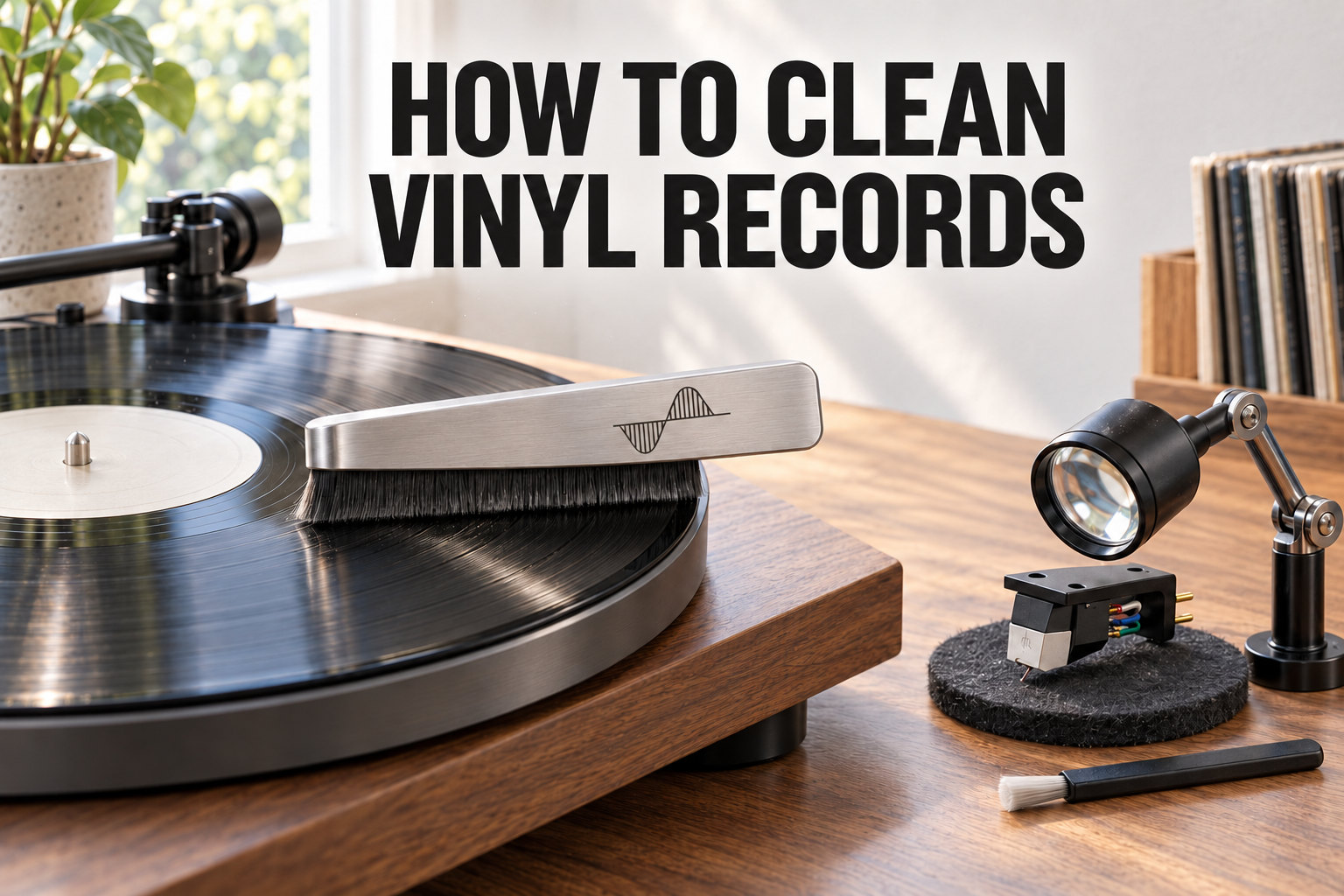
Under the magnifier on my workbench, the stylus of my $500 phono cartridge was not broken. It was bent, just sad and crooked: the cleaning cloth I had run over the turntable the night before had caught the cantilever. The guilty one was me. I got in the car in my pyjamas and drove to the dealer.
So I know how to clean vinyl records badly. This is how to do it well, stylus included: a carbon-fibre brush before every play, a deep clean before any record meets the needle, a stylus brushed in one direction only, and an honest account of what no machine can fix. Cleaning reveals the pressing. It cannot repair it. Done carelessly, it can cost you a cartridge.
A bent cantilever, a cleaning cloth and a drive in pyjamas
Let me take you back to the day I almost fainted. I had been away from vinyl for over a decade when I came back with a McIntosh MT5. If it sucked, I thought, at least it would look good on a shelf. It did not suck. It was incredible, and a few weeks in I was buying reference albums and classic pressings and spending way too much.
Then one day I put on an album and the sound was awful. Distorted, scratchy, very wrong. My dealer tolerated me on the phone for about five seconds and named the suspect: the cleaning cloth. I blamed everyone except myself before I remembered. I had cleaned the turntable myself the night before, because friends were coming over for one of our listening sessions.
Then came the pyjamas, the car and the dealer's counter. The verdict was short and expensive: a replacement, or a new stylus and cantilever, some weeks of waiting and almost the price of a new cartridge. I nearly fainted for the second time, right there in the store. I bought a cheap stopgap for a few hundred dollars and went down the rabbit hole that became my film on the $500 cartridge I destroyed and moving coil against moving magnet. That disaster taught me more about vinyl playback than years of casual listening, and the lesson fits in two sentences from that November 2025 film:
Cleaning is good. Being careful is better.
Dirt against defects: what cleaning can change and what it cannot
A record carries two kinds of noise. The first sits on the surface and down in the groove: dust, static, fingerprints, old residue. It moves when you clean; leave it, and your stylus meets it first. The second was pressed in at the factory: non-fill, a damaged stamper, particles and air bubbles trapped in the vinyl. That noise never moves, because it is the groove itself.
My system forgives neither. The MT5 feeds the dedicated phono stage of the McIntosh C12000, then MC611 monoblocks and Wilson Audio Yvettes. On a $300 turntable with a basic cartridge, you might shrug surface noise off as the vinyl experience. On a reference system every defect is exposed with surgical clarity. The better your system, the more unforgiving it becomes.
So I clean every record before it ever touches my stylus. Not to turn a bad pressing good, but because once the first kind of noise is gone, whatever is left is the second kind. Clean first, judge second. Period.
Before every play: a carbon-fibre record brush and hands off the grooves
My daily routine is boring, and boring is the point. A carbon-fibre brush before every play. Zero fingerprints, because I don't touch the playing surface.
The carbon-fibre record brush is the cheapest insurance in vinyl. AudioQuest's anti-static brush runs about $17 to $35 at US retailers as of September 2026, depending on version. Its job is narrow: lift loose dust off the surface before the stylus gets there.
Know its limit. A brush does not wash. Grime settled into the groove over decades in a paper sleeve stays where it is; pretend otherwise and your stylus does the washing.
One more habit belongs here: when the cartridge is not playing, put its stylus guard on. Ortofon asks for exactly that. After my cloth, I would add a padlock if I could.
How to clean vinyl records properly: by hand, by vacuum or by ultrasound
For the deep clean there are three families of method, separated by how much of the work your own hands do.
A wet clean by hand works, and costs little; what it cannot remove is you. Use distilled water, not tap water; I use lab-grade distilled water even in my machine. If you add anything, make it a record fluid, never a solvent: Ortofon does "not recommend the use of solvents of any kind for cleaning of either record surface or stylus." The weak point is the dirt you have just loosened: it is now in the fluid, and the fluid is still on the record. Wipe it away and let the record dry completely; for a handful of records a month, that is enough.
A vacuum machine attacks that weak point. You still apply the fluid and scrub, but then a vacuum pickup clears the record. In the words of the listing for Nitty Gritty's Model 1.0, it removes "the used solution along with suspended dirt and debris." On the VPI HW-16.5 that pickup pass takes about 35 seconds a side. In August 2026 the VPI listed at $1,200 at Music Direct and the Okki Nokki ONE DV at $749 at Turntable Lab. It suits the collector who cleans in batches and does not mind scrubbing.
Ultrasonic cleaning takes your hands off the record entirely. In the Degritter, a pump fills the tank with distilled water and a little optional fluid, ultrasound does the scrubbing, and the record dries in filtered air from the machine's own fans. The Degritter Mk II I own listed at $3,600 at Music Direct in August 2026. In my Degritter Mk II film, published in September 2025, I set out why I chose it over Audio Desk, VPI, Okki Nokki and HumminGuru. As I said in my pressing investigation, an ultrasonic cleaner will "remove every possible contamination so you can hear exactly what the pressing gave you." My advice in that same film was blunt. If you invest in vinyl, invest in proper cleaning.
| Method | Typical cost (US) | Your effort | What it removes | Risks and limits |
|---|---|---|---|---|
| Carbon-fibre brush, dry | About $17 to $35 (AudioQuest, by version) | Seconds, before every play | Loose surface dust | Does not wash |
| By hand, wet | Low: distilled water, record fluid, soft pad | Both sides, then full drying | Fingerprints, surface grime | Wet labels, residue; no solvents (Ortofon) |
| Vacuum machine | $749 (Okki Nokki ONE DV) to $1,200 (VPI HW-16.5) | Fluid, scrub, vacuum each side | Used fluid and suspended dirt | Your hands still apply and scrub |
| Ultrasonic machine | $3,600 (Degritter Mk II) | Load, press, wait | Groove grime, residue, fingerprints | Water and filter changes; cannot fix pressing defects |
From a brush at about $17 to a $3,600 ultrasonic machine: cost, effort, what each method removes and what it cannot do. Prices as of August 2026 (machines) and September 2026 (brush).
Prices: US retail as of August 2026 (machines) and September 2026 (brush).
Living with an ultrasonic cleaner: my Degritter routine
A machine does not clean records. A routine does. Here is mine, as I set it out in my April 2026 film on modern pressings:
- Lab-grade distilled water.
- The manufacturer's cleaning solution.
- Solution and filters changed every 20 to 30 cycles.
- A carbon-fibre brush before every play.
- Zero fingerprints.
The third line matters more than it looks. The water is the cleaning tool, and every record leaves something of itself in the tank. Skip the change and record sixty is washed in water that has already met the first fifty-nine. Owners are all over the map. In a 2021 What's Best Forum thread on the original Degritter, one changed the water every 10 to 12 records, another discarded it after every session, and a third reckoned on about 25 cycles and changed the filter only "whenever it's too dirty." My routine changes both on a count, not on a guess.
One step my list leaves out costs almost nothing: once the fans finish, give the clean record a clean inner sleeve, not the dusty paper one it came in.
Now the humbling part: even so, enough of my new, factory-sealed premium records still sounded terrible.
How to clean a turntable stylus without breaking it
Clean a turntable stylus with a dry stylus brush, from the back of the cartridge forward to the tip, and never with a cloth. Ortofon's FAQ says to "use the brush in the forward direction from the rear of the cartridge towards the stylus tip", never from side to side. Its stylus-brush page closes the last loophole: never from the stylus tip back to the rear of the cartridge. A few strokes along the cantilever whenever you play a new record or change sides is the whole job; Ortofon says no further stylus cleaning is normally needed. Keep solvents away, because on the stylus and cantilever they "may damage stylus cement".
Read every label as live text
- Back to front
- Never tip to back
- Never side to side
- No cloth
- No solvents
- Guard on when not playing
To that I add two rules my accident taught me:
- No cloth anywhere near the stylus. A cloth can snag a cantilever; mine did.
- Guard on and arm on its rest before you clean anything else on the turntable. My mistake was not the cleaning; it was cleaning around an exposed cantilever.
The stakes are real. A moving magnet cartridge has a replaceable stylus, costing 30 to 70% of the cartridge's value depending on the maker. With a moving coil, a broken stylus has no simple fix. My daily cartridge is a Sumiko Starling at around $3,000, and I have told beginners not to jump straight to that level, partly because if you break it, you will hate yourself. I was speaking from experience at a sixth of the price.
When to replace a stylus: hours, symptoms and a magnifier
Replace a stylus when it has done its hours, or sooner if the sound tells you to. Ortofon says that with proper care "up to 1000 hours is possible without degradation of performance", and that DJs should plan on about 500 at most. Audio-Technica's VM95 styli are listed by shape, from around 300 to around 1,000 hours, and the VM95SH, the Shibata version, was one of the moving magnets I bought after the accident.
| Stylus | Rated life |
|---|---|
| Ortofon, general use with proper care | Up to 1,000 hours |
| Ortofon, DJ use | About 500 hours at most |
| Audio-Technica VM95, elliptical | Around 300 hours |
| Audio-Technica VM95, conical | Around 500 hours |
| Audio-Technica VM95, Shibata (VM95SH) | Around 800 hours |
| Audio-Technica VM95, Microlinear | Around 1,000 hours |
Stylus life from Ortofon's FAQ and Audio-Technica VM95 stylus listings: from around 300 hours for a VM95 elliptical to up to 1,000 for Ortofon with proper care, or around 1,000 for a VM95 Microlinear.
Sources: Ortofon FAQ; Audio-Technica VM95 stylus listings.
An hour a night, every night, reaches 1,000 hours in under three years. Keep a rough count.
Ortofon also lists the audible warnings: distortion, more of it on voices and string instruments, and high frequencies that lose clarity and transparency. Learn the difference between wear and damage. Wear builds over hundreds of hours; my cartridge went from fine to awful in one careless clean. When the sound changes overnight, put the cartridge under a light and a magnifier before you blame the record, the phono stage or anyone else.
What cleaning cannot fix: non-fill, stamper damage and inclusions
Back to those terrible new records. Cleaned and never touched, they still sounded bad enough that I investigated them in my film on modern vinyl pressings. The problem was baked into the vinyl before it left the factory:
- Non-fill. Too low a temperature, too short a cycle or too little pressure, and the vinyl does not fill the groove walls. The noise is rough, metallic and permanent, worst on the outer grooves and better towards the centre, because the outer edge fills last.
- Stamper damage. Every record from a damaged stamper carries the identical defect, a pop or crackle once per revolution. Buy ten copies and you get the same problem in the same spot.
- Inclusions. Foreign particles, air bubbles, recycled material. Invisible on the surface; your stylus finds every one.
My test: four albums from one of the most recognised catalogues in audiophile history, same cleaning, same chain. One had minor clicks in silent passages. Two had textbook non-fill. The worst was a premium anniversary edition at $80. Three of the four came from one plant generally considered upper tier, and on one album side four was clean while sides one and two were defective. Same factory, different stampers, different result.
You are not unlucky. The entire run is compromised.
So do not buy another copy of the same pressing, and do not blame your cleaning routine for problems manufactured into the record. Return it. Before you buy, read the dead wax for the plant, the cutting engineer and sometimes the stamper, and research the pressing on Discogs and the Steve Hoffman forums. I once put the whole idea into one title: cleaning reveals the pressing; it cannot fix it.
My fourth lesson in the cartridge film was to always blame yourself. With the cloth, that was right. With a defective pressing, for once, it is not you. Read the dead wax before you reach for the fluid again.
Frequently asked questions
How do I clean vinyl records at home without a machine?
Brush with carbon fibre before every play. For a deeper clean, use distilled water, a record fluid and a soft pad, never solvents, and let the record dry completely.
How should I clean old vinyl records I just bought?
Give them a wet or ultrasonic clean before the stylus touches them; a brush cannot lift decades of grime from the groove. Whatever noise survives a proper clean is in the record, not on it.
Is a carbon-fibre record brush enough on its own?
For everyday dust, yes. It does not wash, so grime already in the groove needs a wet or ultrasonic clean.
How do I clean a turntable stylus safely?
With a dry stylus brush, a few strokes from the back of the cartridge forward to the tip; never side to side, never from the tip back. No cloth, no solvents, guard on when not playing.
How many hours does a stylus last?
Ortofon says up to 1,000 hours with proper care; Audio-Technica's VM95 styli are listed at around 300 to 1,000 hours depending on shape.
More from the Journal
Keep exploring.
Loading articles…