The Journal / Articles & reviews
Klipsch at 80: The Heritage Line Explained, From Heresy to the Klipschorn
Horn-loaded, hand-built and remarkably efficient: which Heritage model fits which room, and why it asks so little of an amplifier.
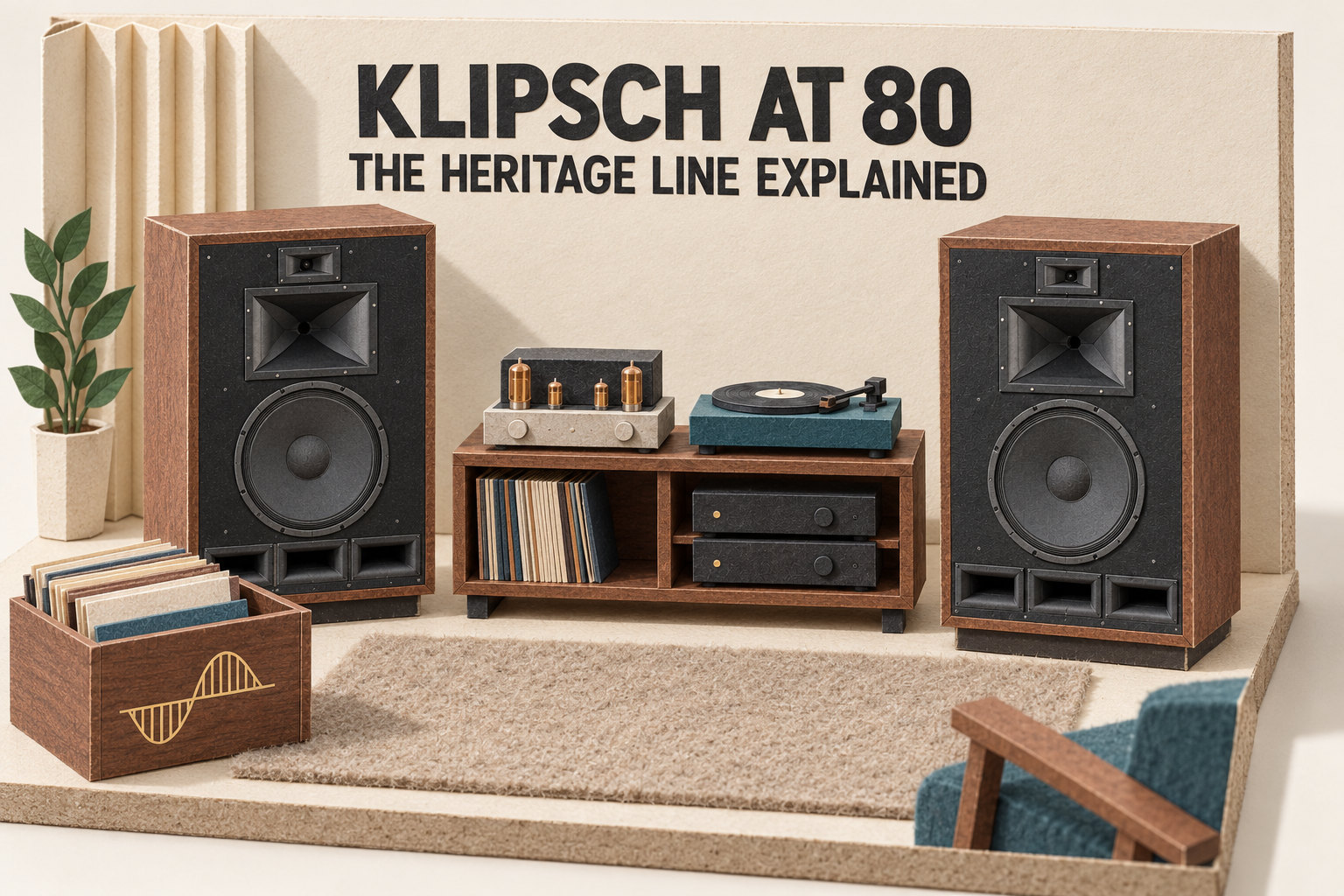
In 1946 Paul W. Klipsch was selling corner horns out of a tin shed in Hope, Arkansas, a year after his design won its patent. A local cabinetmaker and the Baldwin Piano Company helped him build the first twenty. The walls of each buyer's room finished the job.
Eighty years on, that corner horn is still in production, and the Klipsch Heritage speakers that grew up around it are still assembled by hand in Hope. In August 2026 the family runs from the new $2,599 Rebellion standmount to the Klipschorn, now also in a limited 80th Anniversary edition at $24,998 a pair. The short version: the Heresy IV is the affordable way in, the Forte IV the reviewers' all-rounder and the Cornwall IV the choice for rock at scale, while the La Scala and Klipschorn want big rooms. All of them play loud on a few watts, so a quiet amplifier matters more than a powerful one.
A corner horn in Arkansas: Paul Klipsch and the Klipschorn
Klipsch, born in Elkhart, Indiana, in 1904, found while working in Chile in 1930 that horn speakers were more efficient than cone speakers, according to the Klipsch Museum of Audio History. He built a crude corner-horn prototype in 1938; US Patent 2,373,692, filed in October 1942, was granted on 17 April 1945. In 1946 he registered Klipsch & Associates. Two years later he moved into the town's former telephone exchange, now the museum, and hired his first employee, cabinetmaker Lloyd McClellan.
The trick was the room itself. As Art Dudley explained in Stereophile in August 2019, the Klipschorn's woofer fires into a folded horn completed by the two walls of a corner; without them, "the horn is cut nearly in half." A horn couples a small diaphragm to the air of the room, raising efficiency, in Dudley's figures, "from approximately 1% or 2% to nearly 50%." Klipsch wanted that efficiency for clean sound, not loud sound.
"Amplifiers are cheap... But when we achieve higher efficiency in the speaker, it achieves a lower distortion." Paul W. Klipsch, as quoted by Stereophile
The speaker has changed beneath its veneer. The early Klipschorn, which Stereophile says hit the market in 1947, was a two-way with a 12-inch woofer; by the late 1950s it had a 15-inch woofer and separate midrange and treble horns. In September 2018 the AK6 closed the bass horn with three MDF panels, becoming, in Dudley's phrase, "a corner horn that comes with its own corner", and the open-backed original was retired. Roy Delgado, who started out working alongside Paul Klipsch and was head designer by 2019, is quoted by Stereophile with the house rule: "I want to do what Paul wanted, not what Roy wants."
Klipsch Heritage speakers: the family tree from 1946 to 2026
Several Heritage models began life as accessories to the Klipschorn. Klipsch's own history says the Heresy, first introduced in 1957, started out as "a compact center channel speaker to accompany the Klipschorn in three-speaker stereo arrays." The name was an in-house joke about a speaker that did not live in a corner; according to Australian Hi-Fi, it reached a brochure only in 1964.
The 1958 H8 was a smaller centre speaker still, of which only 16 were made. The Cornwall arrived in 1959 as "a larger, full-range alternative to the Heresy," in Klipsch's words, for the centre spot between two Klipschorns. The La Scala of 1963 was designed for performing-arts venues; Klipsch says Paul offered it to Winthrop Rockefeller, then an Arkansas gubernatorial hopeful, who later used it on a train car. The Forte, slimmer than the Cornwall and fitted with a passive radiator, joined in 1985.
The fourth generation was under way by 2019, when Klipsch announced the Cornwall IV. In March 2025 the Klipschorn AK7 and La Scala AL6 launched with an optional digital Heritage Active Crossover at $3,499 a unit, and in June 2026 the H8 returned as the Rebellion, a fitting sequel to a speaker called Heresy. Above them sits the Jubilee, a large horn system released for homes in mid-2022, which Delgado told Gear Patrol "has all the tricks we know."
Read every label as live text
- 1945
- US Patent 2,373,692 'Loud-speaker' granted (17 April)
- 1946
- Klipsch & Associates registered in Hope, Arkansas
- 1947
- two-way Klipschorn, 12 in woofer (Stereophile's market date)
- 2026
- Rebellion (announced June, on sale July, $2,599/pair); 80th Anniversary Klipschorn, 280 pairs, North American debut 7-9 August
- 1957
- Heresy (centre speaker for Klipschorn stereo)
- 1958
- H8 (16 made)
- 1959
- Cornwall
- 1963
- La Scala
- 1985
- Forte
- 2018
- Klipschorn AK6, enclosed bass horn (September)
- 2019
- Cornwall IV announced (fourth generation under way)
- 2022
- Jubilee horn system for homes (mid-year)
- 2025
- Klipschorn AK7, La Scala AL6, Heritage Active Crossover (March)
Model by model: size, sensitivity and the room each needs
The Rebellion, Heresy, Forte and Cornwall put horn-loaded upper frequencies over a conventional woofer; the La Scala and Klipschorn horn-load the bass as well, and Klipsch itself says only the Jubilee, Klipschorn and La Scala "exceed the Cornwall in bass extension and output."
| Model | Design | Size class | Rated sensitivity (Klipsch) | US list price per pair |
|---|---|---|---|---|
| Rebellion | 2-way, horn tweeter, rear port | Standmount, 8 in woofer | 95 dB | $2,599 (2026 launch) |
| Heresy IV | 3-way, horn mid and treble, ported | Compact floorstander, 12 in woofer | 99 dB | $3,198 |
| Forte IV | 3-way, horn mid and treble, passive radiator | Floorstander, 12 in woofer, 15 in radiator | 99 dB | $4,500 |
| Cornwall IV | 3-way, horn mid and treble, ported | Large floorstander, 15 in woofer | 102 dB | $5,999 |
| La Scala AL6 | 3-way, horn-loaded vented bass | Large floorstander, 12 in woofer | 103 dB | $14,998 |
| Klipschorn AK7 | 3-way, fully horn-loaded | Corner horn, 15 in woofer | 103 dB | $17,998 |
| 80th Anniversary Klipschorn | 2-way, fully horn-loaded, DSP crossover | Corner horn, 15 in woofer | not published | $24,998 (2026 launch), 280 pairs |
Klipsch sensitivity ratings and US list prices per pair: the five established models as listed in Gear Patrol's Heritage guide (last updated October 2025), launch prices for the two 2026 models. Street prices in August 2026 vary by finish and dealer. The Jubilee is not included.
Prices for the five established models are Klipsch list prices as given in Gear Patrol's Heritage guide, last updated in October 2025. Street prices in August 2026 vary by finish and dealer. The Jubilee is left out.
Rebellion: the Heritage sound on a stand
A K-702 compression driver on a Tractrix horn sits over a new 8-inch woofer, with a rear port that flares like a horn. Published specifications give 95 dB and a 60 Hz to 20 kHz response; Klipsch quotes a minimum impedance of 3.3 ohms. The least sensitive Heritage model and the lightest in the bass, it is the horn sound scaled for smaller rooms, with a subwoofer the obvious second purchase.
Heresy IV: small box, clean bass
Hi-Fi News (Mark Craven, December 2020) heard a speaker that "plays loud with minimal effort", with "impressive dynamic ability, a direct nature to its mids and highs, and grippy bass." Its laboratory measured bass to 47 Hz at minus 6 dB, a 20 Hz gain over the Heresy III. Australian Hi-Fi's reviewer wrote that in the midrange the Heresy IVs "sound simply amazing", but preferred to sit at least three metres away.
Forte IV: the most room-friendly full-range model
In Stereophile (September 2021), Ken Micallef heard the Forte IV as "smoother and richer than the III from the midrange through the upper treble," though in his room the bass "sometimes lacked a little definition." Hi-Fi+ (April 2023) found "a noticeably bigger, better sound than the smaller Heresy," bass depth "broadly similar" to the Cornwall's, and a presentation "more-comfortable for near-field listening." One AudioKarma owner: "Much more bass than the Heresy IV and smaller footprint than the Cornwalls. And cheaper."
Cornwall IV: scale without a bass horn
TONEAudio's Bob Gendron needed six words: "Cornwall IV plays with enormous sound." He set it up easily in a 16 by 18 foot room, found it rewards "whoever sits dead-center in the sweet spot," and named rock, metal, R&B, rap, electronic music and jazz as its strengths, for listeners who "can live without laser-sharp imaging and exacting specificity."
La Scala AL6: the stage horn, refitted
The AL6 rethinks the bass, swapping the 15-inch woofer for a vented 12-inch unit, and adds a 3-inch midrange compression driver; Klipsch rates it at 103 dB with bass to 40 Hz. StereoNET (August 2025) found the imaging "surprisingly precise" but "the bottom end isn't massively extended," and suggested sitting about 20 feet away or adding a subwoofer. With the active crossover it sounded "noticeably more dynamic and focused than passive."
Klipschorn AK7: the original, still in the corner
The AK7, launched in March 2025, keeps the fully horn-loaded 15-inch bass, rated at 103 dB and 34 Hz. The fullest verdict is still Dudley's on the AK6: "uncolored vocals, surprisingly good spatial performance, much better senses of touch and impact," against "less than the tightest bottom octaves, a trace of grain under strain." At $14,998 in 2019 he called it "a steal." Plan on two able-bodied people and doorways at least 29 inches wide.
What horns do well, and what they ask in return
Horns give dynamics without effort. Micallef wrote that the Forte IV "rocked dynamics and visceral textures like every Klipsch model from time immemorial (or from 1946, to be precise)." The laboratories add the fine print: the published sensitivity figures are optimistic, though still high.
| Model | Klipsch rating | Measured sensitivity | Lowest measured impedance | Laboratory |
|---|---|---|---|---|
| Heresy IV | 99 dB, 8 ohms | 95.4 dB (2.83 V, 1 m, 500 Hz to 8 kHz mean) | 4.2 ohms at 118 Hz | Hi-Fi News, 2020 |
| Heresy IV | 99 dB, 8 ohms | 93 dB (2.83 V, 1 m) | 4.2 ohms at 133 Hz | Newport Test Labs for Australian Hi-Fi, 2021 |
| Klipschorn AK6 | 105 dB, "8 ohms compatible" | 101.1 dB (2.83 V, 1 m) | 2.7 ohms in the upper bass | Stereophile, 2019 |
Three laboratory measurements put real sensitivity between about 4 and 6 dB below the published figures, and impedance well below the 8-ohm rating.
Even 93 dB made the Heresy IV the most efficient speaker Newport Test Labs had tested in over a decade, and John Atkinson's 101.1 dB was the second-highest sensitivity he had measured in 30 years. The cost shows elsewhere. Atkinson measured the Klipschorn's woofer output arriving 6 ms after the midrange, found the speaker more directional than a conventional design, and concluded that the parameters "generally held in the 21st century to correlate with good sound quality" had been "compromised to achieve that astonishingly high sensitivity."
The La Scala on this channel: Klipsch magic, and a day off
KD came to the La Scala as a Klipsch owner. For years his speakers were Klipsch Reference Premiere on a flagship Yamaha receiver, "dynamic, loud, energetic speakers that add vividness to the music," the subject of the Daily Years of Klipsch on a Yamaha receiver. To follow his Bowers & Wilkins 800 Series he narrowed the field to the La Scala and the Wilson Audio Yvette, drawn to the Klipsch by good memories, its looks in a living room and a flagship line he described as coming from "a very limited production facility in the US."
In the film, published on 9 November 2025 as Klipsch La Scala vs Wilson Yvette: $13K vs $25K Truth, the La Scala played through a mid-tier McIntosh system with a HiFi Rose streamer-DAC on Qobuz. First came the horn's calling card: "That horn-loaded immediacy hits you instantly. There is a jump factor, a presence." He found it "very musical, extremely vivid," with "their own vintage soul," and less fatiguing than the diamond tweeters of his Bowers & Wilkins. Then the reservations: a soundstage "narrowed down to a specific area behind them," and a sound that "could get loud, but it was thin."
The bass performance was absent. It took a day off during auditioning. KD, Klipsch La Scala vs Wilson Yvette, 9 November 2025
He bought the Wilsons, which he called "a completely different category of performance", but he did not write the Klipsch off. The La Scala, he said, suits warm-sounding electronics, vinyl lovers, digital listeners with decent discrete DACs and anyone who plays everything rather than only reference recordings: "For most people, it's the right speaker." His line about the bass became the title of a Daily, The bass took a day off.
The published record agrees: StereoNET says even the AL6's bottom end "isn't massively extended," and Dudley found the Klipschorn's deep bass "AWOL" until he changed amplifiers. The film's other number is 19 dB, the gap between the 105 dB KD quoted for the La Scala and the 86 dB he quoted for the Yvette. He rounded it to a hundredth of the power; strictly, 19 dB is about 79 to 1, and a full hundred takes 20 dB. The point survives the rounding: even the current AL6, rated at 103 dB, needs only about a fiftieth of the Yvette's power for the same level. That arithmetic is the subject of the Daily 19 dB, or a hundred times the power.
Amplifiers that suit Heritage horns: a few good watts
At a rated 99 to 103 dB, a Heritage floorstander reaches with one watt the level an 86 dB speaker needs roughly 20 to 50 watts to match. Even at Hi-Fi News's measured 95.4 dB, a Heresy IV needs about a ninth of the power of an 86 dB design. Power is not the problem. Quality, noise and matching are.
- Low-power tubes shine. Micallef found his 20-watt Shindo Haut-Brion "easily, profoundly better" on the Forte IV than solid-state amplifiers, though the Parasound Halo Hint 6 ($2,995 at the 2021 review) also suited it.
- Output impedance shapes the treble. Atkinson measured a Shindo tube amplifier pulling the Klipschorn's 11 to 13 kHz output 10.7 dB below a solid-state amplifier's, and warned that with typical solid-state designs "the region covered by the tweeter will be too hot."
- Matching beats muscle. With dips to 2.7 ohms, the Klipschorn "will not be at its best with amplifiers that are not comfortable driving 4 ohm loads," Atkinson wrote. The same Shindo that flattered the Forte IV left Dudley's Klipschorn short of bass, which he blamed on its single 16-ohm output windings; a 25-watt Luxman MQ-88uC made the bass "come alive".
- Silence and honesty matter more than watts. StereoNET heard a faint hiss at minimum volume in its active La Scala setup. Gendron found the Cornwall IV happy with tubes or solid state, but warned that it does not mask mediocre power or cabling "as blindly as some harder-to-drive models."
At Audio Advice Live the anniversary Klipschorn was offered as a $32,000 system with Onkyo Icon separates. The rule: buy the quietest amplifier you can, tube or solid state, check how it handles 4 ohms and below, and judge the treble in your own room.
Eighty years on: who owns Klipsch, and the anniversary editions
Klipsch has had three owners since its founder. Paul Klipsch, who died in 2002 at 98 with 23 patents, sold the company in 1989, at 85, to Fred S. and Judy Klipsch; manufacturing stayed in Hope while operations moved to Indianapolis. Audiovox, which renamed itself VOXX International that December, bought Klipsch on 1 March 2011. On 1 April 2025 Gentex Corporation, a maker of electro-optical products, completed its $7.50-a-share purchase of VOXX, whose Premium Audio Company holds Klipsch beside Onkyo and Integra.
The Rebellion went on sale in North America in July 2026, with a limited Tigerwood among its finishes. The Limited Edition 80th Anniversary Klipschorn made its North American debut at Audio Advice Live on 7 to 9 August 2026: 280 pairs worldwide in Tigerwood with brass inlay, and a return to the two-way layout of the 1947 original, with a 4-inch compression driver using the Jubilee's motor over a 15-inch woofer. At $24,998 a pair it includes the Heritage Active Crossover and a 180-gram pressing of 1950s KlipschTape recordings. The Absolute Sound calls the Klipschorn the world's oldest commercial loudspeaker in continuous production.
In 2019 Atkinson wondered how "a fully DSP-corrected, tri-amplified version" of the Klipschorn would sound. Seven years later the anniversary edition comes with an external DSP that adjusts phase and time delay, the very tools for the 6 ms lag he measured.
Which Heritage speaker to buy, by room and music
- A smaller room: the Rebellion on stands, with a subwoofer in mind.
- A small-to-medium room where you can sit three metres back: the Heresy IV, the most affordable Heritage floorstander.
- A medium room and mixed listening: the Forte IV, the reviewers' all-rounder, with near-Cornwall bass depth in a slimmer box.
- A larger room, rock and live music at scale: the Cornwall IV.
- A large room, a seat well back and a quiet amplifier: the La Scala AL6, with the active crossover as a later upgrade.
- A big room, ideally with two free corners: the Klipschorn AK7, or the anniversary edition for the collector.
KD closed his La Scala film with a single question: "Do I have the foundation? System, room, electronics?" His answer for anyone still building was the Klipsch: "something like the La Scala is a smarter choice and you will be absolutely happy with them." Paul Klipsch let the walls of a room finish his first horn. The room still finishes every Heritage speaker, and a quiet amplifier does the rest.
Frequently asked questions
Who owns Klipsch?
Gentex Corporation owns Klipsch, through its acquisition of VOXX International completed on 1 April 2025.
What is the Klipsch Rebellion?
The Rebellion is the first Heritage standmount, a two-way horn design revived from the 1958 H8, sold at $2,599 a pair since July 2026.
What makes the 80th Anniversary Klipschorn different?
It is a two-way Klipschorn limited to 280 pairs, with a Jubilee-derived 4-inch compression driver, Tigerwood veneer and a DSP active crossover included in its $24,998 price.
Do Klipsch Heritage speakers need a powerful amplifier?
No: a few watts play loud, but measured impedance falls to about 4 ohms (Heresy IV) and below 3 ohms (Klipschorn AK6), so choose a quiet amplifier stable into low loads.
More from the Journal
Keep exploring.
Loading articles…