

The Journal / Articles & reviews
Buying Vintage Hi-Fi in 2026: The Receivers and Amplifiers Worth Owning, and What Restoration Really Costs
Vintage gear can be a bargain or a money pit; the difference is knowing what you are buying and what it will need.
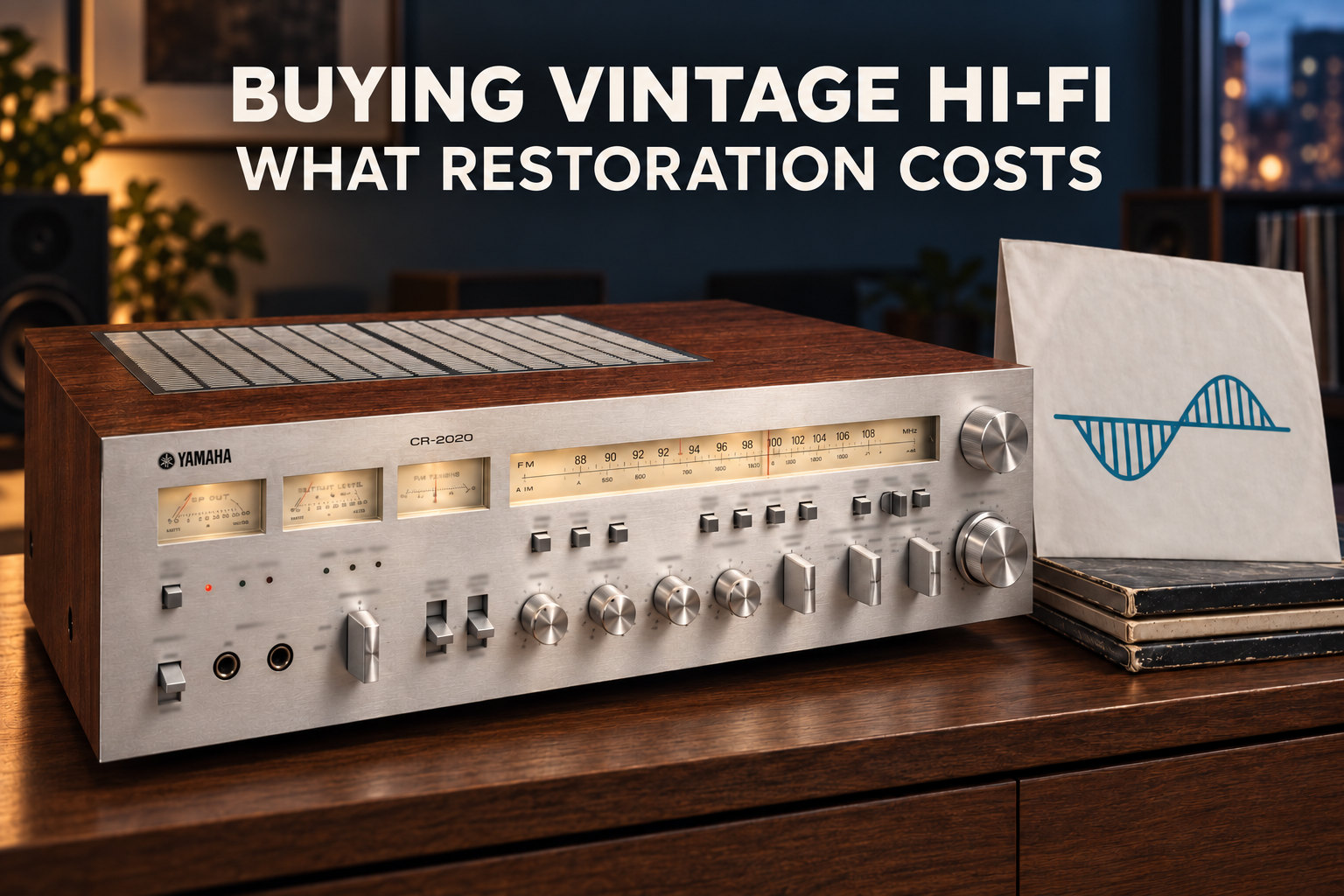
In 1978 Pioneer priced the SX-1980 receiver at $1,295, rated it at 270 watts per channel and built it to weigh 78 pounds. In January 2025, in an AudioKarma thread on price trends, one member said he had got an SX-1980 for $3,500. Another answered that it was a lovely receiver, but "I would hardly call that cheap or a bargain." That exchange is the vintage stereo equipment market in two lines. The silver receivers of the 1970s now cost as much as many new amplifiers, and the asking price is only the first invoice.
Vintage gear can still be the most satisfying money in hi-fi, or a 50-year-old power supply under fresh polish. Price the restoration before you price the dial. Every dollar figure below is US currency, dated to its source.
Why vintage stereo equipment got expensive
The AudioKarma thread's opening post, on 13 January 2025, saw receiver prices "getting out of control on the 'big 3' (Pio/San/Mar)", meaning Pioneer, Sansui and Marantz, while separates, integrated amplifiers and tube gear "seem to be more stable in pricing." One seller found that "the vast majority of people responding to my ads are under 30"; another member took the actuarial view that "more customers are dying than coming into adulthood." Young buyers want the old look; veterans doubt there are enough of them to hold the line.
The objects explain part of the premium. The US Federal Trade Commission's Amplifier Rule of May 1974 required power claims stated as "minimum sine wave continuous average power output, in watts, per channel," and the makers raced on that number. Per Hi-Fi News, Marantz's 1978 range listed 14 receivers, topped by the 2600 claiming 420 W at 1 kHz into 4 ohms. Tuner, preamplifier, phono stage and power amplifier in one heavy, lit, wood-cased box: that is what buyers pay for.
Not everyone thinks the premium is earned: on Audio Science Review in November 2022, one member called most Superscope-era Marantz "horrifically over-rated and overpriced." Our position: buy vintage to listen to it, and price it as a used appliance that needs work, not an asset that will keep rising.
The vintage receivers and amplifiers worth owning
Each pick has a specification documented in maker literature or period reviews, a reputation that survives today's owner forums, and living support from restorers or a maker that still documents it. These are the best vintage receivers and amplifiers to start from, not the only good ones.
| Model | Era (original US price if documented) | Rated power | Check before paying | Documented service work |
|---|---|---|---|---|
| Marantz 2270 | Early 1970s | 70 W/ch, 4 or 8 ohms, 0.3% THD | Service history, lamps, controls | Electrolytics, lamps, bias, DC offset |
| Marantz 2325 | 1974, $799.95 | 125 W/ch, 8 ohms | Lamps, controls | Electrolytics, transistors, BA312 ICs, LED lamps, alignment |
| Pioneer SX-1980 | 1978, $1,295 | 270 W/ch, 8 ohms | Lamp supply, freight damage | Lamp supply (one owner), bias, DC offset |
| Yamaha CR-2020 | 1977, $750 | 100 W/ch, 8 ohms, 0.05% THD | MC phono, Presence, Defeat | Transistors, resistors, power-supply capacitors |
| Sansui AU-717 | Late 1970s, $449 | 85 W/ch, 8 ohms, 0.025% THD | Every input and control | Capacitors by age, bias, DC offset |
| McIntosh MC275 | 1961–71; reissued 1993 | 75 W/ch, or 150 W mono | Generation, tubes | Four KT88 and seven small-signal tubes |
| McIntosh C22 | 1963–72; Mk V current | Tube preamplifier | Generation, tubes | Tubes, noisy controls |
Rated power is the maker's figure. The last column records work published for that model by a restorer (SkyFi, Marantz 2325), a magazine (Sound & Vision's serviced CR-2020) or an owner (SX-1980); for the other models it lists general vintage-amplifier service points from Hi-Fi News and What Hi-Fi?. Sources: Marantz 2270 service manual; SkyFi Audio; Audio and Stereo Review tests via HandWiki; Sound & Vision; Yamaha; Radiomuseum; a dealer listing (AU-717 price); McIntosh.
Marantz 2270 and 2325: the silver-faced standard
These receivers set the look everyone else is priced against. The 2270's service manual rates it at 70 watts per channel into 4 or 8 ohms, in a 38.5-pound chassis. The 2325 listed at $799.95 in 1974, and a restored one still passed its 125-watt check at SkyFi Audio, a New Jersey restorer. The Music Room (TMR Audio) listed a certified pre-owned 2270 at $2,192.93, service history "None"; by October 2026 it had sold. Both suit FM-and-phono listeners who want the classic dial; the drawback is that everyone else wants them too.
Pioneer SX-1980: the power-war flagship
The SX-1980 is the receiver as muscle car. Audio magazine's September 1978 test found nearly 460 watts of short-term power, and Stereo Review saw the outputs clip at 300 watts per channel with both channels driven. At 78 pounds it is also a freight problem. One owner, writing on the Vinyl Pursuit blog in July 2021, had LED dial lamps flicker until a technician found "too much power going to the lights." It suits power-hungry speakers; its weakness is the price of its fame.
Yamaha CR-2020: the engineer's receiver
Yamaha launched the CR-2020 in 1977 at $750. Sound & Vision gives its rating as 100 watts per channel into 8 ohms with "no more than 0.05% total harmonic distortion." It has MM and MC phono, a Presence control centered at 3 kHz and a Defeat button that bypasses the tone controls. Its weakness is grip: Yamaha puts its damping factor at 40, a fifth of the modern R-N2000A's. It suits moving-coil vinyl listeners who want real tone controls.
Sansui AU-717: the integrated alternative
The AU-717 drops the tuner and puts the money into the amplifier. Radiomuseum dates it to 1978–79 at 85 watts per channel into 8 ohms and 0.025% distortion; one dealer gives its original list price as $449. Integrated amplifiers have been steadier in price, partly, one AudioKarma member argued, because "the dearth of good FM is making good integrated amps more desirable and affordable." Its drawback is shared by every 1970s amplifier: no digital input. It suits streamers who would rather pay for amplification than a tuner.
McIntosh MC275 and C22: the tube classics that never left
McIntosh launched the MC275 in 1961, dropped it in 1971, revived it in 1993 to honor co-founder Gordon Gow, and now builds the sixth generation, rated at 75 watts per channel from four KT88 output tubes. The C22 preamplifier ran from 1963 to 1972 and is made today as the Mk V. That continuity is both attraction and trap. A used MC275 Mk VI was listed on Reverb at $5,000 on 26 June 2026, below a $5,300 median tracked by StereoNET's Radar, so confirm the generation before paying a 1960s premium for a reissue. The MC275 suits listeners who want tubes and accept eleven of them to look after.
What 50 years does to vintage audio electronics
Age attacks four places, each with a symptom you can hear or see before paying. Storage, wear and old repairs, Audio Science Review members noted in 2022, make any single unit unpredictable.
Read every label as live text
- 1
- Electrolytic capacitors: age with time; replacing them all can prove expensive
- 2
- Controls and switches: unexpected noises point to dirt in the mechanism
- 3
- Dial and meter lamps: a common fault; replace or convert to LED
- 4
- Output stage: check bias and DC offset; on some designs only a fuse per channel protects the speakers
Capacitors and controls
Electrolytic capacitors are the clock. "Depending on the unit's age you may be looking at replacing all the capacitors in the circuit, and this could prove expensive," warns Ketan Bharadia, technical editor of What Hi-Fi?, in an August 2022 buying guide. Parts supply matters: in 2016 an AudioKarma member warned that the Marantz 2285B could cost a little more to restore because its dual main filter capacitors were no longer made. Controls give themselves away by ear. Unexpected noises from volume, tone, balance or switches "would point to dirt getting into the mechanism," Bharadia writes, and a faulty button "may prove hard and expensive to repair in the long run."
Lamps, output stages and protection
Hi-Fi News' Tim Jarman, reviewing the Marantz 2226B in May 2022, named "the failure of the lamps behind the fascia" as its most common problem. The amplifier "needs only the occasional checking of its bias currents and offset voltages," he wrote, but on that design "the only thing protecting your loudspeakers" if the output transistors fail "is a fuse in each channel," so fit the correct type: "foil from KitKat wrappers, and pieces of sawn-off nail definitely won't do!" Good restorers go further: SkyFi's 2325 job replaced the "known troublemaker transistors," fitted matched input pairs and converted the lamps to warm white LEDs.
What does restoring a vintage amplifier cost?
Expect $150 to $300 for a bench check at one US shop, then several hundred dollars in labor for a full recap. For the whole job, the market speaks: in October 2023 Sound & Vision found CR-2020s asking from $1,000 for a "good condition" unit that may or may not work to $3,000 for a near-perfect, fully serviced one. The $2,000 between them buys restoration, condition and a dealer's margin in one lump.
On the full recap, the experts disagree. Bharadia calls replacing every capacitor worth doing "to optimise reliability and performance." Jarman is calmer about the 2226B: most "have lived trouble-free lives," the lamps being the usual casualty. Our view: have a technician measure first, replace what has drifted, and pay for the full recap on a unit you will keep, which is Bharadia's own caveat, "particularly if you intend to use the product for a while."
| Restoration level | What it covers | Typical cost | Source |
|---|---|---|---|
| Bench check | Diagnosis and a quote | $150 standard; $300 for McIntosh and other vintage gear | BEL rate card, January 2025 |
| Service | Controls, lamps, fuses, bias, DC offset | Bench fee plus $75–$125 an hour | AudioKarma, April 2014; Retro Gear Shop, October 2026 |
| Full recap | Every electrolytic capacitor | 5–6 hours: $450–$600 at 2014 rates, $625–$750 at $125 an hour, plus parts | AudioKarma (Fisher 505-T), April 2014; Retro Gear Shop |
| Full restoration | Recap, transistors, LED lamps, alignment | Quoted per job; serviced CR-2020s asked $3,000, untested $1,000 | Sound & Vision, October 2023 |
US dollars from a named rate card (BEL, January 2025), a dated forum estimate (AudioKarma, April 2014), a shop's hourly rate (Retro Gear Shop, $125) and a magazine's survey of asking prices (Sound & Vision, October 2023). The $625–$750 figure applies the 2014 estimate's five to six hours to the $125 rate. Ask any restorer for an itemized quote before approving work.
Run the arithmetic before you fall for a dial. An untested CR-2020 at $1,000, plus BEL's $300 vintage bench fee and five to six hours of recap labor at $125 an hour, comes to $1,925–$2,050 before parts, lamps or a single transistor. Suddenly the $3,000 serviced example looks fair: its seller has already paid the invoice you are about to receive. Restoration is money spent on listening, not a deposit you collect at resale.
Where to buy vintage stereo gear, and how to protect yourself
KD's advice for listeners mid-journey, from his film on the $35,000 he spent learning about cables, fits old electronics exactly:
Buy used when possible... Sell what doesn't work. Learn from each purchase.
In his film on snake oil and certainty in audio, he adds the rule vintage buyers skip: experiment "always with the ability to return it." Local sellers let you hear the unit first, with no freight risk; one who will not let you hear it working has answered your question.
Specialist restorers and dealers sell what a vintage unit most lacks: a paper trail and a warranty. TMR Audio's certified pre-owned 2270 carried a 90-day warranty and 30-day returns, and SkyFi publishes a board-by-board list of its 2325 work, from power supply and phono stage to final alignment. Demand that list from anyone charging a restored-unit price.
Marketplaces such as eBay and Reverb give the widest choice and the weakest view of condition. eBay's Money Back Guarantee covers items that arrive broken, faulty or not as described, within 30 calendar days of delivery, or the seller's returns window if longer; a change of mind depends on the seller's return policy. Ask for a video of the unit playing and photographs of the inside.
Vintage receivers against modern amplifiers
A vintage receiver puts tuner, phono stage, tone controls and filters in one box, while AudioKarma loyalists complain about new "one knob" receivers with no tone controls and "sometimes not even a balance control." On Audio Science Review a restorer argued that a vintage two-channel receiver "will easily outperform an equivalent modern AVR"; another member called claims of "beefier" vintage power "measurably nonsense." Both can be right: against a budget surround receiver, a good 1970s receiver is a serious amplifier; against a modern stereo design, its advantages are features and feel.
Yamaha's March 2023 comparison notes that "vintage products of the 1970s lack any digital inputs," and explains what a damping factor of 40, against 200 for the R-N2000A, costs: with low damping, Yamaha's Phil Shea says, a woofer "will overshoot and undershoot the target a little bit." Smaller models have less in reserve: Hi-Fi News measured a maximum of 4.0 A from the 26-watt Marantz 2226B, whose tone controls cannot be switched out of the signal path.
Streaming splits the experts. Jarman calls the 2226B's Aux and Tape 2 inputs "ideal for modern sources, such as CD players and DACs." Yamaha, which sells the modern alternative, says vintage receivers "were not designed to handle the wider dynamic range of digital music." We side with Jarman: a modest streamer into Aux is the cheapest modernization there is, and in most systems the streamer is not the bottleneck.
A serviced CR-2020 at 2023's $3,000 asking price sits against Yamaha's R-N2000A: 90 watts per channel into 8 ohms, streaming, a phono input and HDMI ARC, at $4,999.95 from US dealers World Wide Stereo and In The Groove as of October 2026. The new box does more and carries a factory warranty. The old one costs less, and Yamaha concedes that "from a sound quality standpoint, the CR-2020 can hold its own with its modern descendant." Great sound at any budget comes from matching the parts, not from the date on the chassis.
A buying checklist for vintage stereo receivers
- Choose the job: a receiver for radio and phono, an integrated amplifier if you stream, tubes only if you accept the upkeep.
- Identify the exact model and generation, and read its service manual.
- Listen at your usual volume on speakers you know, working every knob, button and input.
- Check every dial and meter lamp, and that the speaker fuses match the manual's type and rating.
- Get the service history in writing, including when bias and DC offset were last set.
- Add the restoration you will need to the asking price.
- Buy with a way back: a warranty, a marketplace guarantee or a seller who lets you listen first.
That $3,500 SX-1980 is neither a bargain nor a rip-off until you know what is inside it. Open the lid before you open the wallet.
Frequently asked questions
Are vintage receivers worth buying in 2026?
Yes, if you price in the restoration: $150 to $300 for a bench check at one US shop, plus several hundred dollars of recap labor.
What are the best vintage receivers?
The Marantz 2270 and 2325, Pioneer SX-1980 and Yamaha CR-2020 lead our list, with the Sansui AU-717 and McIntosh MC275 and C22 as alternatives.
How much does it cost to recap a vintage amplifier?
A 2014 AudioKarma estimate for a Fisher 505-T put labor at $450–$600; at $125 an hour, the same hours cost $625–$750, plus parts.
Is vintage audio a good investment?
Treat it as a listening purchase. The famous receivers climbed sharply into 2025, but skeptics call Superscope-era Marantz overpriced.
More from the Journal
Keep exploring.
Loading articles…