The Journal / Articles & reviews
Streamer, DAC or All-in-One? Where Separates Start to Make Sense
Separates beat all-in-ones every day, at five times the price; the question is whether your system can tell.
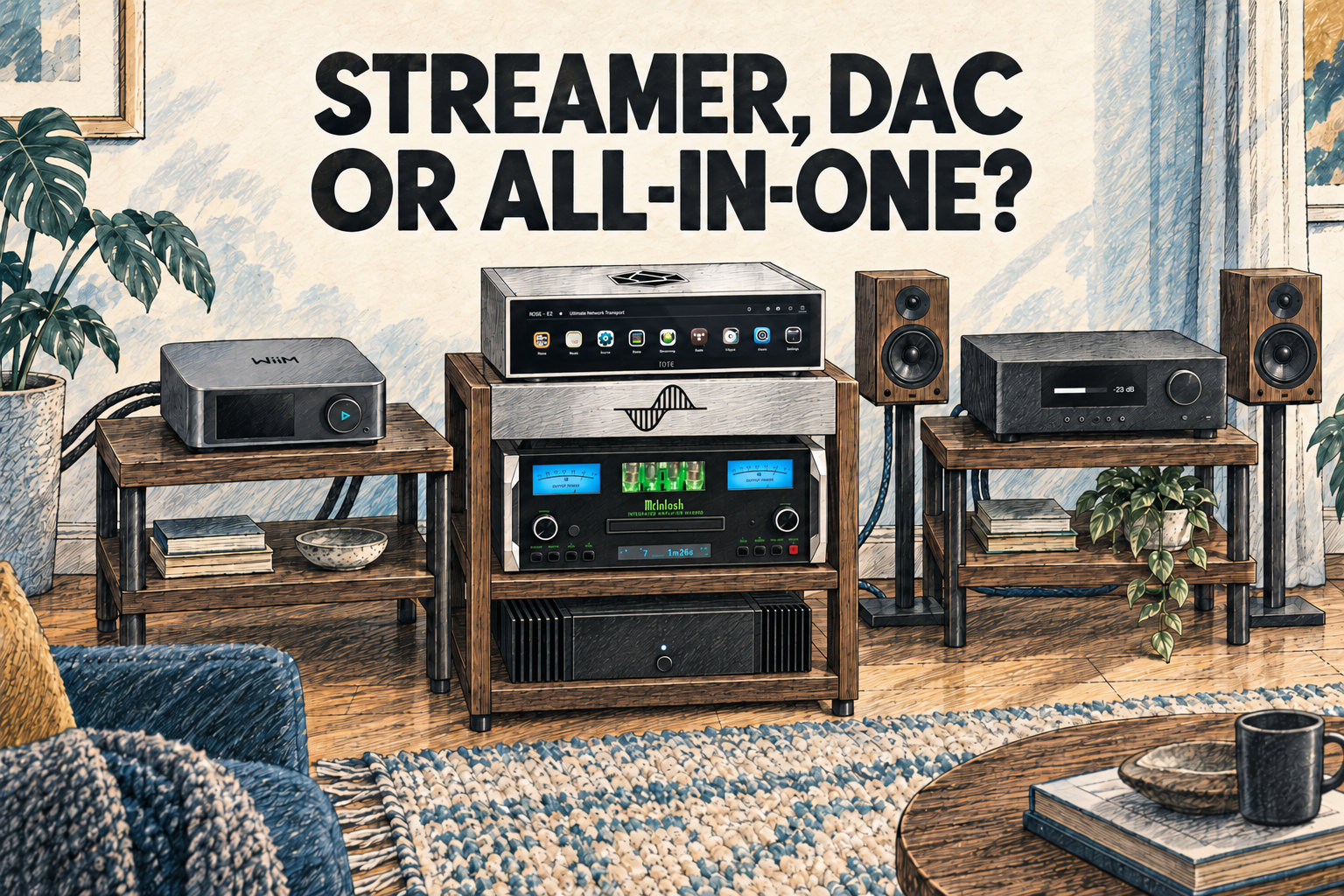
The HiFi Rose caught my eye in a showroom: gorgeous, full-size boxes with an authoritative presence and the best touchscreens in the industry. My verdict arrived before the music did. That's just a glorified LCD, I thought. No way this thing is worth as much as an 85-inch Gallery Series OLED TV. Then I auditioned the Rose RS150 anyway, and my jaw dropped.
Music streamer, DAC or all-in-one: I have lived with two of the three and a near relative of the third, from an Apple TV 4K feeding a Yamaha receiver to a WiiM Ultra, Eversolo's A6 Master Edition and A8, and today a McIntosh MCD12000. The lesson: separates beat the all-in-one every day. Below about $10,000 of system, the difference rarely justifies the bill. Above about $30,000, in a sorted room with speakers that can reveal it, you will hear it.
The glorified LCD that changed my mind
My DAC journey started where most people's does: streaming from an Apple TV 4K, which sounded fine to me. Then my dealer convinced me to buy the Eversolo A6 Master Edition, around $1,000 for a streamer and DAC with dual ESS chips. And then I became insufferable. Friends would come over and I would force them into A/B tests, Apple TV against Eversolo. Listen to this. Guess what's what. Once you hear it, you cannot unhear it. I was that guy, and to the friends who tolerated it, I apologise again.
Then came the Rose. What came out of the RS150 had nothing to do with the screen. It had what I loved in my McIntosh SACD/CD transport and DAC: that liquid, analogue quality, the detail, the organicness. For the record, my verdict was not entirely unfair. The RS150B, as Twittering Machines lists the model, carries a 14.9-inch touchscreen and listed at $4,995 when Michael Lavorgna reviewed it in November 2021. I had priced in the screen. I had not priced in the sound.
I was not ready to spend $5,000, so I stayed with the memory. In this hobby, the memory of a great audition keeps knocking on your door for days, weeks, even months, and you know what comes next. The whole story is in my film testing DACs from $1,000 to $100,000; the shortest version is the Daily A glorified LCD, I said.
Why the Eversolo A8 anyway: the cheap Rose man
With the RS150 at $5,000, I dressed up as the cheap Rose man and bought the Eversolo A8 instead, for $2,000, double the A6 Master Edition. AKM's factory was back in operation, the A8 carried its new AK4499EX and AK4191EQ chips, and I was fascinated. What Hi-Fi? listed the A8 at $1,980 at its launch in December 2023, with an all-analogue preamp where the A6 had a digital one. Mine is the original A8; its successor, the DMP-A8 Gen 2, unveiled at HIGH END Vienna in June 2026 with the same AKM chips, lists at $1,980 as of October 2026.
So, my Eversolo A8 review in one line: a clear win over the A6 Master Edition on all fronts. More detail, better imaging, more refinement. It was so good that the dilemma I had been carrying, the McIntosh DA2 DAC against the A6 Master Edition, stopped being a dilemma. Period.
But the Rose at $5,000 was still better, and this is where I started to understand something important. DACs with different power supplies and different analogue stages sound different. As you move up to more serious implementations, different also becomes better, and at The Sound Lab better has one definition: more convincing to what live sound sounds like. Once you understand why separate chassis and separate power supplies matter, you start dismissing the logic of every all-in-one device. Off-the-shelf DAC chips cost no more than $100. You are paying for the implementation.
Three ways to build it: music streamer into DAC, streaming DAC or all-in-one
Strip the marketing away and every digital front end does three jobs. Something fetches the music from Qobuz, Tidal or your own library: the streamer. Something turns the bits into an analogue signal: the DAC. Something drives the speakers: the amplifier. The only real question is how many boxes those three jobs live in.
Read every label as live text
- 1 Streamer into DAC
- Network streamer: fetch
- DAC: convert
- Preamp + power amps: amplify
- Speakers
- 2 Streaming DAC
- Streaming DAC: fetch + convert + volume
- Power amp or integrated: amplify
- Speakers
- 3 All-in-one with amplification
- All-in-one: fetch + convert + amplify
- Speakers
- Powered speakers: everything inside
- fetch
- convert
- amplify
Streamer into DAC: two boxes or more
A network streamer working as a pure transport hands the bits to a separate DAC. This is my system today: a HiFi Rose RS130 transport feeding the McIntosh MCD12000, then the C12000 preamplifier and the MC611 monoblocks. The MCD12000 carries two ESS ES9038PRO eight-channel DACs, one per channel, with tube or solid-state outputs. It is the most convincing route I have lived with, and by far the dearest.
Streaming DAC: one box, plus amplification
Streamer and DAC share a chassis, usually with a volume control, and feed a power amplifier or an integrated. The WiiM Ultra, the Eversolo A6 Master Edition and A8 and the Rose RS150 all live here. When my McIntosh MA9500 arrived, the first song through it, Giorgio by Moroder, came from exactly this kind of box: an Eversolo A6 Master Edition, over AudioQuest Yukon XLR cables. For most of you, this is the right address.
All-in-one: one box, or the box inside the speaker
Streamer, DAC and amplifier share a single chassis, or live inside powered speakers. Mine was a near relative: an Apple TV feeding a Yamaha flagship receiver over HDMI, which carries the music as digital data, so the receiver did the converting as well as the amplifying. Tidy and simple, and the chain on which my new Bowers & Wilkins Diamonds sounded hollow on every song, until the MA9500 took over the amplifying. It was a revelation. When one box does everything, its weakest stage sets the ceiling for all the others.
Your streamer is not the bottleneck: WiiM Ultra against Eversolo
A network streamer's job is narrower than its price tag suggests: it fetches the music and hands it on. So how much does a better box buy you? I tested that with my own money: the WiiM Ultra at its $329 retail price against the Eversolo A6 Master Edition Gen 2, the update that moved to a linear power supply, at almost $1,400 (both prices as of October 2025), side by side for over three months on my reference system and a less revealing one.
On paper the fight looked unfair. The WiiM runs one ESS Sabre Q2M chip off a switch-mode power supply. The Eversolo runs two of those same chips, one per channel, off its linear supply. The Eversolo should dominate.
We do not listen to specifications. We listen to music.
On the C12000, McIntosh monoblocks and Wilsons, fully balanced on Transparent Reference cables and streaming Qobuz, I played Six Blade Knife from Dire Straits, Patricia Barber's This Town and Take Five from Time Out. The two sounded far closer than the $1,070 gap suggests. Uncomfortably close, for anyone who paid four times more. The Eversolo has better imaging, a wider and deeper soundstage, better layering, more low-level detail and a completely dark background, mainly thanks to its dual-DAC design. The WiiM is warmer, more vivid and airier at the top, and makes classic rock and poor recordings easier to live with for hours. The Eversolo is the audiophile tool; the WiiM is your everyday smooth listener.
On my system I can tell them apart ten times out of ten. In a less revealing $5,000 to $10,000 system, with the visual cues removed and long pauses between, I am not convinced anyone can. Even on mine, the difference was real but subtle: the last 3 to 5% of performance. The limiting factor in most systems is not the streamer. It is the speakers, it is the electronics, and maybe the cables. An extra $1,000 on the streamer of a $5,000 or $10,000 system is a Formula 1 engine in a conventional car. The short version is the Daily your streamer is not the bottleneck; the full test is my WiiM Ultra against Eversolo comparison film.
When separates win: five times the price, and above $30,000 of system
A true McIntosh fanboy who already owned the MCD350, I took my chances and auditioned the MCD12000: a tube output stage, glowing meters, and a price tag enough to trigger a vertigo. I hooked it up to a Rose flagship transport and compared it with the RS150, both feeding the same McIntosh electronics and Sonus faber Amati speakers. The McIntosh stack expanded the soundstage, with a natural vividness and that tube organicness, without colouration. Everything just sounded right, or more convincing.
Separates beat the all-in-one devices every day. But at five times the price, plus cables, plus rack space, plus complexity.
The arithmetic is brutal. The Rose was five times the price of the A6 Master Edition. The MCD12000 with the Rose transport and the interconnects was five times the Rose again, 25 times the Eversolo. Is this a hobby or an obsession? I went one step further to find out: the dCS Lina with and without its clock, a dCS Varese system at a quarter of a million dollars, and the MSB Select at about $100,000. They were the closest thing to analogue master tape I have ever heard, different from each other but not coloured.
| Step | Device | Price on film (November 2025) | Times the A6 Master Edition | What changed |
|---|---|---|---|---|
| Streaming DAC | Eversolo A6 Master Edition | about $1,000 | 1x | Beat the Apple TV 4K |
| Streaming DAC | Eversolo A8 (first generation) | $2,000 | 2x | Clear win on all fronts |
| Streaming DAC | HiFi Rose RS150 | $5,000 | 5x | Liquid, analogue-like; better than the A8 |
| Separates | McIntosh MCD12000 + Rose transport + interconnects | five times the RS150 | 25x | Bigger soundstage, tube organicness without colouration |
| Discrete DAC | MSB Select | about $100,000 | about 100x | Closest to master tape; not 100 times better |
The Rose cost five times the A6 Master Edition and the McIntosh stack five times the Rose; the MSB Select at about $100,000 was not 100 times better than the $1,000 Eversolo.
Source: my film of 23 November 2025; the MSB multiple is from its price.
And here is the truth, my truth. None of them is a hundred times better than the Eversolo. If your speakers cannot reveal it, your room is not treated or your amplification is not up to the task, you are simply wasting your money, and you will still be talking about snake oil on a quarter of a million dollars of DAC. For my own digital chain, built around the MCD12000, diminishing returns hit at around $25,000. Everything beyond was wonderful, sometimes magical.
My DAC film opens the door at $10,000 of system, with about 20% of the value of your front end. My streamer film retires the WiiM above $30,000, where separates cost only a marginal share of the system. Between the two, the door is open; above $30,000, walk through it. The one-paragraph version is the Daily on why separates win, and what they cost.
A decision path by system value, from $1,000 to reference
Find your system's value and read across.
| System value | Architecture | Digital budget | Why |
|---|---|---|---|
| Under $5,000 | Streaming DAC or all-in-one, such as the WiiM Ultra ($349 as of October 2026) | $1,000 maximum | The rest buys better speakers or room treatment |
| $5,000 to $10,000 | Streaming DAC | $1,000 to $2,000, the sweet spot | The WiiM Ultra still qualifies; savings go to room, amplification or speakers |
| $10,000 to $15,000 | Streaming DAC or first separates | About 20% of the front end | Separates start to make sense; a dearer streamer is hard to justify |
| $15,000 to $30,000 | Streaming DAC, or the WiiM as a pure streamer into a DAC | About 20% of the front end | Analogue stage, linear supply and digital I/O earn their keep |
| Above $30,000 | Separate streamer and DAC | About 20% of the front end, to a $50,000 system | The WiiM is no longer viable even as a streamer |
| $100,000 and up | Discrete DAC | Your own preference | Only with speakers, room and amplification to reveal it |
Six tiers, from a streaming DAC or all-in-one under $5,000 to discrete DACs above $100,000: the architecture and the digital budget for each.
Source: my films of 15 October and 23 November 2025; WiiM's list price.
Do the arithmetic on the first row: in a $1,000 system, the $349 WiiM Ultra already takes 35% of the budget, which leaves no room for a second box. For nine audiophiles in ten, that little box is a revelation. And whatever your budget, do not buy a $5,000 DAC to fit $5,000 speakers. If you have these thoughts, ask someone to come to your home and help you rearrange your priorities.
The cheap Rose man ended up with a Rose after all: an RS130, working as the transport, feeding the DAC whose price tag once triggered a vertigo. Your system decides whether you can hear what you paid for. The best component is the one that gets out of the way of the music.
Frequently asked questions
Do I need a DAC?
Yes, every digital source needs one, but below about $10,000 of system it need not be a separate box: a streaming DAC such as the WiiM Ultra does both jobs.
What is a music streamer?
A music streamer, or network streamer, fetches music from Qobuz, Tidal or your own library and hands it to a DAC; many include one.
Streamer vs DAC: which matters more for sound?
The DAC's implementation: its power supply and analogue stage, not the chip. In most systems, though, neither is the bottleneck; the speakers, the electronics and maybe the cables are.
Is the Eversolo A8 worth it over the A6 Master Edition?
In my system, yes: the original A8, $2,000 when I bought it, was a clear win on all fronts, although the $5,000 HiFi Rose RS150 was still better.
More from the Journal
Keep exploring.
Loading articles…