The Journal / Articles & reviews
Wilson Audio Yvette: An Owner's Review, and the Klipsch La Scala That Nearly Won
Do I have the foundation? If yes, the Yvette is a bargain; if not, the La Scala is the smarter buy, and there is no shame in it.
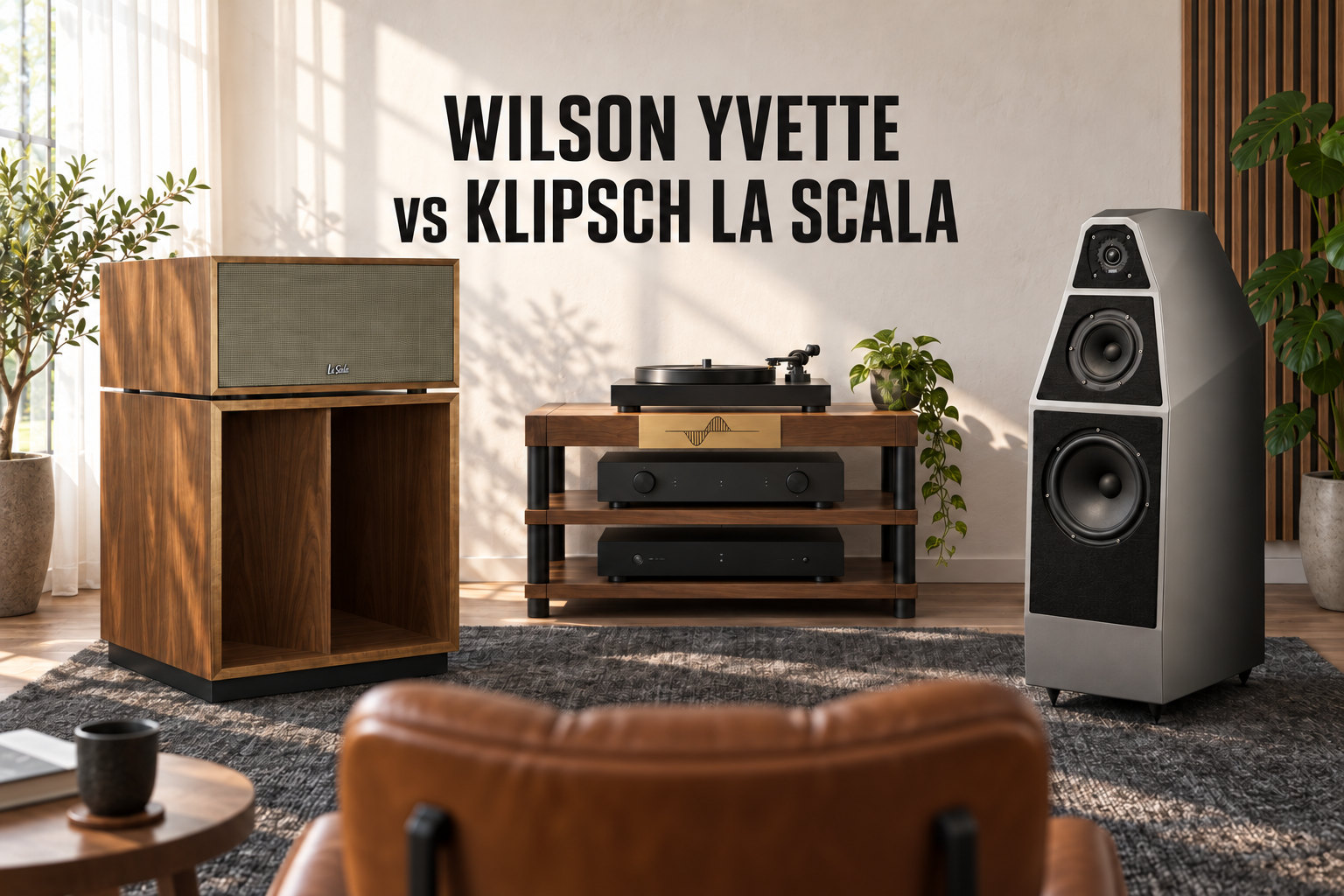
The Klipsch La Scala was the speaker I wanted to love. I had good memories of the brand, I liked its looks, and at the audition it played on a McIntosh system much like mine. The horns hit me from the first note. The bass never showed up. It took a day off during auditioning.
That audition is why a pair of Wilson Audio Yvettes plays in my listening room today. This is my owner's review of them, and the story of the Klipsch La Scala that lost: $13,000 against over $25,000 in my La Scala versus Yvette film of November 2025, what each did with the same music, and the one question that should decide which you buy: do you have the foundation?
The Klipsch La Scala came first, for good reasons
For years I owned Klipsch Reference Premiere floorstanders on a Yamaha flagship receiver: dynamic, loud and pleasing, but general-purpose speakers bought for home theatre. Then came Bowers & Wilkins 800 Series Diamonds, revealing and demanding. On Billie Eilish's "Bad Guy" I could push them past about 95 dB and hear them clip. Once you hear that clipping, you cannot unhear it. It sent me hunting for a better match for my McIntosh electronics. Two schools of thought remained.
The first was horns, and Klipsch in particular: a Heritage line built practically by hand in a limited-production facility in the US. Three reasons pulled me there. Good memories of the brand. A speaker I find better-looking in a living room. And a flagship line, no longer the do-it-all Klipsch I knew, that might take an old emotional connection somewhere new.
The second was Wilson, which I had always filed under unapproachable: expensive speakers built for flagship, mostly limited-production electronics. Sweet-sounding, beautiful La Scalas, or robot-looking Yvettes at twice the price? Appearances matter. Sound matters more, at least to me, and the ears decide. So I set up a side-by-side audition with electronics like mine and a playlist I knew well.
Klipsch magic, Wilson truth: the same music on both
The La Scalas played through a mid-tier McIntosh system, a HiFi Rose streamer-DAC, Qobuz, and AudioQuest cables and power conditioning. That horn-loaded immediacy hits you instantly: a jump factor, a presence. When the music starts, it is there. Very musical, extremely vivid, capable with dynamic swings, with a vintage soul all their own. Their horns were less fatiguing than the diamond tweeters I had lived with, their character more coloured than the Bowers & Wilkins but more pleasing.
But the soundstage stayed confined to one area behind the speakers. The sound could go loud, but it was thin. The low end never clipped on my demanding songs, and I want to be honest about why: the frequencies that would have clipped were simply not there.
The Yvettes played through McIntosh MC3500 tube monoblocks and a C2700 tube preamplifier, with the same sources and cables. Wilson specifies the Yvette down to 20 Hz, and you do not hear that last octave so much as feel it in your chest. The room pressurises differently. The soundstage was wider, deeper and three-dimensional, instruments placed with a precision I had not experienced before, and reverb tails and room ambience, there on those recordings all along, finally appeared. "Bad Guy", the track that pushed my Bowers & Wilkins into clipping, came through perfectly: no compression, no distortion, powerful and dynamic.
The La Scalas gave me that Klipsch magic, that immediate fun, engaging presentation. The Wilsons gave me truth, accuracy, a window into what the recording actually contains.
I never really had a choice. The Wilsons don't give you any room for a decision. I bought them. The La Scala had nearly won before a note was played, on memories and on looks, and on looks it still wins.
Was it a fair fight?
On the film I called it apples to apples: same quality of amplification, same sources, same room. The Yvettes' amplifiers were grander on paper, but amplifiers did not decide the bass. Klipsch rated the La Scala AL5 at −4 dB at 51 Hz, and John Atkinson's nearfield measurement for Stereophile, published in March 2023, confirmed it. No amplifier adds an octave the cabinet does not make. Nor does the La Scala need much amplifier: Atkinson's B-weighted sensitivity estimate of 101.3 dB, against Klipsch's 105 dB specification, was still the second-highest he had measured. "This speaker will play loudly even with a flea-powered amplifier driving it."
His data also offer a clue to the imaging I heard. The horn openings sit in one plane while the horns differ in length, so the tweeter's output arrives first, the midrange 1.5 ms later and the woofer 2 ms after that: within the ear's tolerance, Atkinson judged, but it "could interfere somewhat with stereo imaging precision."
The Yvette, at 86 dB, is the opposite animal. On the film I said the 19 dB gap means the La Scala needs roughly a hundredth of the power; the exact arithmetic is nearer one eightieth. One speaker reaches concert levels on a 10-watt tube amplifier; the other wants real current into a load that dips below 3 ohms.
| Klipsch La Scala AL5 | Wilson Audio Yvette | |
|---|---|---|
| Price per pair in my film, November 2025 | $13,000 | Over $25,000 |
| Sensitivity | 105 dB/2.83 V/m specified; 101.3 dB(B) measured | 86 dB/W/m specified |
| Impedance | "8 ohms compatible"; 4.17 ohms minimum at 335 Hz (measured) | 4 ohms nominal; 2.94 ohms minimum at 90 Hz |
| Bass extension | −4 dB at 51 Hz | 20 Hz (±3 dB, room average) |
| Weight per speaker | 201 lb | 175 lb |
| Amplifier needs | Concert levels from a 10 W tube amplifier | Real current into 4 ohms; 50 W per channel minimum |
| Who it suits (my verdict) | Warm electronics, vinyl lovers, listeners who play everything | A fixed on-axis seat, a treated room, top electronics, critical listening |
| In my words | Klipsch magic | Truth |
Price per pair as quoted in KD's film (November 2025), sensitivity, impedance, bass extension, weight, amplifier needs, who each suits and the character in KD's words; the La Scala measurements are Stereophile's, taken on the AL5.
Sources: makers' specifications and Atkinson's La Scala measurements, Stereophile (Yvette, April 2019; AL5, March 2023); prices, amplifier needs, verdicts and character, my film of 9 November 2025.
One note on generations: these measurements are the AL5's. The La Scala AL6 (March 2025; dealer price about $15,400 a pair as of October 2026) swaps the 15-inch woofer for a 12-inch one in a newly vented bass horn and is specified to 40 Hz (±4 dB). For StereoNET (August 2025), James Michael Hughes found its imaging "surprisingly precise", yet "the bottom end isn't massively extended." Wilson retired the Yvette by June 2024, when it unveiled the WATT/Puppy.
Living with the Wilson Audio Yvette: what it demands
The Yvettes first went onto my McIntosh MA9500, an integrated I still call one of the best ever made. Period. Together they produced some of the most amazing musical moments I have ever experienced. But at around 95 dB, where reality bends and the band materialises in your room, I felt the MA9500 working harder than it ever had. Not struggling. McIntosh doesn't struggle. Pushing its limits. The Yvettes can bend time, space and reality, and for the first time in years my McIntosh was being challenged.
Was it real, or just another upgrade fever? I trusted Charlie Randall and the team at McIntosh, whose engineering behind the C12000 preamplifier and MC611 monoblocks suggested this was what Wilson Audio speakers wanted: not to beat them into submission, but to tame them. That was an extra $40,000, the story of my $40K McIntosh upgrade film, justified in my head by an expected 5 to 10%, if I was lucky. I was wrong from the first session. The MA9500, 300 W per channel, controlled the Yvettes admirably. The MC611s, 600 W each, command them. Crescendos build without compression, and the system is so quiet you forget you are listening to a system.
So the Yvette asks for three things. Amplification that delivers current. A room, because Wilson's 20 Hz is a room-average figure and the Yvette's low end is dominated by the room's properties. And a source chain that deserves it; mine is the McIntosh MCD12000 SACD player and DAC, a HiFi Rose RS130 transport and the McIntosh MT5 turntable with a Sumiko Starling. The Yvettes reveal everything, the good and the bad. They can be forgiving sometimes. Only sometimes.
Diminishing returns evaporate: why the Wilson Yvette is a bargain
This is where the frugal part of my brain should have objected. Almost every curve in this hobby flattens: with cables the big gains come in the first few hundred dollars, and a cost-no-object DAC is not a hundred times better than an Eversolo. I expected the Yvette to sit on the same curve. What surprised me most was that it did not: twice the price of the La Scala did not buy something 20 or 30% better.
With the Yvette, the law of diminishing returns evaporates. Twice the money buys a completely different category of performance: that 20 Hz extension, that soundstage precision, that resolution, that ability to disappear and simply present music in three-dimensional space. Five times the performance for twice the price? Wrong question. It is a performance that cannot be benchmarked with a ratio, and for what it delivers, a $25,000 speaker is actually a bargain. I know how that sounds; I made the same case, shorter, in A $25,000 bargain.
The bargain has a condition, the part most people miss. Without proper amplification, a treated room and a capable source chain, you might be wasting your money. When I bought them, I had that foundation: my McIntosh system, my room treatment, my sources and my cables. Or so I believed.
The new listening room: what the Yvettes still had to give
Now the confession. I had a foundation. It was not the whole one.
My previous room was about 800 square feet and L-shaped: the system in the cramped leg, one circuit shared by everything, one possible speaker position, my seat 3.5 metres away with zero gap to the back wall. The McIntosh MEN220 measured a 37% correction there, the highest we have ever recorded in any room, and panels brought it down only to the mid-teens. I used to tell people in the industry I was cursed with the worst room possible.
The new listening room of The Sound Lab, shown in my film of 18 February 2026, is rectangular and 1,000 square feet or more. Each MC611 has its own dedicated 40-amp circuit from the main board; the preamplifier, DAC and sources share a third circuit through my IsoTek conditioning. The treatment suits a living room: mild absorption behind natural-wood panels, corner bass traps, ceiling absorption, thick curtains. I placed the Yvettes with Wilson's WASP procedure, using my own voice to find what Wilson calls the zone of neutrality. In the old room, WASP gave me almost no room to move. Here I had real choices.
On Pink Floyd's The Wall, the helicopter came from high on the ceiling to my right, approached, then moved out to the left until it vanished, and it stayed high, because it is a helicopter and it is flying. On the Dave Brubeck Quartet's "Take Five" from Time Out, the kick drum filled the room for the first time. On the Cowboy Junkies' The Trinity Session, recorded in the Church of the Holy Trinity in Toronto, I was in the church. Daft Punk's "Giorgio by Moroder" came back textured and three-dimensional, like headphones but with the physical pressure of real bass.
Nothing in the signal chain changed: same Yvettes, same separates, same Transparent cables, same sources. Only the room and the power did, and the result was transformative. The old room had been holding the system hostage.
I thought I knew what my Wilson Audio Yvettes and my McIntosh separates could do, and I was wrong. They had more to give, a lot more. I just never gave them the room to prove it.
The rule for a Yvette shopper: if your room has obvious problems, stop. Fix the room before you spend $5,000, $10,000 or $20,000 on any component.
Who should buy which: the foundation question
Before a speaker like this, ask yourself the question I keep coming back to: do I have the foundation? System, room, electronics. If yes, the Yvette is worth every penny of that $25,000. If no, something like the La Scala is the smarter choice, and you will be absolutely happy with it.
For most people, the La Scala is the right speaker. It suits sweet-spot electronics with a distinctive, ideally warm sound, vinyl lovers with a decent setup, decent discrete DACs, and anyone who plays everything, not only reference-grade recordings.
The Yvette suits a fixed seat on axis, a treated room with space around the speakers, extremely competent electronics, and listening that aims to be accurate, lifelike, transparent and convincing. If you are still building, the Yvette will show you what is missing before it shows you the music.
Living-room realities: looks, size and the case for horns
The La Scala's story explains its sound. Paul Klipsch built the original in 1963 as a public-address speaker for Winthrop Rockefeller's campaign for governor of Arkansas: a box made to throw a voice across a crowd. That jump factor, music simply there the moment it starts, is a horn doing what it was born to do.
On looks alone the La Scalas would have won: natural cherry or American walnut veneer on the AL5, against the automotive gloss of a Wilson I once called robot-looking on camera. There is no shame in choosing them, and no regret. Neither speaker is small. Sound & Vision notes that the La Scala was once considered a "portable" Klipschorn; the AL5 weighs 201 lb, too heavy for Atkinson to lift onto a stand even with help. A Yvette is 175 lb and 41 inches tall.
Aesthetics are subjective, but they matter; don't let anyone tell you otherwise. The gear serves the music, not the other way around, and there is a system for everyone, from a thousand dollars all the way up to infinity. Mine happens to be a pair of robots.
Frequently asked questions
Is the Wilson Audio Yvette hard to drive?
It needs current more than headline watts: 86 dB, 2.94 ohms at 90 Hz, 50 W per channel minimum. My MA9500 pushed its limits around 95 dB; the MC611s command it.
Does the Klipsch La Scala have enough bass?
Not in my audition: the bass was absent and the sound thin. Klipsch rated the AL5 at −4 dB at 51 Hz, and Stereophile's measurement confirmed that roll-off; the AL6 is rated to 40 Hz.
Is the Wilson Yvette worth $25,000?
Only with the foundation: proper amplification, a treated room and a capable source. With it, over $25,000 a pair (my film's price, November 2025) is a bargain; without it, the La Scala is the smarter buy.
More from the Journal
Keep exploring.
Loading articles…