

The Journal / Articles & reviews
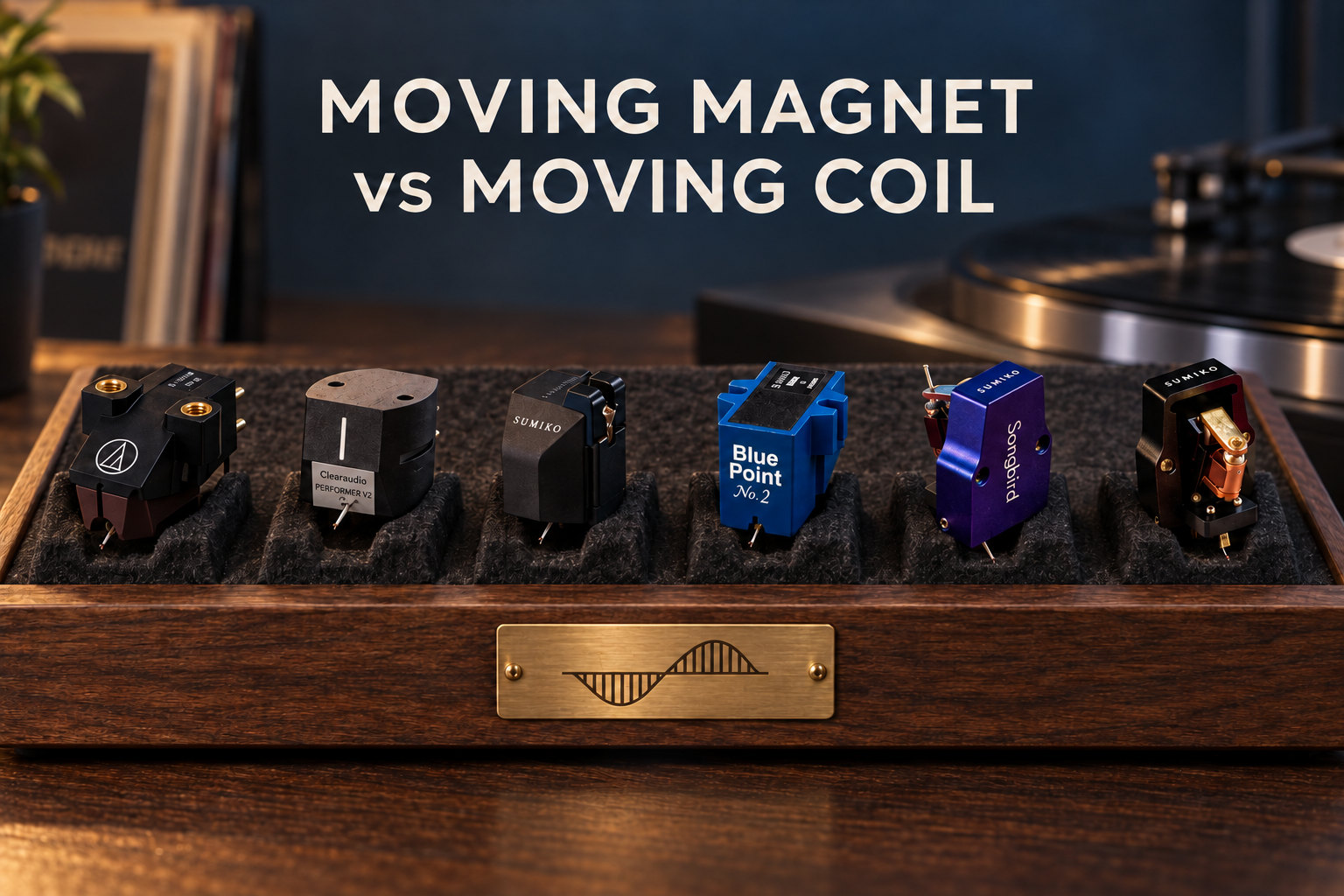
Moving Magnet vs Moving Coil: An Owner's Cartridge Ladder From $250 to $3,000
Like getting glasses for the first time: the cartridge is where diminishing returns stop behaving, provided the phono stage can keep up.
After more than a decade away from vinyl, I bought a McIntosh MT5 because it was a beautiful visual match for my system and the reviews were good. I didn't overthink it. Part of me thought, if it sucks, at least it looks good on a shelf. But it didn't suck. It was incredible. Within weeks I was spending way too much on pressings.
Then I destroyed a $500 cartridge with a cleaning cloth, my own fault entirely, and the real education began. This is what it taught me about moving magnet vs moving coil, from an owner who lived with six cartridges and borrowed none, climbing from the roughly $250 Audio-Technica VM95SH to the roughly $3,000 Sumiko Starling. My verdict up front: start with a good moving magnet, live with it, and climb to moving coil only when your records and your phono stage deserve it. And do climb. Cartridges are where I watched diminishing returns stop behaving.
A new stylus and cantilever meant weeks of waiting and almost the price of a new cartridge. I nearly fainted in the store, bought a stopgap for a few hundred dollars and went down the rabbit hole with one question: how can a tiny piece of metal and magnet cost so much? The answer took six cartridges, and the whole story is in my moving coil vs moving magnet cartridge film of 18 November 2025.
Moving magnet vs moving coil: how the two designs differ
Every cartridge does the same job. A diamond traces the groove, a cantilever carries the movement, and a magnet and coils of wire turn that movement into voltage. The only question is which of the two rides on the cantilever and which sits still. That one choice sets the output, the price, the cost of an accident and the phono stage you need.
Moving magnet: the heavier part moves
In a moving magnet cartridge, the stylus connects to a tiny magnet, and that magnet moves between fixed coils of wire. Magnets are relatively heavy, so there is more mass bouncing around in the groove. In exchange you get three easy things. Output is high: around 5 mV is the rule of thumb I gave on air, and the makers rate the VM95SH at 3.5 mV and the Amethyst at 2.5 mV, both into the usual 47k ohm moving magnet load. Prices typically run from $50 to $300. And the stylus is replaceable: break it and you buy a new needle, usually 30 to 70% of the cartridge's price depending on the maker.
Moving coil: the lighter part moves
Moving coil reverses the arrangement. The coils are attached to the cantilever and the magnet stays fixed, and that detail changes everything. Wire coils are much lighter than magnets, so the stylus tracks the groove more precisely, responds faster to tiny vibrations and retrieves noticeably more detail. The catch also comes in three parts. Prices run from about $300 to tens of thousands of dollars. Output is low: the Starling is rated at 0.5 mV, a seventh of the VM95SH, so the phono stage needs about 17 dB more gain, or a step-up transformer in front of it. And when a moving coil stylus breaks, there is no simple fix. You cannot just slide in a new needle.
High-output moving coils blur the line
Two Sumikos refuse the neat label. The Blue Point No.2 and the high-output version of the Songbird are moving coils rated at 2.5 mV into 47k ohms, the same figures as the Amethyst, so they plug straight into a moving magnet input. On air I counted the Blue Point among my moving magnets. Strictly it is a high-output moving coil, but it competed in that tier, so that is where it sits here.
Read every label as live text
- Moving magnet
- magnet (moves)
- fixed coils
- heavier moving part
- 3.5 mV (Audio-Technica VM95SH)
- load 47k ohm
- Moving coil
- coils (move)
- fixed magnet
- lighter moving part
- 0.5 mV (Sumiko Starling)
- load more than 100 ohm
- 7x less signal = about 17 dB more gain needed
The revelation at $250: the Audio-Technica VM95SH
I bought a number of cartridges and worked my way through the Sumiko lineup, partly because Sumiko was a sister company of McIntosh and I expected better synergy. The Amethyst was my main cartridge. McIntosh fits it as the stock cartridge on the MT5, and on a turntable I put at $10,000 on air, that tells you it is competent. It performs excellently and, unlike the power cables in the same box, it does not scream for an upgrade.
The Blue Point No.2 comes across as more detailed and dynamic, because of how it treats the high frequencies. The Amethyst delivers more dynamic range and more air, and it sounds more musical, naturally and unchallenged. In my opinion the Amethyst is the superior all-rounder: half audiophile cartridge, half highly revealing everyday one.
The revelation, though, was the Audio-Technica VM95SH, a dual moving magnet with a Shibata stylus that costs about $200 to $250. It has most of the Amethyst's properties: effortless detail, dynamic range and musicality. The main difference is that it is not as analytical. On air I said it does all that at a quarter of the cost, and US prices in October 2026 agree: about $220 for the VM95SH against about $800 for the Amethyst. On a more affordable turntable I recommend it strongly. The short version is in most of the Amethyst at a quarter of the cost.
The Clearaudio detour: the Performer V2
Not every step up the price list is a step up the ladder. The Clearaudio Performer V2 is a moving magnet in an ebony body, rated at about 3.3 mV and listed at about $500 in the US, more than twice the price of the VM95SH. It never found its place in my system, mainly because of congestion in the midrange.
That detour proves a point I made on air: within each technology, the variations in performance and character are significant. Price inside a tier does not rank sound, and neither does a famous badge. Clearaudio is a serious maker, one I count among the real competition above $3,000. This one simply lost, on price and performance, to every other moving magnet I owned.
Into moving coil: the Songbird opened everything up
Then came the real revelation. I bit the bullet and spent serious cash on moving coil, again with Sumiko. After the cloth I was not going to test with borrowed cartridges, and I already knew the brand. I paid about $1,000 for the Songbird, and US dealers list it at about $1,100 as of October 2026. It replaced the Amethyst as my main cartridge.
Everything opened up. Micro-detail retrieval became more effortless and natural, and there was more air in the soundstage. The noise floor stayed remarkably low and unnoticeable, despite the extra amplification a moving coil requires. Dynamic range expanded compared with the moving magnets, and the presentation became more organic and more natural. On air I put a number on it: the Songbird is two times better than the Amethyst.
Tripling the stakes: my Sumiko Starling review
Then it was time for the Starling. I read the reviews, made a few phone calls, and I was ready to triple the stakes. On air I put the Starling at around $3,000, which is where the tripling comes from; US dealers list it at about $2,000 to $2,100 as of October 2026. Why bet that much? Because my cartridge upgrades so far had proven this is one of the components that make the most prominent and impactful upgrade. It was a bet with a track record.
The reaction was instant and genuine. My eyes opened, and I was extremely happy I had not made a mistake again. My best pressings, Miles Davis and Buena Vista Social Club among them, went a level higher. The Starling does everything the Songbird does, and more. The soundstage expands, and so do the imaging, the layering and the separation. Detail retrieval is considerably higher, yet it is never fatiguing or surgical. The music becomes so organic that the performance is naturally convincing, and the noise floor is gone. It is the very best thing I have ever heard in my listening room, and the best match. A moving coil at this level shows why vinyl lovers are so strongly biased towards the format.
This journey is like getting glasses for the first time. You didn't know the world was so blurry until suddenly it wasn't.
I think cartridges are where the law of diminishing returns does not work, especially over $1,000. The Starling is two to two and a half times better than the Songbird. People will tell you the opposite. I strongly disagree, and I made the case in where diminishing returns stop working. There are gems between $200 and $400, but an exotic cartridge makes too big a difference to dismiss as diminishing returns.
The whole ladder, in one place:
| Cartridge | Type and output | Price on air | US price, October 2026 | What changed, in my words |
|---|---|---|---|---|
| Audio-Technica VM95SH | Moving magnet, 3.5 mV | about $200 to $250 | about $220 | The revelation: most of the Amethyst, a little less analytical |
| Sumiko Blue Point No.2 | High-output moving coil, 2.5 mV | not quoted | no longer sold new; replaced in 2021 by the No.3 ($499 at launch) | More detailed and dynamic through the treble; the Amethyst has more air and musicality |
| Clearaudio Performer V2 | Moving magnet, about 3.3 mV | not quoted | about $500 | Congested midrange; could not justify its price |
| Sumiko Amethyst | Moving magnet, 2.5 mV | stock on the MT5 | about $800 | The all-rounder: more dynamic range and air |
| Sumiko Songbird | Moving coil, low- and high-output versions (high output 2.5 mV) | about $1,000 | about $1,100 | Everything opened up; twice the Amethyst |
| Sumiko Starling | Low-output moving coil, 0.5 mV | around $3,000 | about $2,000 to $2,100 | Two to two and a half times the Songbird; the best I have heard in my room |
The Starling KD quoted at around $3,000 lists at about $2,000 to $2,100 in the US in October 2026, the Amethyst at about $800; outputs run from 3.5 mV down to 0.5 mV.
Outputs: makers' ratings, as published by dealers. Prices: US dealer listings, October 2026; the Blue Point No.3 figure is Sumiko's 2021 launch price.
The phono stage decides whether moving coil works
The key to all of the above is the phono stage. You need more than a cartridge to hear any of this: you need a carefully curated chain, and the phono stage is its first link. In my case that is the phono stage inside the McIntosh C12000 preamplifier, fed by the MT5; the C12000 drives MC611 monoblocks into Wilson Audio Yvettes. I said the same about turntables in March 2026: a flagship deck with a cheap cartridge into a $500 integrated amplifier and cheap speakers will not perform, because the system works as a whole. Cartridges obey the same law.
Three things decide whether a phono stage can carry the step to moving coil:
- Gain. A 0.5 mV Starling hands over a seventh of the voltage of a 3.5 mV VM95SH. Your stage must add about 17 dB more, or a step-up transformer must do it before the input.
- Noise. Every extra decibel of gain lifts the hiss along with the music. On my chain the Songbird's noise floor stayed remarkably low and the Starling's disappeared. Demand that before you spend.
- Loading. The VM95SH and the Amethyst want 47k ohms and 100 to 200 pF; Sumiko asks only for more than 100 ohms behind the Starling. Loading is a tuning question. Gain is pass or fail.
My rule is blunt: unless you are certain about your phono stage, do not move to moving coil. The cheap end is more forgiving. Cartridge changes up to about $400 are fairly impactful even in a less revealing system.
My ladder for you: start with a $250 moving magnet
So what should you actually buy?
- Start with a good moving magnet. On air I named the Audio-Technica VM95SH or an Ortofon 2M Blue, at $200 to $300, as excellent choices: replaceable styli and almost zero drama. Live with one for some time, learn what you like and build your collection.
- Move to moving coil when you are serious about vinyl, meaning you already spend real money on pressings and you listen critically, and only when you are sure of your phono stage.
- Make the first moving coil step at $500 to $900. On air I named Hana and the low-output Songbird for this range; the Songbird now lists at about $1,100 in the US, so at today's prices it sits just above that step.
- Do not jump straight to a $3,000 cartridge. You won't appreciate the difference yet, and if you break it, and trust me, you might, you will hate yourself.
- Go beyond $3,000 only with the system to support it: a great turntable, a great phono stage, great speakers. Otherwise you are very likely wasting money. The real competition up there comes from Hana, Clearaudio and many others, and I suspect Soundsmith has a statement to make with its Hyperion line.
The Starling is the one I use every day. But the cartridge that taught me the most was the $500 one I ruined with a cloth. The differences between moving magnet and moving coil are material and distinct, an excellent moving magnet can still beat a poor moving coil, and the chain matters more than the badge. Respect your gear. Cleaning is good. Being careful is better.
Frequently asked questions
Is moving coil better than moving magnet?
Not automatically: an excellent moving magnet can beat a poor moving coil. The step to moving coil only pays with a capable phono stage behind it.
Can a moving coil cartridge run on a moving magnet phono input?
Only a high-output moving coil runs on a moving magnet input. The Blue Point No.2 and the high-output Songbird are rated at 2.5 mV into 47k ohms and plug straight in; a 0.5 mV design like the Starling needs a moving coil stage or a step-up transformer.
Is the Sumiko Starling worth it?
In my system, yes: it is the best thing I have heard in my listening room, two to two and a half times the Songbird. Not as a first moving coil, though. Jump straight to a $3,000 cartridge and you won't appreciate the difference yet; buy one only if your phono stage is up to it.
More from the Journal
Keep exploring.
Loading articles…