

The Journal / Articles & reviews
Speaker Placement: The Free Upgrade That Can Be Worth $10,000
Before panels, cables or a new amplifier: move the speakers, a few centimetres at a time, and listen.
The old room gave my speakers exactly one place to stand. It was about 800 square feet and L-shaped, with the whole system squeezed into the short leg. The left speaker looked into a massive open area; the right one was pushed against a full glass wall leading to the balcony. My seat sat three and a half metres from the speakers, with zero gap to the wall behind it. Beautiful views. A nightmare by every audiophile standard.
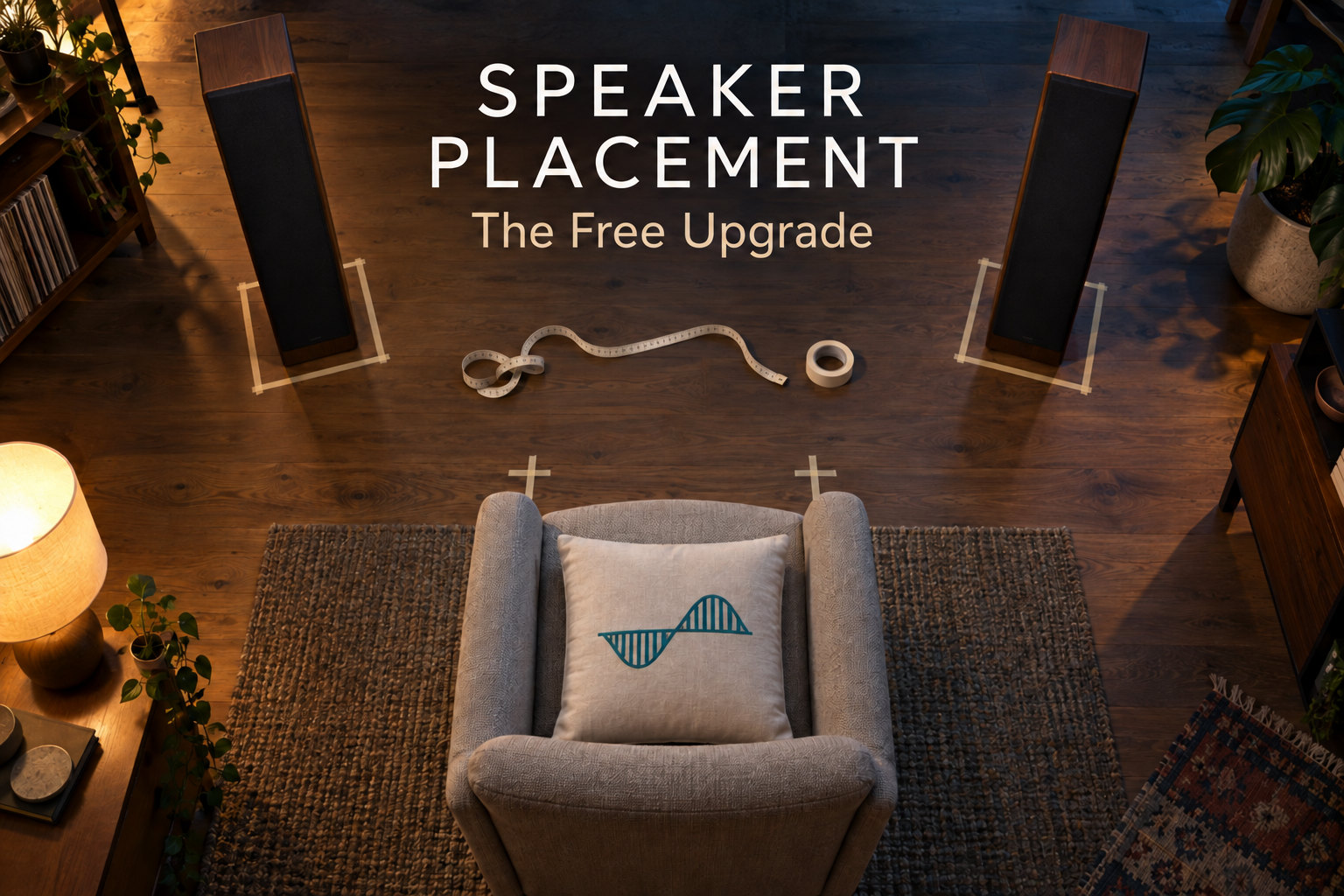
Speaker placement is the upgrade that room could never give me, and it costs nothing. In October 2025 I said on camera that a properly positioned speaker is the difference between a $5,000 speaker and a $15,000 pair: a $10,000 gap for the price of an evening and a roll of tape. The method has four steps: the stereo triangle as Ethan Winer sets it out, the distance from the walls, toe-in, and Wilson Audio's voice test for what it calls the zone of neutrality, which I used in my new room.
An L-shaped room with one speaker position
I tried everything in that room. As I said in the February 2026 film, my McIntosh MEN220 room correction measured a 37% correction, the highest ratio we have ever recorded in any room. Panels brought it down to the mid-teens, and the problems remained. I told people in the industry I was cursed with the worst room possible. No amount of walking and talking was going to move a glass wall.
Over the winter of 2025–26 I changed rooms. My first criterion for the new one was a butterfly layout: a rectangular living room of about 1,000 square feet, other rooms branching off left and right, so the shape would never again force a single position. After 10 to 20 hours of burn-in on the new power circuits, I followed the Wilson Audio Set-up Procedure (WASP) and used my own voice to find the zone of neutrality. It did not take long to find where the speakers' needs and the room's looks met.
In my old room, WASP gave me almost no room to move. Here, I had real choices.
Let me be clear about what the new room does not prove. Placement was not the only change that winter: shape, treatment and power changed too, while the Wilson Audio Yvettes, the McIntosh electronics, the cables and the sources stayed the same, as I showed in the new listening room film of 18 February 2026. Alone, in the first session, I played Pink Floyd's The Wall, and for the first time in my system the helicopter came from high on the ceiling to my right, approached, then moved out to the left until it vanished. And it stayed high, because it is a helicopter and it is flying.
Why speaker placement is worth real money
That price gap came from an expensive lesson. When I moved from Klipsch Reference Premiere to Bowers & Wilkins 800 Series D4, my first thought at home was that my dealer had cheated me: too harsh, the soundstage gone, elements I had heard on the Klipsch missing. Gear was his answer. What I could not see then was that the B&Ws were a step up the ladder, and more revealing speakers make a room's problems sound bigger, not smaller.
A little later I started studying room acoustics, and the first step cost nothing: toe-in, toe-out, the distance from the wall behind and from the sides. It is still the first step I recommend to anyone, as I said in my room acoustics film of 13 October 2025.
Experimenting even in very small increments on the positioning of your speakers costs nothing and can dramatically change the properties of your soundstage.
Speakers are designed to work inside a room: put my Wilsons in an open field, as I said in the KD Answers episode on speakers against room treatment, and they become unlistenable. Indoors, reflections cause comb filtering, standing waves build bass peaks and nulls, and early reflections smear the soundstage. If the room puts a 10 dB peak or null around 60 Hz at your seat, that is the response you hear, whatever the electronics cost. Move the speaker or the chair, and those peaks and nulls move too.
Stereo speaker placement starts with a triangle
My old seat failed the geometry before a single speaker moved: its back was against the wall. Ethan Winer, writing for RealTraps, puts the speakers and the seat at the points of an equilateral triangle, with the speakers aimed at the listener's head and the setup centred left to right, because stereo imaging needs symmetry.
Wilson Audio's Yvette manual adds two limits. The seat should ideally sit no more than 1.1 to 1.25 times the tweeter spacing from the speakers: in a 12 by 18 foot room with tweeters 9 feet apart, that is 9 feet 11 inches to 11 feet 3 inches, more than halfway down the long axis. And a head closer than 14 inches (about 36 cm) to a wall suffers from boundary interaction.
Winer places the seat with the 38 percent rule, whose logic he reprints from acoustician Wes Lachot: the flattest low-frequency response comes 38 percent of the way back from the front wall or, with the same benefit, 38 percent of the room length from the rear wall. The worst seat is exactly halfway, where every rectangular room has a deep bass null.
In that same 18-foot room, the two rules can part company. From the front wall, 38 percent is about 6 feet 10 inches, short of Wilson's distance even with the speakers against that wall. From the rear wall, it puts the seat about 11 feet 2 inches from the front, more than halfway down, where Wilson lands too. When they disagree, Winer's own advice settles it: the only way to know which spot really is flattest is to measure.
Read every label as live text
- front wall
- rear wall
- equilateral triangle
- zone of neutrality
- 2.5-3 ft (about 75-90 cm) from the wall behind
- 8 in to 3 ft
- 38% of room length from the rear wall
- 50%: deep bass null
- seat no more than 1.1-1.25 x tweeter spacing from the speakers (Wilson)
- head at least 14 in (about 36 cm) from any wall (Wilson)
- Winer (RealTraps); Wilson Audio Yvette manual
Speaker distance from the wall: bass against depth
Wilson states the trade-off precisely: the closer a loudspeaker sits to the wall behind it, the more pronounced the low bass and the centring of the image, at the cost of a smaller stage, less bloom and poorer upper-bass quality. Then the warning: "Overcompensated systems are sometimes pleasing in the short-term, but long-term satisfaction is always achieved through proper balance."
The arithmetic behind the bass is simple. Sound from the woofer reaches the wall behind and comes back; at the frequency whose quarter wavelength equals the woofer's distance from that wall, it returns out of phase and cancels part of the output. In symbols, f = c / 4d, with c the speed of sound. Genelec's table puts that first cancellation at 86 Hz for a speaker 1 metre from the wall behind it and 43 Hz at 2 metres; a metre and a half lands near 57 Hz. Moving a speaker 20 or 30 centimetres can change the bass in a way no cable will.
Then the side walls. Wilson's first priority is to eliminate them as a sonic influence: too close, and a strong primary reflection brings comb filtering and a changed tonal balance. My old room had one speaker pushed against a glass wall and the other exposed to an open area: no symmetry, and no clean boundary for either.
Bookshelf speaker placement obeys the same trade-off. On a shelf or against the wall, a small speaker gains the low bass Wilson describes and gives up stage size and bloom; on stands, out in the room, it joins the triangle like any floorstander.
Speaker toe-in, a few centimetres at a time
Robert Harley, in the 1994 edition of The Complete Guide to High-End Audio, defines toe-in as pointing the loudspeakers inward toward the listener, then refuses to set an angle: "There are no rules for toe-in; the optimum amount varies greatly with the loudspeaker and listening room."
Most loudspeakers, he explains, are brightest on-axis, so more toe-in means more treble at your seat, and an overly bright speaker can often be tamed by pointing it straight ahead. Toe-in also cuts sidewall reflections and, in his words, "shrinks the apparent soundstage size, but allows more precise image localization." His summary: "The optimum toe-in is often a trade off between too much treble and a strong central image."
My rule from that room acoustics film is simpler: toe them in, toe them out, until the soundstage shows you the elements you are looking for. You will hear the differences pretty much immediately.
To put Harley's trade-off to work tonight, start aimed at your head, as Winer recommends, with one vocal recording you know well. Turn both speakers out by the same small step, a few centimetres at each rear corner, and listen. While the stage widens and the voice stays put, keep going; when the voice wanders, come back one step. Keep both sides identical, which Harley calls vital: measure from the wall behind to each speaker's rear corners, or check from the seat that both inner side panels show equally.
Read every label as live text
- straight ahead
- less treble at the seat, larger, more diffuse stage, less precise centre
- partly toed in
- aimed at the listener's head
- more treble at the seat, weaker side-wall reflections, smaller stage, more precise images
- turn both speakers by the same small step (a few centimetres at each rear corner); keep toe-in identical
- Harley, The Complete Guide to High-End Audio (1994); Winer (RealTraps)
Finding the zone of neutrality with your own voice
This is the method I used in the new room. Wilson defines the zone of neutrality as "an area in your room where the speakers will sound most natural", where they interact least with the room's boundaries.
- Stand against the wall behind where the speaker will go and speak into the room, moderately loud and at a constant volume. Your voice sounds heavy and "chesty".
- Keep speaking and walk slowly forward, parallel to the side wall, ideally with a helper in the listening seat. Your voice "frees up" from the wall's added bass; to your helper it sounds large and hard to place.
- When your voice turns tonally correct and easy to pinpoint, you are at the inner edge: tape it. In most rooms it begins two and a half to three feet (about 75 to 90 cm) from the wall behind.
- Usually one to two feet further, your voice loses focus and echoes off the wall ahead: the outer edge. Tape it. The zone is usually eight inches deep in small, interactive rooms and up to three feet in large, more neutral ones.
- Repeat from the side wall, walking between the two marks. The four marks form a rectangle: that speaker's zone. Then do the other channel.
The test listens to the room, not the box. In the old room it left me almost nothing; in the new one, a rectangle on each side and room to choose inside it.
Mark it, measure it, live with it
Tape first: mark each zone, each speaker's feet and the seat, so every experiment can be undone.
Then measure. REW (Room EQ Wizard) is free software by John Mulcahy; its site recommends miniDSP's UMIK-1 calibrated USB microphone as the simplest setup. Measuring was my fourth step in October 2025: identify the problems before you spend on gear, cables or extensive treatment. I bought the McIntosh MEN220; it is a little bit expensive, and I would not go that far. Before any microphone arrives, clap and listen for an echo. More in the Daily Measure first, and do it for free.
Then live with it. A position that dazzles at first can wear thin, which is Wilson's point about overcompensation, so let ordinary listening, not the first evening, judge each change.
| Symptom at the seat | Placement fix to try first | If placement is not enough |
|---|---|---|
| Boomy, heavy bass | Further from the wall behind | Corner bass traps |
| Thin bass | Closer to the wall behind; never sit exactly halfway | Measure: the seat may sit in a null |
| Vague, wandering centre | More toe-in, identical on both sides | First-reflection panels, one at a time |
| Narrow stage | Less toe-in; further from the wall behind | Measure before adding treatment |
| Bright treble | Less toe-in | First-reflection panels, one at a time |
| Smeared, echoey images | Further from the side walls | Absorption and diffusion at first reflections |
Try the free fix in the middle column first; the right-hand column follows the order I gave in October 2025, for when the room, not the position, is the limit.
When speaker placement is not enough
Placement has a ceiling. If you have set the triangle and found the zone, and the bass still booms or the stage still smears, the limit is the room, not the position.
The order I gave in October 2025, once the speakers are placed: a maximum of $500 on first-reflection absorption and diffusion, one piece at a time, very likely a bigger upgrade than any cable or gear change. Then corner bass traps on a similar budget, which I strongly suspect will give you a tighter, cleaner low end than any subwoofer integration someone recommends. Do not overdo it: an over-treated room becomes dead and lifeless, and I did it more than most. Install, measure, reapply.
If you are about to spend $5,000, $10,000 or $20,000 on a component while your room has obvious problems, stop. Fix the room first; the return is not even comparable. My own version of that lesson: My best upgrade had no gear in it.
The industry cannot sell you a room, and it cannot sell you a position either. Move the speakers before you move your money.
Frequently asked questions
How far should speakers be from the wall?
In most rooms, Wilson Audio finds, the zone of neutrality begins two and a half to three feet from the wall behind the speaker. Closer gives more bass; further, a bigger stage.
How much should I toe in my speakers?
There is no fixed angle, says Robert Harley. Start aimed at your head, as Ethan Winer suggests, and turn both speakers in equal small steps while you listen.
Where should bookshelf speakers go?
On stands, in the same triangle as floorstanders. On a shelf or against the wall they gain bass and lose stage size.
More from the Journal
Keep exploring.
Loading articles…