

The Journal / Articles & reviews
Acoustic Treatment on a Budget: My Four-Step Plan, and the Mistake of Doing Too Much
The room is a component no dealer can sell you; here is how to improve it one panel at a time without making it dead.
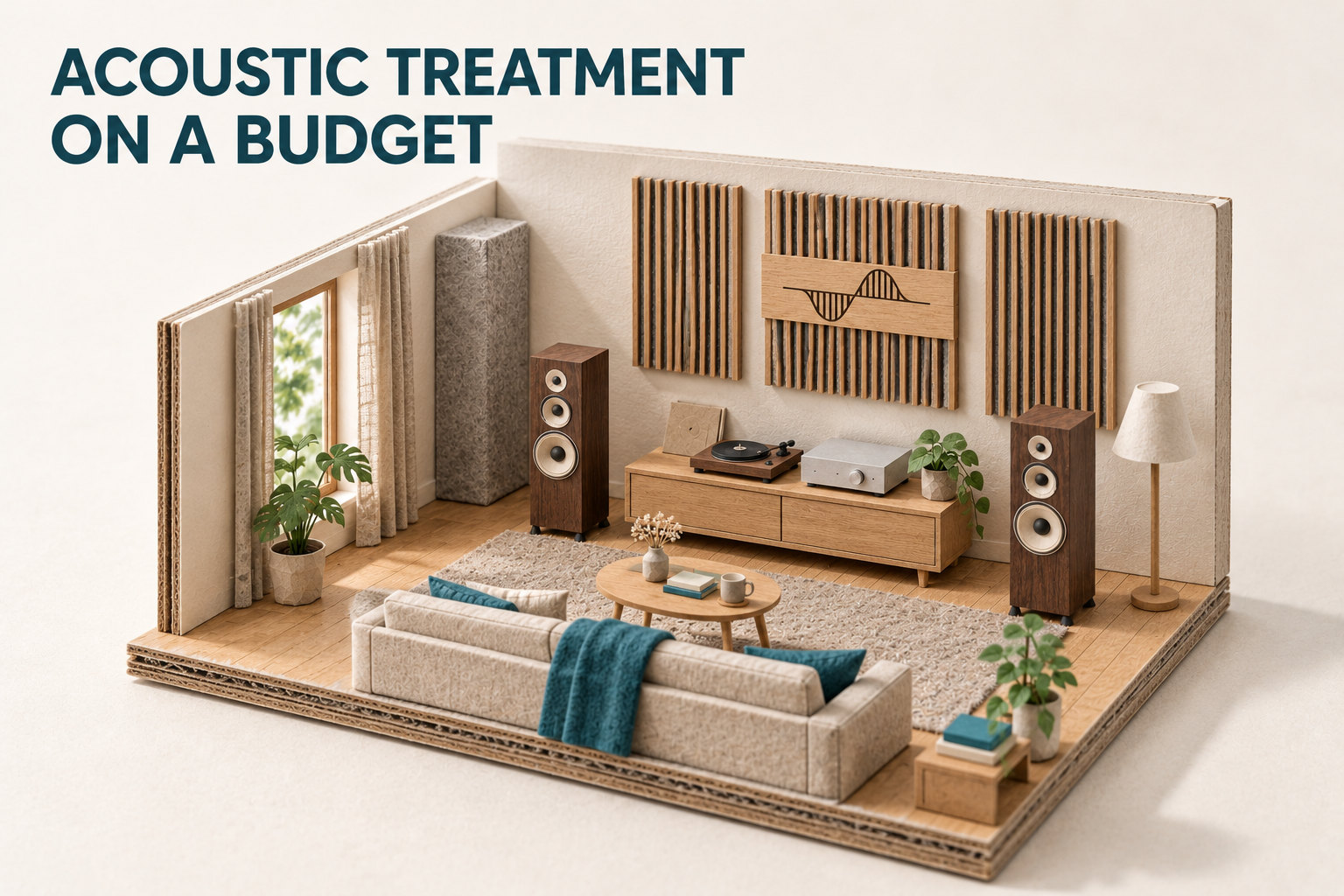
My first real system cost about $10,000, and I put it in an awkwardly shaped room, 10 metres wide by 7 metres long. To my ears it was impressive, so impressive that I kept inviting people over to show it off. Then the problems started, and I did what almost every one of us does. I went down the rabbit hole of gear upgrades.
Here is the plan I wish someone had handed me first. Acoustic treatment, done in the right order, is the cheapest big upgrade in this hobby. Move the speakers first, which costs nothing. Spend up to $500 on the first reflection points, then a similar amount on bass traps in the corners. Then measure, with free software and a microphone. And stop before the room dies, because the biggest mistake with acoustic treatment is not doing too little. It is doing too much. I know. I have done it more than most.
A proud owner in the wrong room
What I could not understand was how my gear could sound so different at home from the rooms where I had auditioned it. The room was not just affecting the sound; it was destroying it. Reflections were creating comb filtering. Standing waves were creating massive bass peaks and nulls. Early reflections were smearing the soundstage. No amount of gear was going to fix any of that.
None of it was clear to me then, so I followed the classic loop. Bass too boomy: new amplifier. Vocals too distant: new speakers. Treble too harsh: maybe it is time for tubes. I spent years doing exactly this.
The wake-up call came when I moved up from Klipsch Reference Premiere to the Bowers & Wilkins 800 Series D4, the speakers I had always dreamed of owning. I brought them home and my first thought was that my dealer had cheated me. They were too harsh, the soundstage was gone, and much of what I heard through the Klipsch was simply missing. When I called him, his answer was gear, and I don't blame him: the gear answer was true, and the McIntosh integrated I bought soon after proved it. What I could not see at that moment was that something else was even more true. The 800 Series is a step up the ladder, and more revealing speakers make a room's problems sound even bigger.
A little later I started studying room acoustics, with Paul McGowan's channel as my first influence. The whole story is in my room acoustics film of 13 October 2025, and that first system has its own Daily: a $10,000 system in a 10 by 7 metre room.
The audio industry doesn't want you thinking about this first because, simply put, they cannot sell you a room.
Room or speakers first? The chicken and the egg
The room comes first, then the speakers. That was my answer one week after that film, in the first episode of KD Answers, to the question in its title: $2,000 for speakers or for room treatment? I called it the chicken and the egg, and joked that we recently discovered it was the chicken. Here, the chicken is the room. The full answer is in KD Answers 001.
Speakers and rooms live in symbiosis: manufacturers design speakers to work inside a room. Put my Wilsons in an open field with no walls and very little sound comes out, and what does is unlistenable. So deal with the room's limitations first, then choose speakers that suit it. A big room, a small room and a congested room each ask for something different.
Now the part I like most, because I think about everything as an investment. Speakers come and go; the room stays. Money spent on room acoustic treatment does not depreciate, and the benefit survives every change of electronics or speakers. Try saying that about an amplifier.
The room is a component, probably the most important one, because everything else has to work through it, the way drivers work through the cabinet around them. Own the most accurate speakers in the world, and if your room creates a 10 dB peak or null around 60 Hz, that is the frequency response you will hear. It is the one component no dealer can sell you, and the one that decides what all the others are worth.
Step 1: speaker position, free and first
Before you spend a cent, move the speakers. It is the first step I recommend to anyone. Toe them in, toe them out. Change the distance from the wall behind them and from the side walls. Do it in very small increments, one change at a time, with familiar music. You will hear differences pretty much immediately; keep going until the soundstage reveals the elements you were looking for.
With the Bowers & Wilkins, positioning was quite simple. Most of us listen in the living room, and that brings its own restrictions; experiment within them. In my experience, a properly positioned speaker is the difference between a $5,000 pair and a $15,000 pair. That is $10,000 of performance for the price of some patience, and nobody can sell it to you.
Step 2: first reflection points, up to $500
Next come the first reflection points. To me they are the biggest problem, and they were worse in my case because my listening seat was very close to the back wall. My rule is $500 maximum at the start, for absorption and diffusion panels at those points, piece by piece. Torn between a $500 power cable and $500 of panels? Buy the panels; very likely they are the bigger upgrade, as I argued in $500 of power cable or $500 of panels.
Acoustic panel placement: the mirror trick
Find the spots with the mirror trick, as the panel maker Primacoustic describes it. Sit in your listening position and have someone slide a mirror along the side wall, between you and the speakers. Wherever you can see a speaker in the mirror, that wall is throwing its sound straight at you. Mark where the view of each speaker begins and ends, then repeat on the other side. Turn around and do the same on the wall behind you; Primacoustic suggests this as a further improvement, and with my seat so close to that wall, it mattered more in my room. Panels go at ear height, speaker height or both, and as Primacoustic notes, "you do not have to cover the full area; covering most of the surface will provide plenty of control."
Read every label as live text
- Left speaker
- Right speaker
- Listening seat
- Mirror
- First reflection zone
- Panels at ear and/or speaker height
- Most of the zone is enough
- Rear wall zone
Absorption or diffusion? Neither school is right
One school will tell you to go full diffusion, the other full absorption. Neither is correct. Each room has its own properties, and you address them one piece at a time. What finally worked for me was absorption panels covering the back wall and parts of the front wall, with carefully positioned acoustic diffusers. That was my room's answer, not a recipe.
On thickness, ATS Acoustics' published tables give two-inch Owens Corning 703 fibreglass board a coefficient of 1.14 at 500 Hz, against 0.68 for one-inch. Laboratory figures can run past 1.0, an artefact of the test method; read anything near 1 as near-total absorption. Two inches is where a reflection panel starts to earn its money.
Step 3: bass traps in the corners, before any subwoofer
Bass is extremely difficult and complicated. That is why step three is bass trapping in the corners, on a budget similar to the first reflection points: about another $500. Experiment with a couple. I strongly suspect your low end will clean up, tighten and end up far superior to any subwoofer integration someone recommends to you. The subwoofer conversation can wait.
Why the corners? Ethan Winer's online guide to acoustic treatment answers in one sentence: "Since bass builds up the most in the corners of a room, this is an ideal location for any bass trap." Thickness decides how low a trap reaches: "As with all absorbent materials," Winer writes, "the thicker it is, the lower in frequency it will absorb to."
| Owens Corning 703 board | 125 Hz | 500 Hz | 4,000 Hz | NRC |
|---|---|---|---|---|
| 1 inch | 0.11 | 0.68 | 0.96 | 0.70 |
| 2 inches | 0.17 | 1.14 | 0.98 | 1.00 |
| 4 inches | 0.84 | 1.24 | 0.97 | 1.15 |
Owens Corning 703 absorption coefficients by thickness, Type A mounting, from ATS Acoustics: thickness is what reaches the bass. Laboratory values above 1.0 are an artefact of the test method.
Source: ATS Acoustics, absorption coefficients in Type A mounting (flat against a solid backing).
The two-inch board that does such a fine job at a reflection point barely touches 125 Hz, at 0.17. Double it to four inches and the figure rises about five times, to 0.84. ATS adds that bass absorption can be enhanced by corner mounting or by adding layers of material. That is the whole argument for thick traps in the corners, and against a wall of thin panels pretending to be bass control.
Read every label as live text
- Start with a couple
- Add after measuring
- Budget similar to first reflections: about $500
- Absorption at 125 Hz, Owens Corning 703, Type A mounting
- 2-inch board 0.17
- 4-inch board 0.84
- 0
- 1
- ATS Acoustics
Step 4: measure with free software, a microphone and a clap
My fourth recommendation is the controversial one: measure your room. I bought the McIntosh MEN220, a Lyngdorf RoomPerfect implementation, because I am a McIntosh boy. It is a little bit expensive, and I would not go that far. REW (Room EQ Wizard) is free, "professional-grade" measurement software. Its site recommends a calibrated USB microphone and names miniDSP's UMIK-1, which miniDSP lists at $79 as of July 2026.
Measurement is also how I proved all this to myself. In my old room, as my October 2025 film showed, the MEN220 had to apply 25% correction without the acoustic treatment. With the treatment back on the walls, only 7%. A colossal difference, for some speaker moves and a modest spend on panels. That is why I opened that film by saying the most important upgrade I had ever made had nothing to do with any piece of gear.
No microphone yet? Use your hands. In KD Answers I said we always start by measuring the room, with REW or very simply by clapping. Listen for an echo coming back, and notice whether friends are hard to follow when you sit and talk. Know the limit, though: Winer warns that thin treatments do nothing to control low-frequency reverb or reflections, "and hand claps won't reveal that." So clap on day one; measure before anything extensive, and before any decision about bass.
The plan on one page:
| Step | What you do | Budget (as of July 2026) | What should change | How to check |
|---|---|---|---|---|
| 1. Position | Toe-in, distance from back and side walls, small increments | $0 | A soundstage that reveals more | Familiar tracks, one change at a time |
| 2. First reflections | Absorption and some diffusion at the mirror points | Up to $500 | A less smeared soundstage; likely more than any cable upgrade | Mirror trick, clap test, before-and-after measurement |
| 3. Corners and bass | Thick traps in a couple of corners | A similar sum, about $500 | A tighter, cleaner low end | REW response at the listening seat |
| 4. Measure | REW software and a calibrated USB microphone | Software free; UMIK-1 $79 from miniDSP | Problems identified before you spend more | Re-measure after every new panel |
Position, reflections, corners, measurement: roughly $1,100 in total as of July 2026.
Acoustic treatment, one panel at a time: the mistake I made more than most
Now the confession. The biggest mistake we all make is to overdo it, and I have made it more than most.
When you overdo it, your room becomes lifeless. It becomes dead.
All this money in speakers, all this money in gear, all these absorption panels, and what you end up with is a lifeless room.
What does dead sound like? Primacoustic, which sells absorption for a living, says it plainly: "Too much absorption will remove the energy and excitement." Winer warns never to make a room completely dead, "because that produces a creepy and unnatural sound." The numbers show how it happens. One-inch Owens Corning 703 absorbs 0.96 at 4,000 Hz and only 0.11 at 125 Hz. Cover a room in thin panels and you strip out the air and the sparkle, while the bass problems you started with stay exactly where they were.
So: step by step, panel by panel, in different positions, and the same for the diffusers. Install, measure, reapply. Only then do you know what you treated and how. Do it this way and, as I said in the film, your life will be happy.
Still a home: treatment that lives with the furniture
In the new listening room, shown in my film of 18 February 2026, I treated with restraint: mild absorption behind the system under natural-wood panels, corner bass traps, custom ceiling absorption for the loud sessions, and thick, layered curtains. What your eyes see is part of the listening ritual. If the room looks like a recording studio, it does not feel like home, and you will not sit in it for hours. A room you avoid is the most expensive kind of dead.
Nothing in my signal chain changed: same Wilson Audio Yvette, same McIntosh C12000 preamplifier, same monoblocks, same Transparent cables, same sources. Only the room and the power infrastructure changed, and the improvement was not subtle. It was transformative. I thought I knew what my Yvettes and my McIntosh separates could do, and I was wrong. They had more to give, a lot more. I just never gave them the room to prove it.
Add it up: nothing for position, up to $500 for reflections, about $500 for corners and $79 for a microphone. Roughly $1,100 for all four steps, before you touch an amplifier. Treat the room first, one panel at a time, and keep it a room you want to live in. The gear serves the music, not the other way around.
Frequently asked questions
How many acoustic panels do I need?
Only as many as the first reflection points need, within $500 to start, plus the wall behind you if you sit close to it. Add more one at a time, when your ears or a measurement ask.
Where should you put acoustic panels first?
At the first reflection points, found with the mirror trick, at ear height, speaker height or both. Bass traps come next, in the corners.
Can you over-treat a room?
Yes. Too much absorption makes a room lifeless, and thin panels remove the treble while leaving the bass problems in place.
More from the Journal
Keep exploring.
Loading articles…