

The Journal / Articles & reviews
WiiM Ultra vs Eversolo DMP-A6 Master Edition: Three Months With the $1,070 Question
Two streamers bought with my own money, the same Qobuz tracks, and an answer that depends on the system rather than the spec sheet.
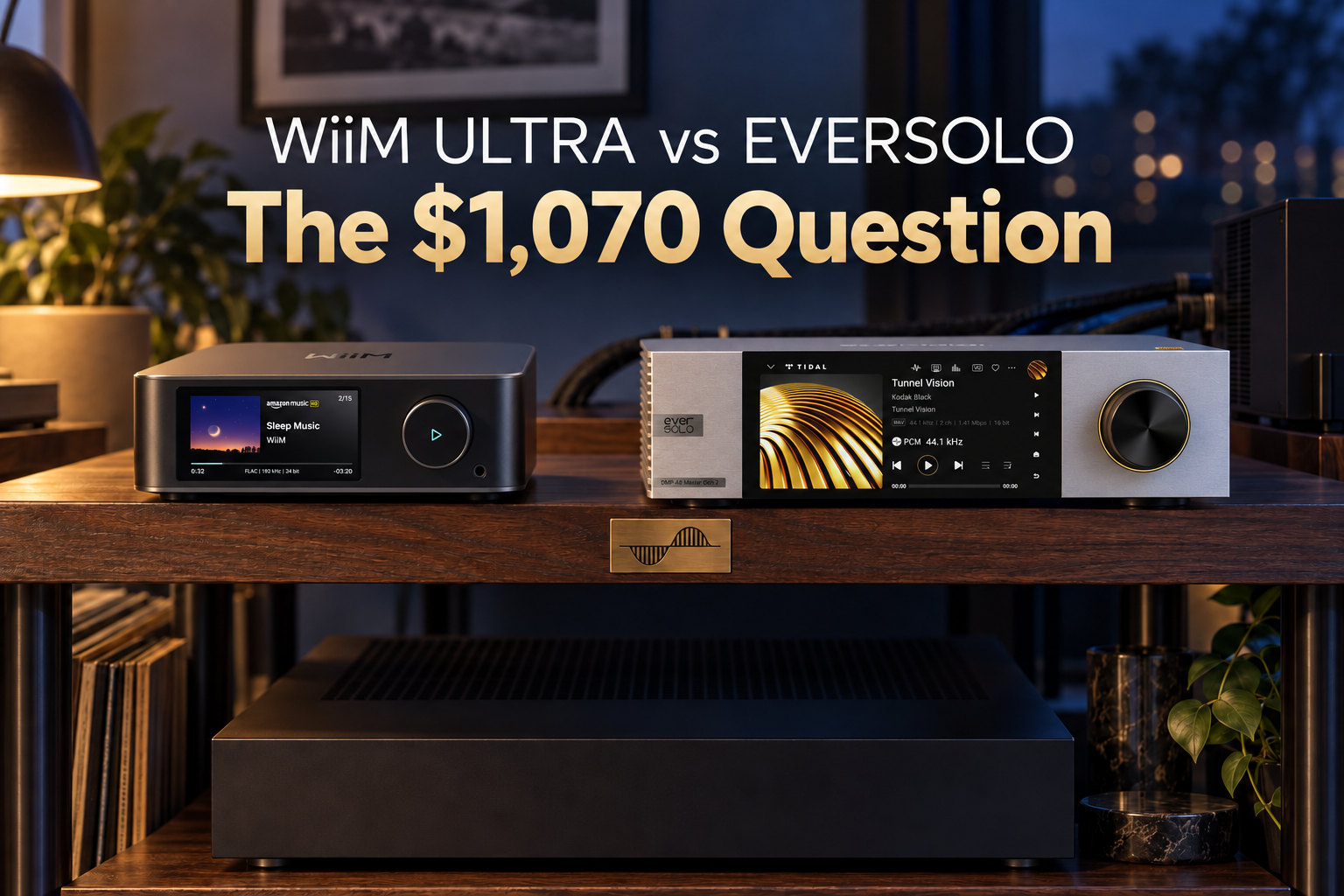
Six Blade Knife on Qobuz. The same McIntosh preamplifier and monoblocks, the same Wilson speakers. Only the box at the head of the chain changes. One is the WiiM Ultra, $329 in October 2025. The other is the Eversolo DMP-A6 Master Edition Gen 2, $1,399 that same month. For more than three months I switched between them. On paper the expensive box should have run away with it. It never did.
This is the written version of my WiiM Ultra vs Eversolo A6 film, published on 15 October 2025. The short answer first. The Eversolo is better, and on my system, knowing what to listen for, I could pick it ten times out of ten. The gap is also small, "uncomfortably close" for anyone who paid four times more, and for most people the WiiM Ultra is the right streamer to buy. Whether the extra $1,070 is worth paying depends on what sits downstream of the streamer, not on the spec sheet.
Bought, not borrowed: two streamers, three months, two systems
Let me be clear. I bought both boxes with my own money. Nobody sent them, nobody gets a link, and I live with what I buy. These two lived side by side for over three months, on my reference system and on a second, less revealing one.
Downstream of the streamers, the reference chain was fully balanced. The McIntosh C12000, the flagship two-chassis preamplifier, fed McIntosh MC611 monoblocks, which drove Wilson Audio Yvette speakers, all connected with balanced cables from Transparent's Reference line, in a room with proper acoustic treatment. Streaming came from Qobuz. I played identical tracks and switched between the Eversolo and the WiiM.
I was no stranger to the Eversolo name. Well before the Gen 2 arrived, my dealer talked me into an earlier A6 Master Edition, and I forced every visiting friend into A/B tests against my Apple TV, a habit I confessed in And then I became insufferable and apologised for in my November 2025 DAC film. As I said on camera in February 2026: I am biased. You are biased. Here is the method, so you can judge mine.
The test: three Qobuz tracks and one shared DAC chip
Three reference-grade tracks carried the listening, all from albums I know very well, chosen to expose the micro and macro elements of each box:
- Classic rock: Six Blade Knife, from the 1978 debut album Dire Straits, written by Mark Knopfler.
- Jazzy female vocal: This Town, the Lee Hazlewood song that opens Patricia Barber's all-standards album Clique on Impex Records.
- Jazz: Take Five, Paul Desmond's tune in 5/4 time, from the Dave Brubeck Quartet's Time Out, released in 1959.
Now the paper, briefly, because one detail on it tells you where to listen for the difference. The WiiM Ultra is a streamer, digital transport, DAC and preamplifier in one box, built around a single ESS ES9038Q2M DAC chip with a switch-mode power supply. The Eversolo uses two ES9038Q2M chips, one per channel, with a low-noise linear power supply, an upgrade on the previous generation's switch-mode supply. The chip is the same. What the extra $1,070 buys is a second chip, so each channel has its own, a cleaner supply and better components. You do not pay for the chip. You pay for the implementation.
On paper, the Eversolo should dominate. But you know what? We do not listen to specifications. We listen to music.
Uncomfortably close: what the Eversolo DMP-A6 does better
Both sound remarkably closer than the $1,070 gap suggests. I mean uncomfortably close for those that spend four times extra for the Eversolo.
That was my first impression, and the Eversolo still wins. I can tell you exactly where. Its imaging is better. Its soundstage is wider and deeper, with better layering and better separation between instruments. It retrieves more low-level detail, especially in complex passages, and its background is completely dark next to the WiiM's. I attribute these differences mainly to the dual-DAC implementation.
But here is what shocked me. The WiiM Ultra comes very close. Its sound is very vivid, its dynamic range feels high, and there is more air at the top, which you perceive as more detail coming out of the recording. It is warmer and more pleasing. Classic rock and poor recordings are smoother on the WiiM, and easier to listen to for long sessions than on the Eversolo.
That is the real split. The Eversolo is the audiophile tool. The WiiM Ultra is the everyday smooth listener: streamer, DAC and preamplifier in one small box.
Can I tell them apart? After many hours of listening, yes, comfortably: ten times out of ten on my system, when I am looking for it. Now remove the visual cues, put a long pause between the two, and move to a less revealing system in the $5,000 to $10,000 range. I am not convinced anyone can tell them apart there. My system is quite revealing. Most are not.
Beyond sound: build, screen, app and what they are worth
Sound is not the only thing you pay for. The Eversolo has a premium build, a 6-inch touchscreen, its own software, smooth operation, a premium feel and a tactile pleasure in use. For certain people that experience is the point. If it is your point, the Eversolo may not be justified on sound alone, and it may still be the right device for you.
On the other hand, the WiiM Ultra completely disappears. It slots into the system and you never notice it. You run it from your phone, with an app I rate above Eversolo's: bug-free and frequently updated. And it gives you a very similar sonic experience. At $329, it is very hard to justify the extra money.
For its size, the WiiM packs RoomFit room correction, an HDMI input for the television, a phono input and a subwoofer output. The Eversolo's case is balanced XLR outputs beside its RCA pair and a wider set of digital inputs and outputs: exactly the analogue output stage and connections that, as I said in the film, become more useful in a $15,000 to $30,000 system.
| WiiM Ultra | Eversolo DMP-A6 Master Edition Gen 2 | |
|---|---|---|
| Retail price, October 2025 | $329 | $1,399 |
| DAC chips | One ESS ES9038Q2M | Two ESS ES9038Q2M, one per channel |
| Power supply | Switch-mode | Low-noise linear |
| Touchscreen | 3.5-inch | 6-inch |
| Connections | In: phono (MM/MC), line, optical, HDMI ARC. Out: RCA line, optical, coaxial, USB, headphone, subwoofer | In: USB-B, coaxial, optical, HDMI ARC, Bluetooth. Out: balanced XLR and RCA analogue; USB, HDMI, coaxial, optical |
| What it does better | Warmer, vivid, airier top; smoother on poor recordings; the better app | Imaging, wider and deeper soundstage, layering, low-level detail, darker background |
| Who it suits | Systems up to $10,000; viable as a pure streamer up to $30,000 | Systems of $15,000 to $30,000; above $30,000 possible, not automatic; owners who want the screen, build and tactile operation |
October 2025 retail prices from KD's film; DAC chips, power supplies, screens and connections from the WiiM product page and Audio Advisor's Eversolo listing; the last two rows are KD's verdict after three months.
Sources: prices, my October 2025 film; specifications, the WiiM and Audio Advisor listings; last two rows, my verdict.
The last 3 to 5%: why the gap needs a revealing system
The Eversolo is objectively superior to the WiiM Ultra. It has better measurements, better build quality, better components and more comprehensive features. Is it four times better? Is it $1,070 better?
In my treated reference room, on that chain, the differences were real but subtle. I mean squeezing out the last 3 to 5% of performance. In the average audiophile system, one that costs no more than $15,000, I find those differences impossible to justify.
The limiting factor in most systems is not the streamer. It is the speakers, it is the electronics, and maybe the cables. Spending an extra $1,000 on a streamer for a $5,000 or $10,000 system is, for me, like installing a Formula 1 engine in a conventional car. The engine is magnificent. The rest of the car cannot use it.
Four months after the film, I saw the other end of the scale. In February 2026 I showed the same system in a new room: same Yvettes, same C12000, same monoblocks, same Transparent cables, same sources. Only the room and the power infrastructure changed, and the improvement, in my words on camera, was "not subtle. It's transformative." It is all in the $100K system upgrade that cost me $0 in gear. That took a new room and new power, not $1,070, so it is no like-for-like trade. The direction is clear, though: the big percentages live in the room and the system around the streamer. And the room keeps paying: it is the upgrade that never depreciates, staying through every change of electronics and speakers.
WiiM Ultra or Eversolo by system value: my three tiers
Here is the practical advice from the film, with a number on every line.
Up to $10,000: buy the WiiM Ultra without hesitation. The $1,070 or more you save is better spent on room treatment, amplification, even speakers, where the audible difference is likely to be bigger. If the room is the target, position the speakers first, then put the first $500 into first-reflection treatment. The film skipped the band between $10,000 and $15,000, but the same logic covers it: under $15,000, I called the difference impossible to justify.
$15,000 to $30,000: the WiiM Ultra is still a viable option, especially if you use it only as a streamer and not as streamer, DAC and preamplifier in one. At this level, though, the Eversolo's analogue output stage, linear supply and digital connections are likely to benefit you more.
Above $30,000: the WiiM Ultra is no longer viable, even as a streamer. In a system fully optimised in room acoustics, speaker positioning and electronics, the Eversolo is a closer match, and its improvements show through a transparent chain. But here a separate streamer and DAC make more sense, and dearer options still cost a marginal share of the system's value. The Eversolo can be a viable option. I am not sure it is the option for you.
| Total system value | My pick | Where the money should go |
|---|---|---|
| Up to $10,000 | WiiM Ultra, without hesitation | Room treatment, amplification or speakers |
| $10,000 to $15,000 (between the film's tiers) | WiiM Ultra | Under $15,000 the Eversolo's advantage is impossible to justify |
| $15,000 to $30,000 | WiiM Ultra as a pure streamer, or the Eversolo | The Eversolo's analogue stage, supply and connections likely pay off |
| Above $30,000 | A separate streamer and DAC; the Eversolo is possible, not automatic | Dearer options still cost a marginal share of the system's value |
KD's three tiers from the October 2025 film, with the $10,000-$15,000 band filled from his "under $15,000" verdict.
My DAC film, from $1,000 to $100,000, published on 23 November 2025, climbs the next rungs of the same ladder. Not ready to spend $5,000 on a HiFi Rose, I bought the $2,000 Eversolo A8, and it beat the A6 Master Edition everywhere: detail, imaging, refinement. The $5,000 Rose was still better. Every rung is real, and the top rungs are wasted without the speakers, the room and the amplification to show them.
Prices in October 2025: $329, $1,399 and the logic that outlives them
All prices here are the film's, from October 2025: $329 retail for the WiiM Ultra and almost $1,400 for the Eversolo DMP-A6 Master Edition Gen 2 ($1,399 list, matching the $1,070 gap I quoted). That is a little over four times the price.
The logic does not move with them: it is a ratio, not a price tag. A $1,070 premium is 21.4% of a $5,000 system, 10.7% of a $10,000 system, 7.1% of a $15,000 system and 3.6% of a $30,000 system. At the bottom of that range you would put a fifth of your system's value into a difference I doubt you can hear. At the top it is a marginal percentage, and the chain may finally be good enough to reveal the last 3 to 5%. Same two boxes. Different answer. If the prices have moved by the time you read this, run the same division with the new gap. The system is still the denominator.
Read every label as live text
- $5,000
- 21.4%
- $10,000
- 10.7%
- $15,000
- 7.1%
- $30,000
- 3.6%
For 90% of the audiophiles, the little WiiM is a revelation, and it proves the law of diminishing returns to its greatest extent. If your chain can show the last 3 to 5%, now you know what it costs. The best component is the one that gets out of the way of the music.
Frequently asked questions
Is the WiiM Ultra good enough for a high-end system?
Up to about $30,000 of total system value, yes, especially as a pure streamer. Above $30,000 a separate streamer and DAC make more sense.
Does the Eversolo DMP-A6 Master Edition Gen 2 sound better than the WiiM Ultra?
Yes: better imaging, a wider and deeper soundstage, more low-level detail and a darker background. On my treated reference system, though, the gain was the last 3 to 5% of performance.
What is the main difference between the Eversolo DMP-A6 and the WiiM Ultra?
The Eversolo has two ES9038Q2M chips, one per channel, a linear supply, a 6-inch screen and XLR outputs. The WiiM has one chip, a switch-mode supply, room correction, a phono input and the app I rate higher, for $1,070 less at October 2025 prices.
Where should I spend the $1,070 instead?
In a system up to $10,000, spend it on room treatment, amplification or speakers. In most systems the streamer is not the bottleneck; the speakers and the electronics are.
More from the Journal
Keep exploring.
Loading articles…