

The Journal / Articles & reviews
Dedicated Circuits, Power Conditioners and Power Cables: What Actually Changed in My System
Is power snake oil? No. Is it universally necessary? Also no. The building decides more than the box you buy.
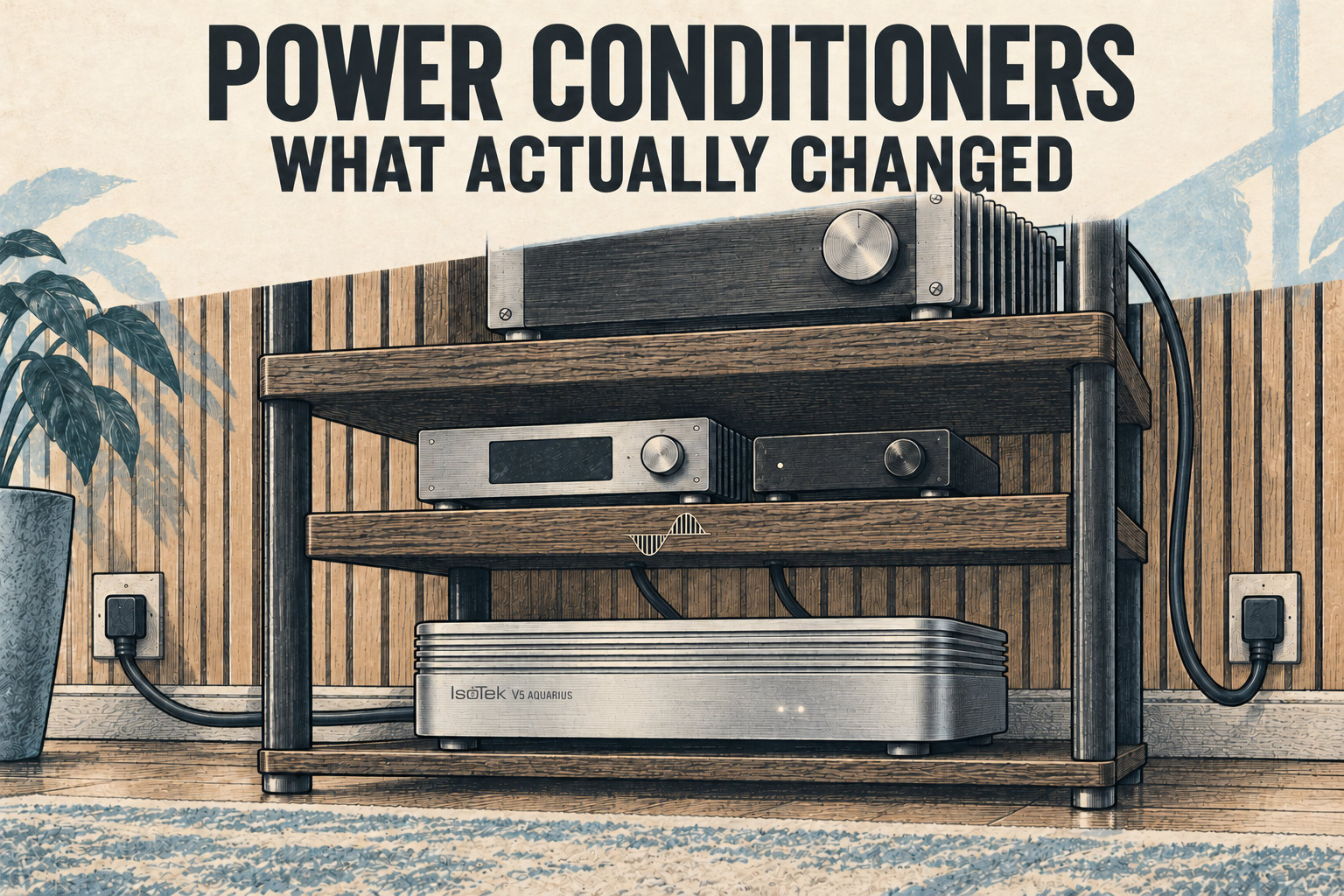
When the crews had left the new listening room and the dealer had installed the system, I did not sit down for a critical listen. I let the electronics run for 10 to 20 hours on brand-new copper. Only then did I start moving the speakers.
Does an audiophile power conditioner work? In my system, the gains were mixed and subtle. The dedicated circuits are a different conversation, and power cables sit last in my order of audible impact. Here is what I built, what I heard, what I cannot separate, and the order I would follow if I were starting again in your building instead of mine.
Dedicated circuits: the one thing I would not compromise
My previous listening room was about 800 square feet and L-shaped. One possible speaker position, dictated by the layout. The listening seat 3.5 metres from the speakers, with zero gap to the back wall. And one electrical circuit shared by everything. I used to tell people in the industry that I was cursed with the worst room possible, and that shared circuit was part of the curse.
I planned the new room in five steps, and step two, the power, was non-negotiable. New lines pulled directly from the main board with thick copper cabling. Two 40-amp circuits, each dedicated to one MC611 monoblock, each pulled independently. The low-power devices, meaning the C12000 preamplifier, the DAC and the sources, share a separate circuit filtered through the IsoTek conditioning I already had. Everything terminates on brand-new outlets and switches, with no reliance on the old wiring.
The electrical work ran in parallel with the acoustic treatment and the finishing: multiple crews, about 10 to 14 days. Then came the waiting you saw at the start: I wanted those capacitors charged and properly warmed up. Science or ritual? In my very next film I called burn-in for electronics "more debatable, but capacitors do stabilise over time", and I stand by both halves of that sentence. Debatable or not, patience is free.
Then the speakers, placed with Wilson's WASP procedure: I used my own voice to find what Wilson calls the zone of neutrality, where the speakers interact least with the room's boundaries. In the old room WASP gave me almost no room to move. In the new one I had real choices.
I did the first critical session alone, so the impressions would be mine. Pink Floyd's The Wall: for the first time in my system the helicopter came in high on the ceiling to the right, approached my seat, then moved out to the left until it vanished. On Time Out, the kick drum in the Take Five solo filled the room. On the Cowboy Junkies' The Trinity Session, recorded in the Church of the Holy Trinity in Toronto, I was finally inside the church.
Nothing in my signal chain changed. Same Wilson Audio Yvettes, same C12000, same monoblocks, same Transparent cables, same sources. Only the room and the power infrastructure changed, and the improvement was not subtle. It was transformative. It is all in the film where I first showed the new listening room.
One honest catch: two things changed at once. I cannot hand you one percentage for the copper and another for the room, and anyone who claims to split that credit by ear alone is guessing. What I can do is take the power side apart, piece by piece, and tell you which pieces I have heard on their own.
What a dedicated circuit does, and who should decide it
Paul McGowan of PS Audio, whose channel was my first influence when I started reading about acoustics, defines it in one line: "A dedicated line simply means a separate wire feeding an AC receptacle." In a May 2018 post he points out that most of the outlets in our homes share the same wire, and that his real worry is the shared ground: noise from something like a computer can travel back along it to your gear. A shared circuit, in his words, is "more like a crowded room."
So a dedicated circuit is wire, not a filter. Whatever arrives at your main board still arrives at your amplifier. What you gain is a line your amplifier shares with no other appliance in the building.
Why one line per monoblock? In the film I summed up step two in six words: clean power directly from the source. Power amplifiers are the heavy drinkers. Each MC611 is rated at 600 watts, and as one UK IsoTek retailer puts it, a power amplifier "can draw quickly changing amounts of current." Give each monoblock its own line and those swings stay away from the circuit that feeds the preamplifier and the digital front end.
Read every label as live text
- Main electrical board
- Dedicated circuit, 40 A
- Monoblock 1 (MC611)
- Dedicated circuit, 40 A
- Monoblock 2 (MC611)
- Separate circuit
- IsoTek conditioning
- Preamplifier (C12000)
- DAC
- Sources
- All lines: new wiring, new outlets. The monoblocks do not pass through the conditioner.
Forty amps is what we designed for my room and my amplifiers. It is not a recipe. Breaker rating, cable size, outlet type and earthing are not audiophile decisions; they belong to a licensed electrician working to your local code. Tell the electrician what you are feeding, how much power it draws, and that you want nothing else on those lines. McGowan's own description of the job: "Often, it's a simple task you call an electrician for and in a day or two you're all set." If the room is already open for works, as mine was, that is the moment to do it.
My audiophile power conditioner result: mixed and subtle
On air I named the two IsoTek units I have used, the Aquarius and the Corvus. Both are V5s. The Aquarius gives high-current loads two outlets of their own, apart from four for, in one retailer's words, "relatively modest loads such as CD players, streamers, DACs"; the Corvus isolates nine outlets from one another. For the Aquarius, IsoTek quotes radio-frequency interference reduction of up to 65 dB. Those are the maker's figures, not my measurements: they tell you what the box is designed to remove, not what you will hear.
In the new room the conditioning sits only on the low-power circuit: preamplifier, DAC and sources. The monoblocks never touch it.
I had the IsoTek conditioning before the new room existed, and in my own electrical environment the result has been mixed and subtle. Not nothing, and not a revelation either. Put it next to the free Vincent Audio cables my dealer threw in with my Bowers & Wilkins speakers, a difference I called shocking because I heard it immediately, or next to the new room, which I called transformative. The conditioner lives in a different vocabulary.
I also have to put my own bias on the table. Before I opened a single bottle in my snake oil film, I made a confession: I am biased. You are biased. Expectation bias was the first of the five I listed: you pay for a box that promises clean power, and your brain wants a blacker background. I have bought things that I later realised made no audible difference. I am not immune when the product is a silent box at the bottom of the rack.
Do power conditioners work? It depends on the building
Power conditioners can work, and the building they are plugged into decides how much. As I said on air, the difference depends entirely on your electrical environment, at least for me. Some of my improvements were subtle, but I have heard systems in other buildings with noisy power where a conditioner transformed the sound. Same category of product, very different verdicts. The category did not change. The building did.
Is it snake oil? No. Is it universally necessary? Also no. That's not a satisfying answer, but it is the honest one.
So where would I expect a conditioner to earn its place? In a building with noisy power, which is where I have heard one transform the sound. Where a computer shares a ground with your gear, the noise path McGowan warns about. Where you rent and cannot run a new line from the board. Those systems give a conditioner real work. Where the system already has its own lines, McGowan's crowded room has been emptied before the box arrives; what is left is whatever the building brings in.
The golden ears say that if you hear a difference, the difference is real. The measurement gurus say that if it does not measure differently, it does not sound different. Period. Both are partially right and both are partially delusional. Just because bias exists does not mean the difference does not exist, and just because you heard something does not mean the box put it there. The full argument is in my snake oil film; the short version is that the test is your system, your building, your ears, and the right to send the box back.
Audiophile power cables: last in my order of impact
I have tested many power cables and, yes, I have heard differences. Better power cables in my system gave me a lower noise floor, better dynamics and more grip on the bass. But those differences are subtle compared with speaker cables or room treatment.
My order of audible impact, from the film about my $35,000 of cables, runs speaker cables first, then analogue interconnects, then digital, then power. People will tell you to work the other way round: power cables first, then interconnects, then speaker cables. I agree with them on one condition: a fully curated high-end system that already has decent cables and some room treatment. If you are starting out, other things in your system and your room are hurting the sound more than the cord from the wall.
The budget rule does not change because the cable plugs into a wall. My cable guide by system value: 5 to 10% on a $2,000 system, no more than 10% on a $5,000 system, at most 12% on a $10,000 system. If you have a $3,000 system, spending $2,000 on cables is insane.
Panels before power: the $500 question
If you are debating between a $500 power cable and $500 worth of acoustic panels, buy the panels first.
I said that in October 2025. Four months later, in the snake oil film, room acoustics came first among the truths I said I would defend: they matter more than almost any component upgrade.
Here is the number behind it. In my old room, the McIntosh MEN220 room correction measured a 37% correction, the highest we had ever recorded in any room. After I added panels, diffusion and absorption, it dropped to the mid-teens. That is a measured change from treatment. For power, all I can offer you is my ears, and my ears said subtle.
After positioning, which costs nothing, the first $500 goes to first-reflection absorption and diffusion, step by step. And treatment is an asset that does not depreciate: it stays through every change of electronics and speakers. A power cord improves one component's connection to the wall; a panel improves every component's connection to your ears. There is a Daily on exactly this choice: $500 of power cable or $500 of panels.
A sensible order: room first, then circuits, conditioner trials and cables
The sequence, if I were starting again:
- Do the fundamentals first: room treatment, speaker positioning and good source material. Positioning is free.
- Fix the circuit. If your system shares a line with the rest of the building, as mine did in the old room, ask a licensed electrician about dedicated circuits under your local code: the power amplifiers on their own lines if the electrician agrees, the low-power components on another. My own layout has its Daily too: Two 40-amp circuits, one per monoblock.
- Then trial a conditioner in your own system, with the right to return it. Start with the low-power components. If an amplifier goes through any conditioner, use the outlets the maker designed for high-current loads.
- Power cables last, inside the cable budget, auditioned at home.
And if you do not hear it, return it. No ego, no sunk cost, just honesty.
| Your electrical situation | What I would expect | What to try first |
|---|---|---|
| One circuit shared with everything else (my old room) | Hard to isolate: my new circuits came with a new room, and together they were transformative | A licensed electrician and a dedicated circuit |
| Noisy building power | The biggest conditioner effects I have heard: the sound transformed | A conditioner trial with a return option |
| Conditioning on low-power components, in my own electrical environment | Mixed and subtle | Leave the power; spend on the room or the music |
| Starting system, untreated room | The fundamentals are still missing, and they come before any power product | $500 of first-reflection treatment first |
| Curated high-end system, decent cables, treated room | Power cables: lower noise floor, better dynamics, more bass grip, but subtle | Power cables, auditioned at home |
What to expect from power upgrades by electrical situation, and what to try first, from KD's own systems and the systems he has heard in other buildings.
Power is plumbing. Get the plumbing right, let an electrician sign it off, and then stop thinking about it. The next record deserves your attention more than the wall does.
Frequently asked questions
Do I need a power conditioner?
Not necessarily. A power conditioner for audio earns its place where the building's power is noisy, so trial one at home with a return option; with my own IsoTek units the gains were mixed and subtle.
Is an IsoTek power conditioner worth it?
With my Aquarius and Corvus, IsoTek conditioning gave mixed and subtle gains. Your electrical environment, not the spec sheet, decides what you hear, so audition one at home with a return option.
Are audiophile power cables worth it?
They can be, but they come last in my order of audible impact. Between a $500 power cable and $500 of acoustic panels, buy the panels first.
More from the Journal
Keep exploring.
Loading articles…