The Journal / Articles & reviews
The 10 Best Phono Cartridges of 2026: Cost-No-Object and Best-Value Rankings
Our turntable ranking left the cartridge out on purpose; this is the missing half, built the same way.
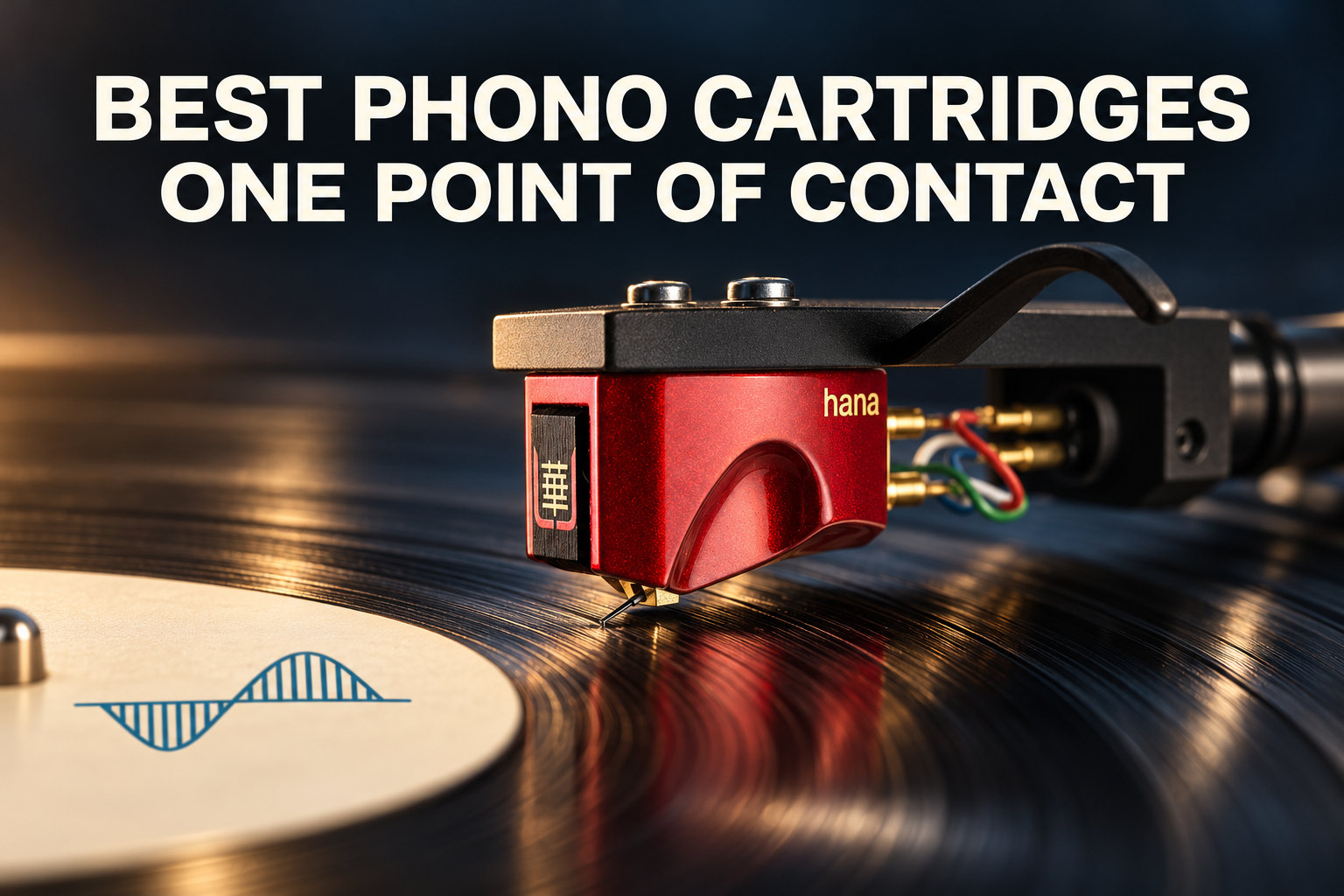
The part of the chain that actually touches the record went without a verdict. When The Sound Lab ranked the turntables of 2026 in March, the cartridge was left out on purpose, on the assumption that buyers mount whatever they want afterwards. This piece supplies the missing half: the best turntable cartridge at any price and the ten best per dollar, one model per maker on each list, scored on published reviews, measurements and owner experience, never on who sent a sample.
The short answer first. At any price, the evidence points to the Lyra Atlas λ Lambda, about $14,500, a moving coil that Stereophile lists in Class A in its April 2026 Recommended Components. Per dollar, it points to the Goldring E3, about $189, a moving magnet that Stereophile files in Class B and What Hi-Fi? keeps decorating. Between them sit eighteen more, from a Denon in production since 1962 to a cantilever grown from a cactus spine, and one finding that breaks the pattern of the turntable ranking: in cartridges, the curve of diminishing returns refuses to flatten where it should.
How we ranked: four criteria, one model per maker
The scorecard has four criteria. First, sonic and engineering merit as published: Stereophile's Recommended Components of April 2026, The Absolute Sound's Editors' Choice and Golden Ear awards, Hi-Fi News lab reports, the What Hi-Fi? Awards and measurement threads on Audio Science Review. Second, real-world recognition: awards, reviewers' own references, years in production. Third, functionality and support: arm compatibility, the gain the output demands, retip and rebuild programmes. Fourth, for the value list only, value and resale, replacement stylus included. Owner forums and YouTube reviewers supplied the long view.
Moving magnet (MM), moving iron (MI) and moving coil (MC) designs are eligible. Optical cartridges are not, because they need their own equaliser instead of a phono stage. That rules out DS Audio's Grand Master, which Jonathan Valin of The Absolute Sound said in 2023 "comes closer to the sound of R2R tape than any other phono cartridge on the market." A maker appears once per list and may appear on both, as Brinkmann did with turntables. No review samples, sponsors or affiliate links played any part, and the Sumiko Starling on KD's own turntable earned no points for living there. Prices are US list or typical street prices as of August 2026.
Cost no object: the best turntable cartridge at any price
Nine of the ten are moving coils, so this doubles as a ranking of the best moving coil cartridges money can buy, with one moving-iron outsider.
| Rank | Model | Type | Output | US price (Aug 2026) | Why it ranks |
|---|---|---|---|---|---|
| 1 | Lyra Atlas λ Lambda | MC | 0.56 mV (SL: 0.25 mV) | about $14,500 | Class A resolution, free Lambda update at rebuild |
| 2 | Clearaudio Goldfinger Statement V2.1 | MC | 0.9 mV | about $21,000 | The Absolute Sound's "most sonically complete" moving coil (as the V2, 2023) |
| 3 | Air Tight Opus-1 | MC | 0.45 mV | about $15,975 | Reference resolution, smoother treble |
| 4 | Ortofon MC Diamond | MC | 0.2 mV | about $10,000 | Diamond cantilever, 70 to 75 µm measured tracking |
| 5 | Soundsmith Hyperion MkII | MI | 0.4 mV | about $8,000 | Fremer predicted an A+ for transparency (original Hyperion); ten-year retipping |
| 6 | Audio-Technica AT-ART1000x | MC | 0.22 mV | $5,999 | Coils sit directly above the stylus |
| 7 | My Sonic Lab Ultra Eminent Ex | MC | 0.3 mV | about $7,495 | Tape-like sound from a 0.6-ohm coil |
| 8 | EMT JSD Novel Titan | MC | 1.0 mV | about $9,495 | Class A, easy on the phono stage |
| 9 | Hana Umami Red | MC | 0.4 mV | about $3,950 | Class A for under $4,000 |
| 10 | Miyajima Shilabe | MC | 0.23 mV | about $3,450 | Mono-like weight from a stereo cartridge |
Rank, type, rated output, US price (August 2026) and one-line reason for the ten best cartridges at any price, one per maker.
Output: maker's figure. Sources: Stereophile, The Absolute Sound, Hi-Fi News, US dealers.
1. Lyra Atlas λ Lambda, about $14,500
The Atlas wins on breadth of evidence. Stereophile's Michael Trei found the Lambda "still has the same tell-it-like-it-is sound as the original Atlas," now "with even further enhancements in resolution and clarity," the famous slam and bass intact. The Absolute Sound made the Atlas pair an Editors' Choice in 2023, and an Atlas returned to Lyra for rebuild gets the Lambda changes free. The real decision is which Atlas. The standard version gives 0.56 mV into 104 to 887 ohms; the SL gives 0.25 mV and wants about 64 dB of gain or a step-up. The Absolute Sound found "a bit more slam and sizzle" in the first, "more finesse and lower noise" in the SL. Let the phono stage choose.
2. Clearaudio Goldfinger Statement V2.1, about $21,000
The dearest cartridge here rests on one formidable conviction. In its 2023 Editors' Choice, The Absolute Sound called the Goldfinger Statement, then in V2 form, "the most sonically complete" moving coil Jonathan Valin had heard, "like a cross between a Koetsu and a Clearaudio," and his reference. The same page concedes the fire: beside the Air Tight, the Goldfinger is the "non-stop thrill-machine and sonic vacuum cleaner." Those verdicts predate today's V2.1. At 0.9 mV it asks little of the phono stage. Buy it for energy and colour.
3. Air Tight Opus-1, about $15,975
Where the Goldfinger thrills, the Opus-1 behaves. The Absolute Sound credits it with a "smoother, better-behaved upper midrange and treble" and "the speed and resolution of über-cartridges, without any trace of the analytic." It is a reference for Valin and Robert Harley alike. Price is the sting: Audiophilia's November 2024 review places the sibling PC-1 Supreme one step below the flagship, at $12,975. For anyone the Goldfinger's fire would tire, this is the summit.
4. Ortofon MC Diamond, about $10,000
A diamond cantilever under a Replicant 100 tip, and lab numbers to match. Hi-Fi News measured 70 to 75 µm tracking and a 20 kHz distortion peak cut from 11% to 7% against the MC Anna Diamond; Adam Smith heard everything done "to a level of accomplishment that is quite astonishing." The 17.5 g body sits "at the very upper end of what most tonearms will accommodate," and Stereophile's Class A list names the cheaper Ortofon Verismo ($7,349.99) instead. Measured output: 168 µV. Bring the gain.
5. Soundsmith Hyperion MkII, about $8,000
The outsider: a moving iron with a cactus-spine cantilever. "We grow these," designer Peter Ledermann told Stereophile. On the original Hyperion, Michael Fremer wrote that it "got out of the way and delivered the contents of LP grooves to degrees achieved by few other cartridges," and predicted readers would give it "an A+ in every category, but especially for Transparency." He also noted "a gracefully rising top end," and more "rock-solid 'grip'" from his reference moving coils. Soundsmith quotes ten years of free retipping for stylus wear to the original owner. KD suspects that "Soundsmith has a statement to make with their Hyperion line." Fremer's review suggests it already made one.
6. Audio-Technica AT-ART1000x, $5,999
Audio-Technica moves the coils to the front of the cantilever, directly over the stylus, and the x version's rectangular coils lift output 10%, to just 0.22 mV. Michael Trei called it "an astonishing cartridge, a tour de force, but it comes with a caveat": cleaning means removing debris "without touching or nudging the tiny coils out of position." KD once bent a cantilever with a cleaning cloth, and on a moving coil a break has no simple fix. Read Trei's caveat twice, then budget for a very quiet phono stage.
7. My Sonic Lab Ultra Eminent Ex, about $7,495
Yoshio Matsudaira's titanium-bodied moving coil draws 0.3 mV from a 0.6-ohm coil, thanks to a magnetic material that needs fewer turns of wire. Herb Reichert heard "how much the Ultra Eminent Ex's presentation sounded like analog tape" and called it "less mechanical than any other MC I've experienced." The evidence is thin and old: a single Stereophile review, from December 2018, carries the case. If tape, not hi-fi, is the sound you chase, no other verdict on this list says so as plainly.
8. EMT JSD Novel Titan, about $9,495
Silver coils, a diamond-plated titanium body and 1 mV of output: five times the MC Diamond's rated figure, 14 dB less work for the phono stage and the highest output of these ten. Fremer's findings, as Stereophile records them, begin in the bass with "generous low-frequency transient textures" and end in "commendable transparency." Low compliance shuts out light arms, and the Class A rests on that one reviewer. A heavier arm and a modest phono stage suit it best.
9. Hana Umami Red, about $3,950
The bargain of the summit. Stereophile lists it in Class A, Reichert praising its "natural-feeling contrast levels, grain-free clarity, and lifelike solidity," and YouTube's The Audio Analyst calls it "arguably the 'Best Buy' in analog phono cartridges today." Hi-Fi News measured 0.46 mV and a 0.14 dB channel balance; 9 cu compliance and a 10.5 g body suit 10 to 16 g arms. The same lab found the blemish: on lateral cuts, the right channel's treble climbs to +4 dB at 18 kHz. Class A, under $4,000, one measured flaw.
10. Miyajima Shilabe, about $3,450
An old-school design two Stereophile writers have championed. Fremer heard "full-bodied, deep, and extremely well-defined"; Art Dudley called it "the closest I've heard a stereo cartridge come to delivering the meat, the force, the sheer solidity of mono." The rest is old school too: 0.23 mV of output, low compliance and a recommended 2.5 to 3.2 g on the stylus-force gauge. Feed it a heavy arm, serious gain and the mono shelf.
Best value: the ten best phono cartridges per dollar
Here performance per dollar sets the order. Seven of the ten cost under $550, and five are moving magnets that play into any MM input. That is where to start: KD's view is that cartridge changes up to $400 "will be fairly impactful, even in a less revealing system."
| Rank | Model | Type | US price (Aug 2026) | Suggested arm | Phono stage |
|---|---|---|---|---|---|
| 1 | Goldring E3 | MM | about $189 | Medium mass | Any MM input |
| 2 | Audio-Technica AT-VM95SH | MM | $219 | Light to medium mass | MM input, 47 kΩ, 100 to 200 pF |
| 3 | Hana SL Mk II | MC | about $850 | Medium mass | MC stage or step-up, 80 to 100 ohm load |
| 4 | Nagaoka MP-200 | MM | about $509 | Medium mass | Any MM input |
| 5 | Sumiko Rainier | MM | about $199 | Light to medium mass | Any MM input |
| 6 | Grado Platinum3 | MI | about $400 | Medium to heavy mass | High: MM input; Low: extra gain |
| 7 | Dynavector DV-20X2A | MC | about $1,450 | Medium mass | L: MC stage; H: MM input |
| 8 | Ortofon 2M Blue | MM | about $220 | Light to medium mass | Any MM input |
| 9 | Denon DL-103 | MC | about $399 | Heavy mass | MC stage or step-up, 100 ohms or more |
| 10 | Lyra Delos | MC | about $2,495 | Medium mass | Quiet MC stage |
Rank, type, US price (August 2026), suggested arm mass and phono stage for the ten best cartridges per dollar, one per maker.
Arm guidance follows published compliance. Sources: Stereophile, What Hi-Fi?, The Absolute Sound, maker specifications, US dealers.
1. Goldring E3, about $189
Stereophile files this sub-$200 moving magnet in Class B, beside $4,000-plus moving coils, after Reichert wrote that "it brought out every note with a precision I never imagined a moving magnet could muster." What Hi-Fi? made it the best cartridge under £100 in its 2025 Awards, "a repeat What Hi-Fi? Award-winner." Nothing about it is exotic, an elliptical tip on an aluminium cantilever, and that is the point. It is the first upgrade from any factory-fitted cartridge.
2. Audio-Technica AT-VM95SH, $219
A Shibata tip for $219, on a body that takes all six VM95 styli. Stereophile's Reichert found it had "more push and bounce" than Ortofon's $749.99 2M Black. The twist: the cheaper elliptical made the Shibata "sound overly smooth and polite" to him, and he judged the cheapest, conical model the most satisfying of the family. KD owned one and called it a revelation, with most of the Amethyst's qualities at a quarter of the cost. One body, and a cheap ladder of styli to climb.
3. Hana SL Mk II, about $850
Stereophile lists this moving coil in Class B, Reichert finding the Mk II "noticeably speedier, clearer, harder hitting" than the original SL, and The Absolute Sound gave it a 2025 Golden Ear award. It pairs a nude Shibata with 0.4 mV, loaded at 80 to 100 ohms: a job for a proper moving-coil stage or a step-up. For a first moving coil, KD names Hana or a low-output Sumiko Songbird, in the $500 to $900 band, and only once the phono stage is ready for it.
4. Nagaoka MP-200, about $509
A boron cantilever, a nude elliptical and a habit of winning: What Hi-Fi? named it the best cartridge between £250 and £500 in 2025, when "super all-round performance" earned it "another win." Positive Feedback heard a generous, big-hearted sound that stays quick and articulate. Running costs bite: its reviewer put a replacement stylus at about $200 to $300. Buy it as the last moving magnet you need.
5. Sumiko Rainier, about $199
Sumiko, which KD describes as a McIntosh sister company, makes the other repeat award-winner under $200: What Hi-Fi? honoured the Rainier again in 2025 as "well-rounded and entertaining." Its body takes the dearer Olympia and Moonstone styli, slide out, slide in, and owners say the Moonstone is the bigger step up. A replacement Rainier stylus, though, costs about $149, three quarters of a new cartridge.
6. Grado Platinum3, about $400
Reichert called this wood-bodied moving iron "a poor man's Koetsu" for its "lush, spacious, color-saturated sound," then went further: it "could save you from spending $4000 on a fancy-pants MC. It's that good." Beside Grado's dearer Aeon3 it sounded "slightly tipped up at the frequency extremes," and low compliance asks for a medium-to-heavy arm. The 4 mV High version plays into any MM input. Buy either for tone above all.
7. Dynavector DV-20X2A, about $1,450
Reichert made the DV-20X2 his "new budget reference phono cartridge," and seven years later still heard it play "clear, fast, and insightfully." That record belongs to the predecessor: the A version has since replaced it, and Stereophile still lists the old 20X2-L at $1,250. In either generation the L (0.3 mV) needs an MC stage, while dealers pitch the H (2.8 mV) at MM-only electronics: the one moving coil on this list that needs no new phono stage.
8. Ortofon 2M Blue, about $220
KD's own suggestion for a newcomer, alongside the VM95SH. Robert J. Reina wrote in Stereophile that it "competes with cartridges at double its price"; Reichert later heard it as more passive than propulsive, its best trait how it "emphasized fine textures and the atmospheric aspects of recordings." Refinement over drive, at a starter price.
9. Denon DL-103, about $399
In production since 1962 and still, in Art Dudley's words, "a superb cartridge and a remarkable buy." A spherical tip and a treble peak push bright recordings "a bit more forward than ideal." Its 0.3 mV from a 40-ohm coil needs an MC stage or step-up, and Steve Hoffman Forums owners still argue 1:10 against 1:20. A compliance of 5 (×10⁻⁶ cm/dyne at 100 Hz) is why they insist on a high-mass arm.
10. Lyra Delos, about $2,495
The ceiling of value: boron cantilever, line-contact stylus, medium compliance. Reichert found it "sounded like a fine-tuned supercartridge under a wide range of loading conditions" and tipped it as "a first-round inductee to the Hi-Fi Hall of Fame." At $2,495 it sits close to the $3,000 jump KD warns beginners against. Graduate to it once a Hana or a Dynavector has taught you what you want.
Diminishing returns: why cartridges defy the usual curve above $1,000
The turntable ranking ended on a familiar shape: KD called the jump from $3,000 to $12,000 enormous, $12,000 to $50,000 meaningful, and everything above $50,000 "incremental at best." Cartridges, in his account, refuse to bend that way.
"I think cartridges [are] the space where the law of diminishing returns does not work, especially over $1,000." KD, 18 November 2025
His evidence is his own ladder, told in KD's film on destroying a $500 cartridge. The Sumiko Songbird replaced his Amethyst "and everything opened up"; the Starling, he says, is two to two and a half times better than the Songbird, which is twice the Amethyst, and "the very best thing I ever heard in my listening room."
The measurements suggest why. A cartridge is a mechanical generator whose errors are still counted in whole percentages. Hi-Fi News measured the MC Diamond's distortion at 0.7 to 8.2% across the band and the Umami Red's at up to 12%; an Audio Science Review thread shows a Shure M97xE at 1.5% THD at 1 kHz. When a new suspension moves a flagship's 20 kHz distortion peak from 11% to 7%, money is still buying measurable ground.
The counter-evidence is just as real. KD's own rule is that an excellent moving magnet beats a poor moving coil, and resale is the other brake: one US dealer's certified pre-owned listings show a Goldfinger Statement V2 at $7,199 against $20,999 new and a Hyperion at $2,999 against an estimated $7,995. The curve keeps climbing for sound, not for money back. And KD's limit holds: beyond $3,000, only with "a great turntable, great phono stages, great speakers."
Matching: arm mass, compliance, loading and the phono stage
Cartridge and arm form a spring-and-mass system. Its resonance is estimated as 159 divided by the square root of mass times compliance, with mass in grams (arm, cartridge and screws) and compliance in µm/mN. Hobbyist references put the safe window at 8 to 12 Hz. Audio-Technica and Denon quote compliance at 100 Hz; a common rule of thumb roughly doubles that figure for the calculation.
Read every label as live text
- resonance ≈ 159 ÷ √(mass × compliance)
- 8–12 Hz window
- 5
- 6
- 7
- 8
- 9
- 10
- 11
- 12
- 13
- 14
- 15
- Hz
- Ortofon MC Diamond · 17.5 g · 13 cu · 12 g arm · about 8 Hz
- Audio-Technica AT-VM95SH · 6.1 g · about 20 cu · 10 g arm · about 8.6 Hz
- Hana Umami Red · 10.5 g · 9 cu · 12 g arm · about 11 Hz
- mass = arm + cartridge + 1 g screws; compliance in µm/mN (cu)
Counting 1 g of screws each time, the Hana Umami Red (9 cu, 10.5 g) in a 12 g arm lands at about 11 Hz. The AT-VM95SH (10 at 100 Hz, so about 20, and 6.1 g) in a 10 g arm lands at about 8.6 Hz. The Ortofon MC Diamond (13 cu, 17.5 g) in a 12 g arm falls to about 8 Hz, the bottom edge, which is why Hi-Fi News prefers lower-mass arms for it.
Then loading and gain. Moving magnets want 47 kΩ and the maker's capacitance (100 to 200 pF for the VM95SH). For moving coils, Hi-Fi News applies a "rule of ten": load at least ten times the coil's impedance. A 1:10 step-up transformer adds 20 dB and presents a 47 kΩ input to the cartridge as 470 ohms. The MC Diamond's rated 0.2 mV sits about 25 dB below the VM95SH's 3.5 mV, so the lowest-output picks here (Atlas SL, ART1000x, Shilabe, MC Diamond) belong on stages of 60 dB or more. KD's warning: the phono stage is the key to all of it, and "unless you are certain about your phono stage, do not do it."
Upgrade paths: stylus swaps first, moving coil second
The cheapest upgrade in vinyl is often a stylus. Moving magnets carry user-replaceable styli, which KD's film prices at 30 to 70% of the cartridge. Ortofon says a stylus can last up to 1,000 hours with proper care, nearly three years at an hour a day.
Moving coils change the economics. Their light coils move less mass and, in KD's film, retrieve noticeably more detail, at the price of output. Break one and, in his words, "there is no solution": the cartridge goes back for a retip or exchange, which is why Soundsmith's retipping and Lyra's rebuilds count in this ranking. KD's path: start with a good moving magnet at $200 to $300, live with it, and step to a moving coil only when you spend real money on pressings, listen critically and trust your phono stage. Start in the $500 to $900 band and "do not jump straight to a $3,000 cartridge": you will not appreciate the difference yet, and if you break it, you will hate yourself.
KD paid for that lesson with a $500 cartridge and a cleaning cloth. His advice fits every budget on both lists: "Respect your gear. Cleaning is good. Being careful is better."
Frequently asked questions
What is the best moving magnet cartridge for the money?
On this scorecard, the Goldring E3 at about $189. For a Shibata tip and stylus-only upgrades, the Audio-Technica AT-VM95SH at $219.
Is a moving coil cartridge always better than a moving magnet?
No. Moving coils move less mass and retrieve more detail, but give far less output and need a capable phono stage. An excellent moving magnet can beat a poor moving coil.
How long does a stylus last?
Ortofon says up to 1,000 hours with proper care. A moving-magnet stylus is a user swap; a broken or worn moving coil goes back for a retip or exchange.
Step-up transformer or active phono stage for a moving coil?
Either works if gain and load fit: a 1:10 transformer adds 20 dB and presents a 47 kΩ input as 470 ohms, while an active stage supplies the gain itself.
More from the Journal
Keep exploring.
Loading articles…