
The Journal / Articles & reviews
Hegel H190v Review: The Streaming Integrated Readers Keep Asking About, and How It Compares
Norwegian grip, a quiet background and a streaming menu that has aged: what the reviews and the lab say, how it compares, and the speakers it suits.
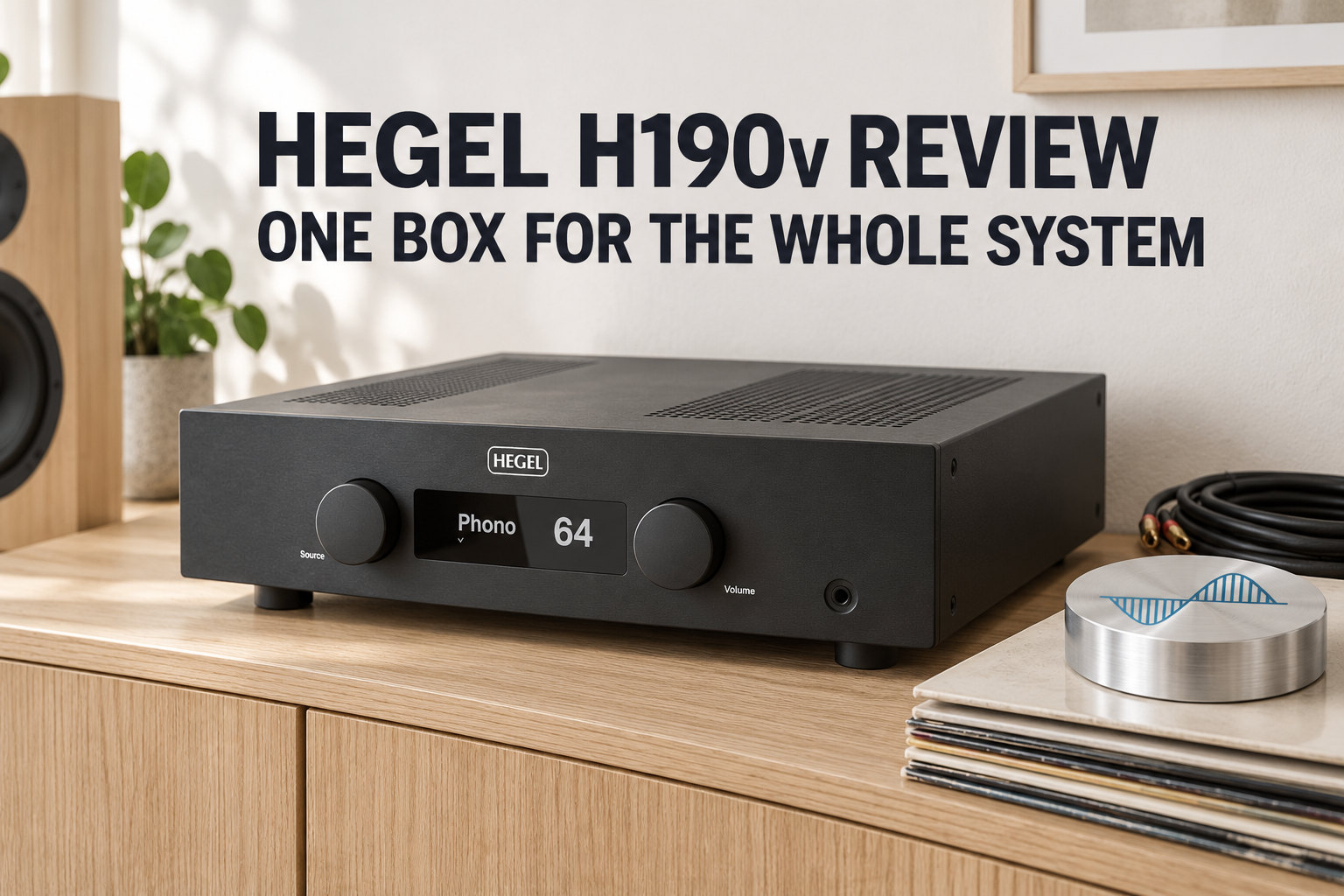
The Hegel H190v is a better amplifier than it is a streamer. Nearly two and a half years of reviews praise the amplifier in almost the same words: bass grip, silence, honesty. A lab measured 149 watts a channel into 8 ohms against a 150-watt rating. The streaming sound is well reviewed; what has aged is the menu of services, and the complaints gather around that menu, the phono stage and bright speakers. Since 6 August 2026, when Hegel announced the H200 at $4,995, the question is no longer whether the H190v is good, but whether it is still the one to buy.
This meta-review reads The Absolute Sound, SoundStage! Hi-Fi and The Ear, the bench data and owner threads, then sets the H190v against McIntosh and Marantz streaming integrateds either side of its $4,600 US list price (as reported in April 2025). The short answer: buy it for the amplifier, weigh the price against the H200, and choose the speakers with care.
Where the Hegel H190v sits, and why readers ask
Hegel owners turn up regularly in the comments under The Sound Lab's videos with pairing questions, the channel's most common kind: with my system, A or B? The H190v invites it by replacing a rack with one box: amplifier, DAC, network streamer, headphone amplifier and phono stage.
Until August 2026, Hegel's integrated range ran from the entry-level H95 through the 75-watt H150 to the 150-watt H190v, then the H400 and, at the top, the H600. The H190v was the first Hegel integrated with a built-in phono stage, and Hegel says it "takes our best-selling product of all time to new heights", meaning the H190 it replaced.
Then came the news. On 6 August 2026 Hegel announced the H200, plus an analogue-only A200 at $3,995 for October. The H200 keeps the H190v's 150 watts, Class A/B output stage and chassis size, carries a V10-derived phono stage, and adds TIDAL Connect, Qobuz Connect, Google Cast, lossless Spotify Connect and internet radio. It costs $395 more than the H190v's list and ships from late August. By 23 August it had won EISA's amplifier award for 2026–2027, with a citation that places it in "the sweet spot in Hegel's integrated amplifier range". That is the H190v's address.
Hegel H190 vs H190v: what the "v" changed
The "v" is an evolution, not a new amplifier. The Ear's Trevor Butler, who owns an H190, and SoundStage!'s Matt Bonaccio describe the same changes: a moving-magnet phono stage scaled down from Hegel's V10 phono preamplifier, with gain and loading set by DIP switches, and a revised preamplifier and DAC power supply, meant to quieten the phono stage but reported by both to help every input. Otherwise, Butler writes, it has "the same features, digital, preamp and output stage circuitry" as his original.
Butler hears a tighter, better-defined bass and a midrange "more open and transparent than the original amplifier", with an honest qualifier: the difference "is not chalk and cheese, but it's audible." Bonaccio's advice to existing owners: the step is hard to justify "if you already have an H190 and a standalone phono preamp that you're happy with."
| Hegel H190 | Hegel H190v (2024) | Hegel H200 (2026) | |
|---|---|---|---|
| Rated power, 8 ohms | 150 W | 150 W | 150 W |
| Phono input | None | MM, scaled-down V10 circuit | MM, V10-derived |
| Preamp and DAC power supply | Original | Revised for lower noise | Not stated |
| Streaming | Same features as the H190v | AirPlay, Roon Ready, Spotify Connect (not lossless), UPnP | Adds TIDAL, Qobuz and lossless Spotify Connect, Google Cast, internet radio |
| Status, August 2026 | Discontinued | $4,600 US list (reported April 2025) | $4,995, shipping late August |
Three generations of the same 150-watt platform: the H190v added the phono stage and a quieter supply; the H200 adds the streaming services.
Sources: Hegel; The Ear; SoundStage! Hi-Fi; StereoNET.
What reviewers praise: grip, clarity and a quiet background
Tom Martin, writing in The Absolute Sound in March 2024, when the US price was $4,200, was the most emphatic. "The immediate standout quality of the H190v is its bass definition and drive," he wrote, and within its power limits he called it "very close to state of the art in this department." His verdict: "the benchmark electronics package beyond which you have to spend substantially."
Bonaccio, a year later, found it "sure-footed in its control over the loudspeakers", heard streams rendered "with near-total transparency", and judged it "worth the $4600 asking price." Butler's streaming note was blunter: Hegel's execution of AirPlay 2, he wrote, "is far superior".
The caveats are just as specific. Martin found it "not treble shy, and yet it is smooth." Bonaccio heard vocals "a bit recessed", and through the RCA inputs the sound was "a bit too delicate and recessed" until he moved to XLR. That lesson costs nothing: if your source has balanced outputs, use the XLR input.
Owner threads are thinner. On a December 2023 What Hi-Fi? thread about used H190s, a former owner "had no issues" and another contributor had "had one back in seven years, and that was for a fault caused during shipping." The sound drew one dissent: a poster found the H190 "somewhat flat and lackluster" next to Hegel's H360, and a member who had heard both disagreed. The pattern matches the reviews: the amplifier adds little of its own, and whether that reads as transparency or blandness depends on the system.
What the measurements show: power, noise and damping
SoundStage!'s lab published a full bench test of the H190v on 1 April 2025, run by Diego Estan on an Audio Precision APx555.
| Parameter | Hegel's specification | SoundStage! lab, April 2025 |
|---|---|---|
| Power, 8 ohms, 1% distortion | 150 W per channel | 149 W per channel, both driven |
| Power, 4 ohms | Not stated | 240 W per channel, both driven |
| Signal-to-noise ratio | More than 100 dB | 109–111 dB, A-weighted |
| Distortion (THD, 1 kHz, 8 ohms) | Below 0.01% at 50 W | Below 0.0125% at 10 W |
| Damping factor | More than 4,000 (main output stage) | 475 left, 376 right |
| Phono signal-to-noise ratio | Not stated | 66–67 dB, A-weighted, 5 mV in |
The H190v met its 150-watt rating within 1 watt and beat its own noise claim by 9 to 11 dB; the damping factor is the one large gap.
Sources: Hegel H190v specifications; SoundStage! lab measurements, 1 April 2025. Hegel and the lab quote distortion at different powers.
The line stage measures like a quiet, honest amplifier. It passed the lab's five-minute dynamic power test, 500 ms bursts of an 80 Hz tone at 250 W into 4 ohms alternating with 16 W for 5 seconds, without tripping its protection, though the top grew very warm. Response at the speaker outputs is within 0.2 dB from 20 Hz to 20 kHz (10 W, 8 ohms). The damping gap looks dramatic, but Hegel applies its figure to the "main output stage", and the lab still called its own number "a strong result for a medium-powered solid-state integrated amplifier."
The phono stage measures like a convenience feature. RIAA accuracy is within 0.5 dB from 35 Hz to 20 kHz, but the lab flagged "significant power-supply-related noise peaks" at 120 Hz and 240 Hz, about 45 and 50 dB below the reference level.
Limits: bright speakers, the phono stage, the interface
Bright speakers come first. Martin frames the risk: "if your speakers or listening room or DAC have some treble impurities, the Hegel won't hide them and may sound a bit dry." The risky pairing is a forward-sounding speaker in a room of glass and hard floors; the amplifier will report it faithfully.
The phono stage is moving-magnet only. Butler notes that high-output moving coils work directly and low-output ones need a step-up transformer. Bonaccio rated its scale above a Creek OBH-8SE, which "lacked the scale and imaging prowess" of the Hegel, but heard a "noticeably dark tonality". It suits a good moving-magnet cartridge. For a serious record collection, that dark tonality and the supply noise on the lab's bench argue for an outboard stage.
The interface has aged most. The H190v connects by Ethernet only, without Wi-Fi or Bluetooth. Hegel marks its Spotify Connect "Not Lossless", and there is no TIDAL Connect, Qobuz Connect or Google Cast, all listed for the H200, and no HDMI input. In 2024 Butler was badgering Hegel for internet radio; the H200 has it.
None of this touches the sound. For Roon users it barely matters; TIDAL and Qobuz users can add an outboard streamer on a digital input. After more than three months with the WiiM Ultra ($329 at the time of the October 2025 film) beside an Eversolo at four times the price, KD concluded in the WiiM Ultra versus Eversolo A6 film that "for 90% of the audiophiles, this little box represents a revelation".
Hegel vs McIntosh vs Marantz: three philosophies
There is no exact like-for-like at $4,600: Marantz's Model 40n costs about $1,900 less and McIntosh's MSA5500 about $3,400 more.
Hegel sells control and transparency in a plain black or white box: a Class A/B output stage with SoundEngine 2, Hegel's feed-forward error correction, a high damping factor and network audio by cable.
McIntosh sells heritage, its own sound and every connection. The streaming MSA5500 brings 100 W into 8 ohms and every service in the table below, HDMI ARC included. The only head-to-head in these reviews is Bonaccio's, with a different McIntosh: the MA6850 was "sounding darker overall and not as open as the Hegel." KD, who lived with McIntosh's 300-watt MA9500 for years, called it on air "one of the best integrated amplifiers ever made. Period." His case for it, in the $40,000 McIntosh upgrade film, is the McIntosh bet in short: bold, authoritative sound that stays musical for hours without fatigue.
Marantz sells convenience. The Model 40n, launched at $2,499, is a 70-watt Class A/B design with Wi-Fi streaming, Bluetooth, a phono stage and HDMI ARC. What Hi-Fi? found it "marvellous in many ways, but musically we want more".
| Model | US price | Power, 8 / 4 ohms | Built-in streaming | Phono | HDMI ARC |
|---|---|---|---|---|---|
| Hegel H190v | $4,600 list (reported April 2025) | 150 W / 240 W (lab) | AirPlay, Roon Ready, Spotify Connect, UPnP; Ethernet only | MM, adjustable | No |
| Hegel H200 | $4,995 (announced August 2026) | 150 W / not stated | Adds TIDAL, Qobuz and lossless Spotify Connect, Google Cast, internet radio | MM | Not listed |
| McIntosh MSA5500 | About $8,000 | 100 W / 160 W | AirPlay, Google Cast, Qobuz, Spotify and TIDAL Connect, Roon Ready, Bluetooth | MM, fixed loading | Yes |
| Marantz Model 40n | About $2,700 | 70 W / 100 W | HEOS over Wi-Fi, AirPlay 2, Bluetooth | MM | Yes |
From about $2,700 to about $8,000: the Hegels give the most power per dollar, the McIntosh and Marantz the only HDMI ARC inputs.
Sources: Hegel, McIntosh and Marantz specifications; SoundStage! lab; StereoNET; US dealer listings. Prices as of August 2026; H190v list as reported in April 2025.
Read it as three bets: Hegel on grip, with streaming as a utility; McIntosh on its own sound and every service; Marantz on one box for music and television, with less than half the power (about 3.3 dB less headroom).
Which speakers suit the H190v?
Speakers of about 87 to 88 dB with a smooth treble, in a medium-sized room, suit the H190v best. That is Martin's guideline, for rooms of 1,500 to 2,200 cubic feet (15 by 14 feet with an 8-foot ceiling is 1,680), plus his treble warning. Hegel lists a 2-ohm minimum load.
Every 3 dB of sensitivity halves or doubles the power needed, so an 84 dB speaker asks twice as much as an 87 dB one. The Sound Lab worked through the extreme case in 19 dB, or a hundred times the power: the 105 dB Klipsch La Scala needs about an eightieth of the power of the 86 dB Wilson Yvette, which the title rounds to a hundredth. On KD's Yvettes, a 4-ohm load dipping to 3 ohms, he sensed even his 300-watt MA9500 working at its limits around 95 dB: not struggling, but pushed. With 240 W measured into 4 ohms, the H190v suits a speaker that hungry only in a medium room.
Reviewers drove Focal's Theva N°2 (Bonaccio), Morel's Avyra 633 and Revival's Atalante 3 (Butler). Avoid low-sensitivity, low-impedance towers in a large room, and forward-sounding speakers in a hard one.
Verdict: a superb amplifier with a dated streaming menu
Four figures carry the verdict: 149 watts measured against 150 claimed, 109 to 111 dB of signal-to-noise, $4,600 list, and $395 more for the H200. The first two are the reason to buy it; the last two are the reason to think twice. What remains open is taste: whether its neutrality reads as clarity or dryness depends on the speakers and the room.
Buy the H190v if you stream through Roon or AirPlay, run speakers of 87 dB or more in a medium room, and want one quiet box. Look elsewhere if you want TIDAL or Qobuz Connect built in (the H200 has both), run a low-output moving coil, need HDMI, or own bright speakers in a hard room.
And if the itch is a stack of separates, read The Sound Lab's note on when not to buy separates first. KD's rule, given after his own step up to separates, is to stay integrated if your speakers cost under $20,000 or you are happy. One well-matched box beats three badly matched ones; matched with care, the H190v is that box.
Frequently asked questions
Is the Hegel H190v still worth buying in August 2026?
Yes, as an amplifier: the reviews and the lab agree on its control and low noise. At full list, though, the H200 adds far more streaming for $395.
What is the difference between the Hegel H190 and H190v?
A moving-magnet phono stage and a quieter preamp and DAC supply. The Ear hears a tighter bass and a more open midrange: a real but modest gain.
Can the H190v phono stage run a moving-coil cartridge?
Only a high-output one. A low-output moving coil needs a step-up transformer or an outboard phono preamplifier.
More from the Journal
Keep exploring.
Loading articles…