
The Journal / Articles & reviews
Where Diminishing Returns Hit in Hi-Fi, Component by Component, and What to Upgrade First
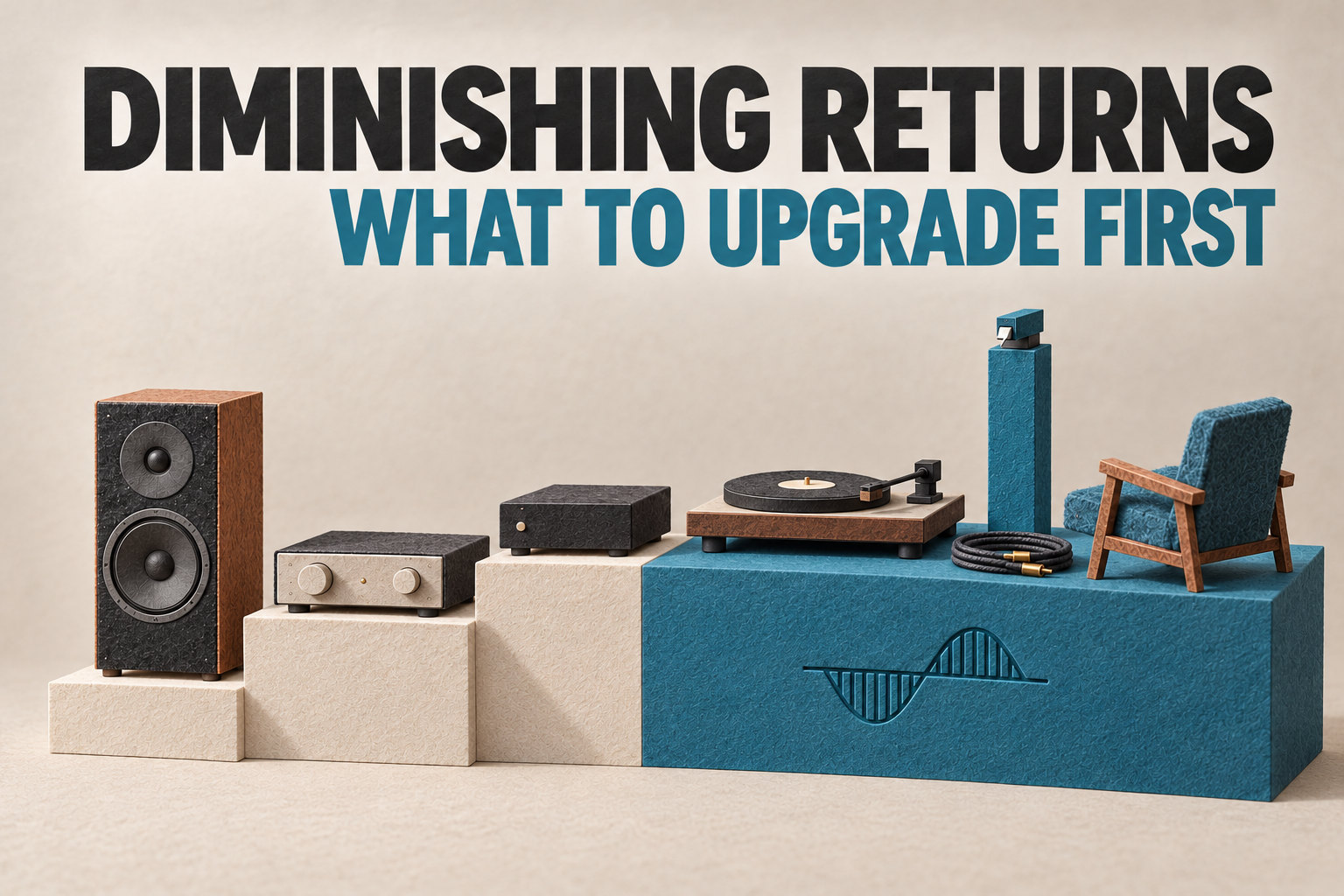
Diminishing returns are real and uneven; the trick is knowing where yours are, and whether you have the foundation for the next step.
Near the end of my March 2026 turntable ranking, after two lists that ran from a $3,300 Technics to a $450,000 TechDAS, I stepped back from the turntables to the chain behind them. A balanced system, I said, will always outperform one where a single component wildly outclasses everything around it. Always. Then the confession: I learned it the hard way, and it cost me a lot of money and a lot of years.
Diminishing returns shape almost every stereo system upgrade, but unevenly: in my experience the curve is brutal in DACs, gentle in cables and absent in cartridges above $1,000. Here, from my films, is where each component flattens and the order I would spend in today, starting with one question: do I have the foundation?
A lot of money and a lot of years: the hero-component mistake
The audio upgrade that taught me this the hard way had a beautiful face. The Bowers & Wilkins 800 Series Diamonds arrived in enormous boxes that shouted premium, and unboxed they stood like sculptures. I connected them to the flagship Yamaha receiver that had driven my Klipsch Reference Premiere for years and sat down to listen critically. More detail than the Klipsch, higher definition, and hollow. Empty, on every song. I swapped the Klipsch back in to check, then rang my dealer shouting that the speakers were defective.
He reminded me that he had warned me: my electronics were not a match. Even Bowers & Wilkins' distributor asked whether anyone had told me about the limits of my amplification. I had royally messed up, and within minutes I had wired the money for a McIntosh MA9500, ordered for same-day delivery. Thirty thousand dollars of speakers on the wrong amplifier: one box so far ahead of the chain that the chain becomes the sound.
The same rule decides whether an expensive part pays off. My Transparent Super speaker cables, over $3,000 a pair, beat my Rocket 88s audibly, even to untrained ears, on my MC611s and Yvettes; on my old receiver and Klipsch they would have been wasted, and I know because I tried. A hero component is a bill you pay twice, once for the box and again for everything it takes to let the box be heard. One hero component cost me years: those speakers demanded upgrade after upgrade in the electronics.
The shape of the curve: where returns flatten, and where they do not
The normal shape is the one I gave for DACs in my February 2026 snake-oil film. Cheap to good is massive. Good to great, noticeable. Great to cost no object brings subtle refinements that only matter if your system can resolve them. The price multiplies while the improvement shrinks, until you reach the question from my DAC film: is this a hobby or an obsession?
Twice, though, I predicted the flat part and was wrong. Moving from the MA9500 to the C12000 preamplifier and MC611 monoblocks cost me an extra $40,000. I had justified it as 5 to 10%, if I was lucky; from the first session the gain was not subtle and not marginal. From the $13,000 Klipsch La Scala to the $25,000-plus Wilson Yvette, the law did not bend. It vanished. And in cartridges above $1,000 I have never found the flat part at all.
The law of diminishing returns, it evaporates.
Every exception has a condition. The separates earned their keep because the Yvettes demanded them. The Yvette earned its keep because I had the foundation. The curve does not belong to the box. It belongs to the box inside a chain, and diminishing returns stop working only when the rest of the system can show you what a component does.
Component by component: where each stereo upgrade flattens
Nine components, nine curves, and no two bend in the same place.
The room: the steepest curve, until you over-treat
The cheapest component has the steepest curve. Speaker positioning costs nothing, and I have put a price on it: a properly positioned speaker is the difference between a $5,000 pair and a $15,000 pair. Then come $500 steps of treatment. The curve turns against you only when you over-treat, and I did, more than most, until the room was dead and lifeless. My method is panel by panel: install, measure, reapply. In the new listening room nothing in my chain changed: same Yvettes, same C12000 and monoblocks, same Transparent cables, same sources. Only the room and the power infrastructure changed, and the improvement was not subtle. It was transformative. Before you spend $5,000, $10,000 or $20,000 on a component, fix the room's obvious problems; the return is not even comparable.
Speakers: a different category, with conditions
The Yvette, discontinued in 2024, cost twice the La Scala, and what I heard was not 20% or 30% better. It was a different category: 20 Hz extension you feel in your chest, a three-dimensional stage, reverb tails that had been on the recordings all along, and the bass that made my Bowers & Wilkins clip, now without compression or distortion. I called a $25,000 speaker a bargain, on one condition: the foundation. At 86 dB sensitivity against the La Scala's 105 dB, the Yvette needs real power into a load that drops to 3 ohms, a treated room and a source up to the task. Without them it reveals everything, the good and the bad.
Amplification: flat, until the speakers ask for more
The MA9500 was, and still is, one of the best integrated amplifiers ever made. Period. The separates beat it by far more than I expected: a truly three-dimensional stage, surgical imaging, crescendos without compression, a silence so deep the system disappeared. But I drew a line: if your speakers cost under $20,000, the integrated is more than enough.
DACs and streamers: the most aggressive curve
The first of five lessons in my DAC film was that diminishing returns are more aggressive in DACs than in other components; three months later I put the bend at about $5,000. Each step on my ladder cost about five times the last: the Eversolo A6 Master Edition, around $1,000 when I bought it, then the $5,000 HiFi Rose RS150, then the McIntosh MCD12000 with a Rose transport at about 25 times the Eversolo. About $25,000 is where diminishing returns hit for my digital chain. Past it, the dCS Lina and Varese and the roughly $100,000 MSB Select were wonderful, special, sometimes even magical: the closest thing to analogue master tape I have heard, and not a hundred times better than the Eversolo. Whether that is worth the money, only you can answer. In October 2025, my $329 WiiM Ultra streamer against an Eversolo $1,070 dearer came down to the last 3 to 5%.
Turntables: enormous, meaningful, incremental
From $3,000 to $12,000 the jump is enormous and you hear it immediately. From $12,000 to $50,000 it is meaningful, if your system can reveal it. Above $50,000, all the way to the $450,000 TechDAS, it is incremental at best: a Porsche 911 Turbo against a Bugatti, when the 911 already does 90% of what you need. The sweet spot sits between $3,000 and $20,000, and the two turntables that headed my value list sit inside it: the Technics SL-1300G and the Rega Planar 10, about $4,000 and $6,350 as of October 2026.
Cartridges: the curve I never found
Above $1,000 I found no flattening at all. On my system the Sumiko Starling, about $2,000 in US shops as of October 2026, is two to two and a half times better than the Songbird, and the Songbird twice as good as the Amethyst. Climbing that ladder felt like getting glasses for the first time. Cheap changes count too: up to about $400 a cartridge swap is impactful even in a less revealing system, and the Audio-Technica VM95SH, at about $200 to $250, gave me most of the Amethyst's qualities for less than half its $599 launch price. The condition is the phono stage, the key to all of it.
Cables: the gentle slope
I have spent over $35,000 on cables, and theirs is the gentlest curve. Within a brand's own range the gains are significant up to about $200, noticeable from $200 to $600, smaller but real from $600 to $1,500, and above $1,500 they belong only in a high-end system. What decides it is the match: $2,000 of cable on a $3,000 system is insane, and $50 cables on a $50,000 system hold it back.
Power: it depends on your wall
Power is the curve I cannot draw for you: it depends on your electrical environment. On my fairly clean supply IsoTek conditioning gave mixed and subtle gains; on noisy power I have heard conditioners transform systems. The two dedicated 40-amp circuits arrived with the new listening room, so I cannot separate their share. Between a $500 power cable and $500 of acoustic panels, buy the panels.
| Component | Where the curve flattens | Film |
|---|---|---|
| Room and positioning | Steepest; turns only if over-treated; "not even comparable" with a component | 13 Oct 2025; 18 Feb 2026 |
| Speakers | Evaporated from $13,000 La Scala to $25,000-plus Yvette | 9 Nov 2025 |
| Amplification | $40,000 separates "not subtle", but not for speakers under $20,000 | 31 Oct 2025 |
| DACs | Bends after about $5,000; my stop about $25,000 | 23 Nov 2025; 24 Feb 2026 |
| Streamers | $329 WiiM against an Eversolo $1,070 dearer: the last 3 to 5% | 15 Oct 2025 |
| Turntables | Enormous to $12,000; meaningful to $50,000; incremental above | 5 Mar 2026 |
| Cartridges | No flattening found, especially above $1,000 | 18 Nov 2025 |
| Cables | Significant to $200; noticeable to $600; smaller to $1,500 | 28 Oct 2025 |
| Power | Depends on your grid; mixed and subtle on mine | 24 Feb 2026 |
KD's breakpoints by component, condensed from his films, with the date of each film. Prices are the figures he gave at the time.
Read every label as live text
- Illustrative: KD's verbal verdicts, not measurements
- massive / enormous / significant
- noticeable / meaningful
- smaller but real
- subtle / incremental
- $50
- $200
- $1,000
- $5,000
- $25,000
- $100,000
- $450,000
- Price of the component (US$, log scale)
- Cables
- only in a high-end system
- Turntables
- DACs
- bends hard after about $5,000
- KD's own stop: about $25,000
- not 100 times better
- Cartridges
- no flattening found, especially above $1,000
- Starling: about $2,000 US retail (Oct 2026)
- Speakers
- evaporated: La Scala $13,000 to Yvette $25,000-plus
Source first? The school I respect, and disagree with
Not in my book: a source is only as good as the chain that reveals it. A serious school says invest at the source first and work down the chain, and I get that logic. In my turntable ranking I called the turntable the first interpreter of your music, the handshake between the groove and your ears.
Where I part company is the order, because the system works as a whole. You cannot put a flagship turntable with some Amazon cartridge into a $500 integrated amplifier and cheap speakers and expect it to perform. It is a Formula 1 engine in a family minivan. Digital follows the same rule: do not buy a $5,000 DAC to fit $5,000 speakers. If you have that thought, ask someone to come to your home and help you rearrange your priorities.
Do I have the foundation? The question before any upgrade
Do I have the foundation? System, room, electronics?
I put that question near the end of my La Scala against Yvette film, and I had answered it before buying: my McIntosh system, my room treatment, my source components and my cables. If yes, the Yvette is worth every penny. If no, something like the La Scala is the smarter choice, and you will be happy with it.
Sometimes the honest answer is no. Before the new listening room I put a DAC upgrade and bigger Wilsons on hold, because the biggest problem in my system was not a component. It was the room.
Upgrade fever and the six-month test: need or itch
When the MA9500 first seemed to push its limits with the Yvettes at around 95 dB, I asked whether I had imagined it. Did I just have another upgrade fever? Note the word another. I trusted McIntosh's engineers that the C12000 and MC611 were what Wilson speakers wanted, and the separates proved the limit was real.
That doubt had a symptom at a level I could name, and so did the one before it: my Bowers & Wilkins clipping above 95 dB on the deep bass of Billie Eilish's Bad Guy. A third was only a memory. After I auditioned the Rose RS150, it kept knocking at my door for days, weeks, even months. I answered it cheaply with the $2,000 Eversolo A8, which beat my A6 Master Edition on every front; the Rose was still better. The cheap answer only proved the memory right, and the next chapter of that film is me auditioning the MCD12000.
Then there is recency bias, the reason for the six-month test: new gear sounds better because your attention is heightened; give it six months and it is just your system. The biases include mine: with $40,000 in McIntosh separates, my brain physically resists anyone telling me a $15,000 integrated sounds identical.
What to upgrade first: my stereo system upgrade order, with numbers
- Position the speakers. It costs nothing.
- Treat the room in steps: $500 on first reflections, a similar budget on corner bass traps, measured with free REW software, never until the room goes dead.
- Fix the worst mismatch: if one component outclasses the rest, bring the rest up to it first.
- Upgrade speakers once the foundation is there.
- Buy digital by system value: under a $5,000 system, $1,000 maximum for the DAC; $5,000 to $10,000, $1,000 to $2,000; $10,000 to $50,000, about 20% of the front end. Up to $10,000, a WiiM Ultra as the streamer.
- Climb vinyl one step at a time: a $200 to $300 moving magnet such as the VM95SH or an Ortofon 2M Blue, moving coil at $500 to $900 only when you are sure of your phono stage, never straight to $3,000.
- Size cables as a percentage: 5 to 10% of a $2,000 system, no more than 10% at $5,000, at most 12% at $10,000. Speaker cables first, then analogue interconnects, digital, power.
- Leave power for last, and only if your grid needs it.
Audition every step in your own system, with a way to return it, and never because a reviewer or a price tag told you to. Then ask the foundation question before the boxes arrive. I found my answer afterwards, on the phone, shouting at the man who had warned me.
Frequently asked questions
Is high-end audio worth it?
When the rest of the system can reveal it, yes. Without that foundation, even a cost-no-object DAC is wasted money.
Where do diminishing returns hit in hi-fi?
Hardest in DACs, after about $5,000; gradually in cables from about $200; in turntables above $50,000. In my experience they do not apply to cartridges above $1,000.
What should I upgrade first in a stereo system?
Speaker positioning, which costs nothing, then the room in $500 steps, then the worst mismatch in the chain.
More from the Journal
Keep exploring.
Loading articles…