

The Journal / Articles & reviews
Wilson Audio Sabrina V Review: The Way Into Wilson, and What It Inherits From the Bigger Models
Wilson's front door: the reviews, the measurements and the setup demands of a speaker that sells on its bigger siblings' reputation.
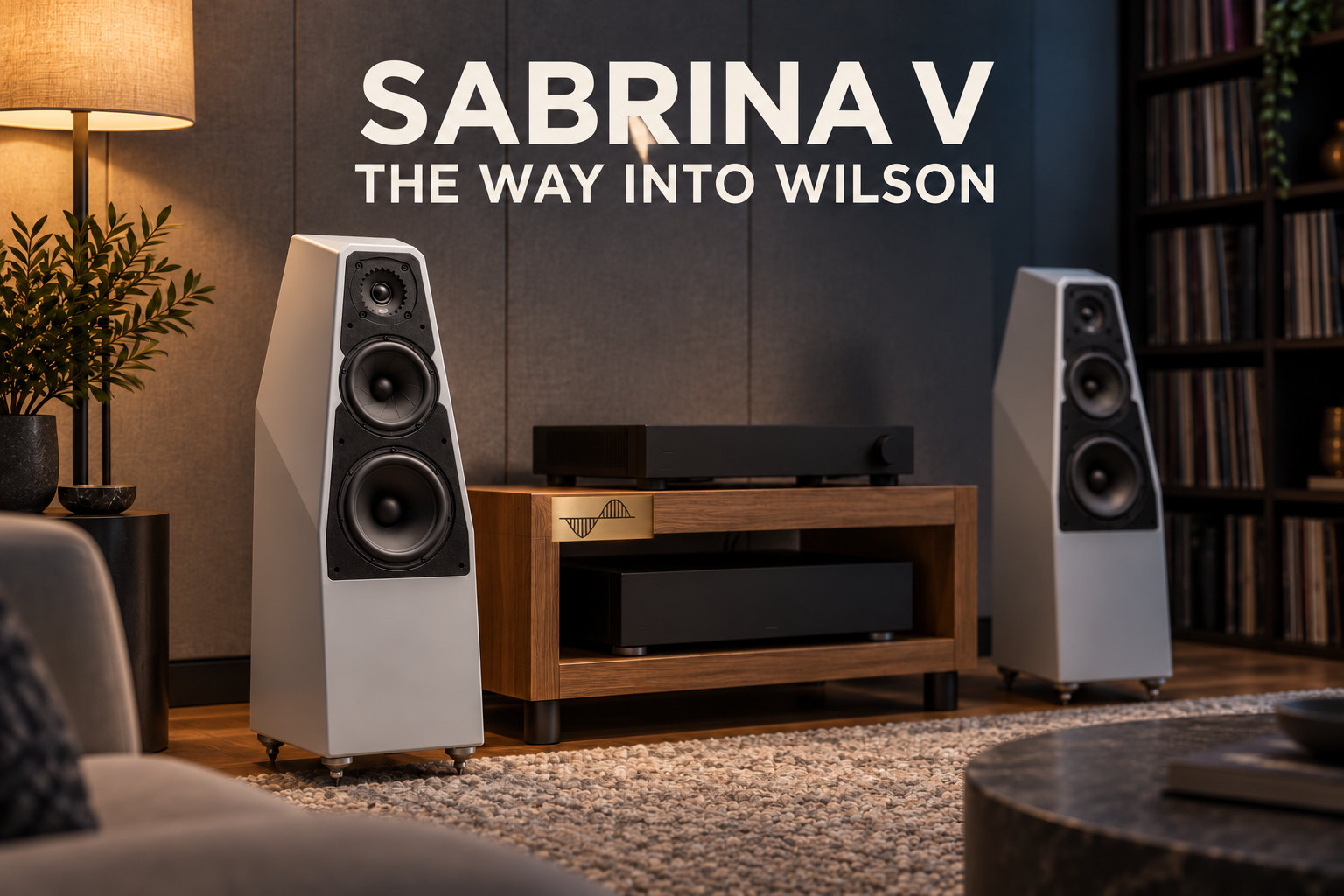
Every larger floorstander in Wilson Audio's current range is built from at least two separate boxes. The Wilson Audio Sabrina V is one: 39 inches tall, 123 pounds, $28,500 a pair in standard finishes as of October 2026, and the least expensive way to buy a new Wilson floorstander. It is the third Sabrina in a decade, and the first to carry the midrange driver of the $400,000 Chronosonic XVX.
Stereophile, The Absolute Sound, Hi-Fi News and The Audio Beat have reviewed it, Paul Miller has measured it, and EISA gave it its High-End Floorstanding Loudspeaker award for 2026–2027. The reviewers agree on the inheritance: the XVX's midrange, the Alexx V's tweeter, the Sasha V's woofer. They split on what a buyer must settle before signing: how much amplifier it needs, and how far to toe it in. The answers follow, and so does the question KD put to buyers in his Yvette film.
Wilson Audio Sabrina V price: the front door to the range
The Sabrina V is the bottom rung of a steep ladder: Stereophile's Fall 2026 Recommended Components list runs Wilson's floorstanders from $28,500 to $400,000 in five steps. Above them, the flagship Autobiography launched in April 2026 at $788,000.
Read every label as live text
- Sabrina V
- $28,500
- The WATT/Puppy
- $41,500
- Sasha V
- $54,600
- Alexia V
- $75,600
- Alexx V
- $164,800
- Chronosonic XVX
- $400,000
The next rung, The WATT/Puppy, costs $41,500; the Sasha V, which doubles the Sabrina V's single woofer, costs $54,600, almost twice as much. The list files the Sabrina V in Class A, Restricted Extreme LF (top-class sound, short of the deepest octave), and both of those in Class A Full Range.
StereoNET reported a $28,000 price for the 3 July 2025 launch; by October 2026, Stereophile and The Absolute Sound print $28,500. British prices climbed harder: Hi-Fi News puts the SabrinaX's start at just under £21,500 and the Sabrina V's at £32,998, more than 50 per cent up.
What changed from the SabrinaX: drivers, cabinet and crossover
The V is no facelift: every drive unit has changed.
| SabrinaX (2020) | Sabrina V (2025) | |
|---|---|---|
| Tweeter | Convergent Synergy MK5 | 1-inch Convergent Synergy Carbon, from the Alexx V |
| Midrange | 146 mm, from the original Sabrina | 7-inch (178 mm) alnico QuadraMag, from the Chronosonic XVX |
| Woofer | 203 mm, from the Sasha DAW | 8-inch (203 mm), as in the Sasha V and The WATT/Puppy |
| Enclosure | X-Material throughout | X-Material panels, H-Material baffle, V-Material spike interface |
| Crossover | AudioCapX capacitors | AudioCapX-WA capacitors, copper variant, new woofer capacitor |
| Rated bass extension | 31 Hz | 27 Hz |
| Specified minimum impedance | 2.6 ohms at 135 Hz | 2.23 ohms at 121 Hz |
| UK starting price, per Hi-Fi News (2025) | just under £21,500 | £32,998 |
Drivers, enclosure, crossover, rated bass extension, specified minimum impedance and UK starting price. Sources: Hi-Fi News (December 2020, October 2025), Stereophile (December 2025), What Hi-Fi? (June 2025).
Sources: Hi-Fi News (December 2020, October 2025), Stereophile (December 2025), What Hi-Fi? (June 2025).
The midrange is the headline: Robert Harley of The Absolute Sound, who has heard a Chronosonic XVX nearly daily for five years, calls the QuadraMag "the heart and soul of the Chronosonic". The cabinet changed too. It grew slightly less than an inch taller and 11 lb heavier, and Daryl Wilson told Stereophile the stretch enlarged the woofer's internal volume. A single baffle rules out the softer S-Material midrange panel of larger Wilsons, hence the new H-Material front. Wilson also bought its capacitor supplier, Reliable Capacitors, and moved production in-house.
What reviewers report: the strengths and the caveats that recur
Consensus first: it plays above its size. Harley writes that it "plays much larger than its size suggests—tonally, dynamically, and spatially", and heard simultaneous 16 Hz and 32 Hz organ pedal points as distinct pitches. Andrew Everard of Hi-Fi News found "a big, bold, room-filling sound without trading away any detail or definition".
The midrange wins the same praise. Harley heard Yo-Yo Ma's cello with "no thinness or bleached timbre"; The Audio Beat's Mark Blackmore credits a "significantly richer midrange, thanks to the inclusion of the QuadraMag driver". Hi-Fi News scored it 90% for sound quality.
The caveats recur too:
- Treble. Harley hears "more upper-midrange and lower-treble energy than the Alexia V or Chronosonic XVX". Blackmore found the on-axis treble "a bit sharp and peaky" until he removed the toe-in, though he suspects the copper capacitors also needed run-in.
- Bass weight. Everard: "There are times when the Sabrina Vs' hefty bass can almost be their undoing."
- Break-in. Matson's pair "felt a bit closed in" for about a week and a half; Blackmore's bass snapped into place by day three.
- Ancillaries. Blackmore found one pair of interconnects "too insistent, too energetic in the treble range". This speaker shows what feeds it.
Nobody pretends it is a big Wilson: Harley says it "isn't the equal of the Alexia V or Chronosonic XVX", which have deeper bass and higher resolution.
Measurements: sensitivity, impedance and bass, from published data
Miller's Stereophile measurements explain both the praise and the caveats. Sensitivity measured 88.9 dB at 2.83 V/1 m, against the SabrinaX's 89.6 dB. Response errors widened to about ±3.9 dB from the X's ±2.9 dB (200 Hz to 20 kHz), easing to ±3.4 dB slightly off axis, which squares with what Blackmore heard.
That trade bought bass: −6 dB at 42 Hz, against 52 Hz for the SabrinaX. Wilson rates it to 27 Hz. Harley heard his 16 Hz pedal notes in a large room, so read them as evidence of pitch definition, not of flat output at 16 Hz.
The load is the catch. Impedance falls to 2.2 ohms at 121 Hz while phase swings from −65° at 65 Hz to +43° at 1.4 kHz, producing an equivalent peak dissipation resistance (EPDR) of 0.95 ohm at 84 Hz: there, the amplifier's output devices work as hard as they would into a plain resistor of under one ohm. Miller's summary: "Capable amplifiers only need apply!"
For scale, in his Klipsch La Scala vs Wilson Yvette film KD gave his own Yvettes, a pair costing over $25,000, an 86 dB sensitivity and a 4-ohm load dropping to 3 ohms around 90 Hz. The Sabrina V is rated a decibel more sensitive, but its specified minimum dips lower. The debate is not new: on Audio Science Review in August 2020, one member called the earlier Sabrina "a bit of a difficult load"; another said it was "not a 'difficult' load".
What it needs: amplification, room size and Wilson's set-up procedure
Amplification: current before watts
Wilson specifies at least 50 watts per channel. The reviewers' amplifiers show how little that settles:
- Harley used a 20 W Berning/Hi-Fi One Reference single-ended amplifier and measured undistorted peaks of 105 dB.
- Matson paired a McIntosh C12000 preamplifier, the model in KD's reference system, with a 450 W MC462; in a smaller room, a 100 W McIntosh MA252 integrated "sounded great".
- Blackmore's BAT VK-60 tube amplifier "never sounded comfortable"; he favoured a 50 W Wattson Madison LE, which has a 2-ohm switch, over his 300 W Innersound.
- Andrew Robinson's YouTube review (February 2026) lists a Devialet Astra and an Onkyo A-50.
Blackmore, who calls the V "a bit more demanding" than the X, judged Wilson's 50 watts "spot on, provided you have an amplifier as good as the Wattson." Wilson's Peter McGrath told Stereophile that "low impedance is not a challenge for a good amp." The stress falls on "good": choose an amplifier specified, ideally measured, into 2 ohms. KD lived a milder version: at around 95 dB on his Yvettes, he sensed his McIntosh MA9500 working at its limits for the first time; not struggling, but pushed.
Room size
Harley found the bass "perfectly suited to smaller spaces", yet adequate in his 18 × 27 ft music room. Wilson's manual seats the listener 1.1 to 1.25 times the tweeter spacing away: 9 ft 11 in to 11 ft 3 in for tweeters 9 ft apart in a 12 × 18 ft room. KD reads the Yvette's low end as dominated by the room, which makes it a speaker built for a treated room; the logic applies here too.
Wilson's set-up procedure (WASP)
The Wilson Audio Setup Procedure needs no test equipment. Stand against the wall behind the intended speaker position, speak at a steady, moderately loud level and walk into the room, marking the floor where your voice turns from "bass-heavy and diffuse to neutral", and again where the wall ahead starts to intrude. Repeat from the side wall: the four tape marks form the Zone of Neutrality.
Read every label as live text
- 12 x 18 ft
- 12 x 18 ft
- voice turns neutral
- wall ahead intrudes
- Zone of Neutrality
- 9 ft
- 9 ft 11 in to 11 ft 3 in (1.1 to 1.25 x tweeter spacing)
Blackmore reused the spots Wilson's Peter McGrath had found for his SabrinaX: front baffles 61 inches from the front wall, cabinet sides 23 inches from the side walls. KD used the same voice method for his Yvettes in the new listening room, as told in his Daily on placing speakers with his own voice. Toe-in is where the sources part: the manual wants only a sliver of the woofer enclosure's inside edge visible from the seat, Matson toed in "a little", Blackmore not at all. Settle it by ear, with the dealer present.
Rivals at the price: Magico, Sonus faber, B&W and others
| Speaker | US price per pair, October 2026 | Rated sensitivity | Minimum impedance |
|---|---|---|---|
| Sabrina V | $28,500 | 87 dB/1 W/1 m (88.9 dB/2.83 V measured) | 2.23 ohms at 121 Hz; 0.95-ohm EPDR measured |
| Magico A5 | $30,800 | 88 dB/2.83 V/1 m | Not specified (4 ohms nominal) |
| Bowers & Wilkins 803 D5 | $35,000 | 90 dB/2.83 V/1 m | 3.0 ohms |
| Sonus faber Serafino G2 | about $31,000 (US dealer listing) | 90 dB/2.83 V/1 m | Not specified (4 ohms nominal) |
| Estelon AURA | $25,900–$33,800 by finish | 90 dB/2.83 V (86.8 dB(B) measured) | Not specified; "very demanding load" |
US prices per pair as of October 2026: Stereophile's Fall 2026 Recommended Components (Wilson, Magico, Estelon); Bowers & Wilkins US site, October 2026 (803 D5); Sonus faber specifications and a US dealer listing (Serafino G2). Wilson rates sensitivity per watt, the others per 2.83 volts.
Sources: Stereophile (Fall 2026 list, specifications); B&W, Sonus faber and a US dealer, October 2026. Wilson rates sensitivity per watt, the others per 2.83 V.
The Magico A5 takes a different route at similar money: a sealed enclosure, a beryllium tweeter and three 9-inch woofers, rated to 24 Hz. It sits in Stereophile's Class A Full Range, and it is bigger: 44.75 inches tall with spikes against the Wilson's 39 without, and 57 lb heavier per side. Buyers chasing the deepest octave should hear it; buyers who need a speaker to recede into a living room will prefer the Wilson.
Bowers & Wilkins moved its goalposts on 9 September 2026, when the 800 Series Diamond D5 went on sale: the 803 D5 costs $35,000 a pair in the US, up from $27,000 for the 803 D4, and the 804 D5 $25,000, so two B&W floorstanders now bracket the Wilson. On paper the 803 D5 is the easier load, with a rated 3-ohm minimum. KD knows the previous generation's limit: his 800 Series Diamond D4 floorstanders, he says, clipped above about 95 dB on Billie Eilish's "Bad Guy", which the Yvettes later played with "No compression, no distortion." Take that track to any 803 D5 audition.
Sonus faber's Serafino G2 lists at about $31,000 a pair at a US dealer, rated 90 dB and 4 ohms nominal; its maker specifies no minimum, so ask for one before pairing it with a modest amplifier. Estelon's AURA struck Stereophile's Kalman Rubinson as "open and detailed and, once properly placed, well-balanced", though Stereophile reports John Atkinson found it a very demanding load.
The fiercest rival is in Wilson's own catalogue. Daryl Wilson's estimate for Stereophile, framed for average listening levels, is that a Sabrina V owner gets "about 80%–85% of the performance of the WATT/Puppy", which costs $13,000 more.
Verdict: the right Wilson, and when the bigger ones justify the jump
The reviews converge. Harley says it delivers "the best value in the Wilson line"; Blackmore calls it "a better speaker on all counts" than the SabrinaX. The limits are as clear: an upper midrange that toe-in must manage, a 0.95-ohm EPDR the amplifier must survive, and one woofer.
The WATT/Puppy buys the remaining 15 to 20 per cent implied by Daryl Wilson's estimate, for 46 per cent more money. The Sasha V buys a second woofer, and the bass power Harley says the Sabrina V lacks, at almost double the price. Blackmore's advice: unless you "must have the extra bass driver in the Sasha V", the Sabrina V "might be the better choice at a substantially lower price". Large rooms and high levels justify the climb. Most living rooms do not.
The better question is the one KD put to buyers in his Yvette film:
Do I have the foundation? System, room, electronics.
He answered yes for himself, and called the Yvette a bargain. Without proper amplification, a treated room and a capable source, he warned, "you might be wasting your money." The Sabrina V asks the same foundation question from the bottom rung of Wilson's ladder. Get the amplifier and the room right, and it is the most persuasive way into Wilson. Get them wrong, and it is a $28,500 way to hear what is missing.
Frequently asked questions
How much does the Wilson Audio Sabrina V cost?
The Wilson Audio Sabrina V costs $28,500 a pair in standard finishes as of October 2026, up from $28,000 at its July 2025 launch.
What is the difference between the Wilson Sabrina X and Sabrina V?
The Sabrina V replaces every SabrinaX drive unit with drivers from Wilson's larger models and adds an H-Material baffle and new capacitors. Rated bass extension improves from 31 Hz to 27 Hz.
What amplifier does the Wilson Sabrina V need?
Wilson asks for at least 50 watts per channel, but the Sabrina V needs an amplifier stable into 2 ohms more than it needs extra watts.
More from the Journal
Keep exploring.
Loading articles…