

The Journal / Articles & reviews
The 10 Best Integrated Amplifiers of 2026: Cost-No-Object and Best-Value Rankings
The second Sound Lab ranking scores the integrated amplifiers that matter in June 2026 on a four-part scorecard to find the best integrated amplifier at any price and for the money: no samples, no sponsors, no affiliate links, and no favours for the brand in KD's own rack.
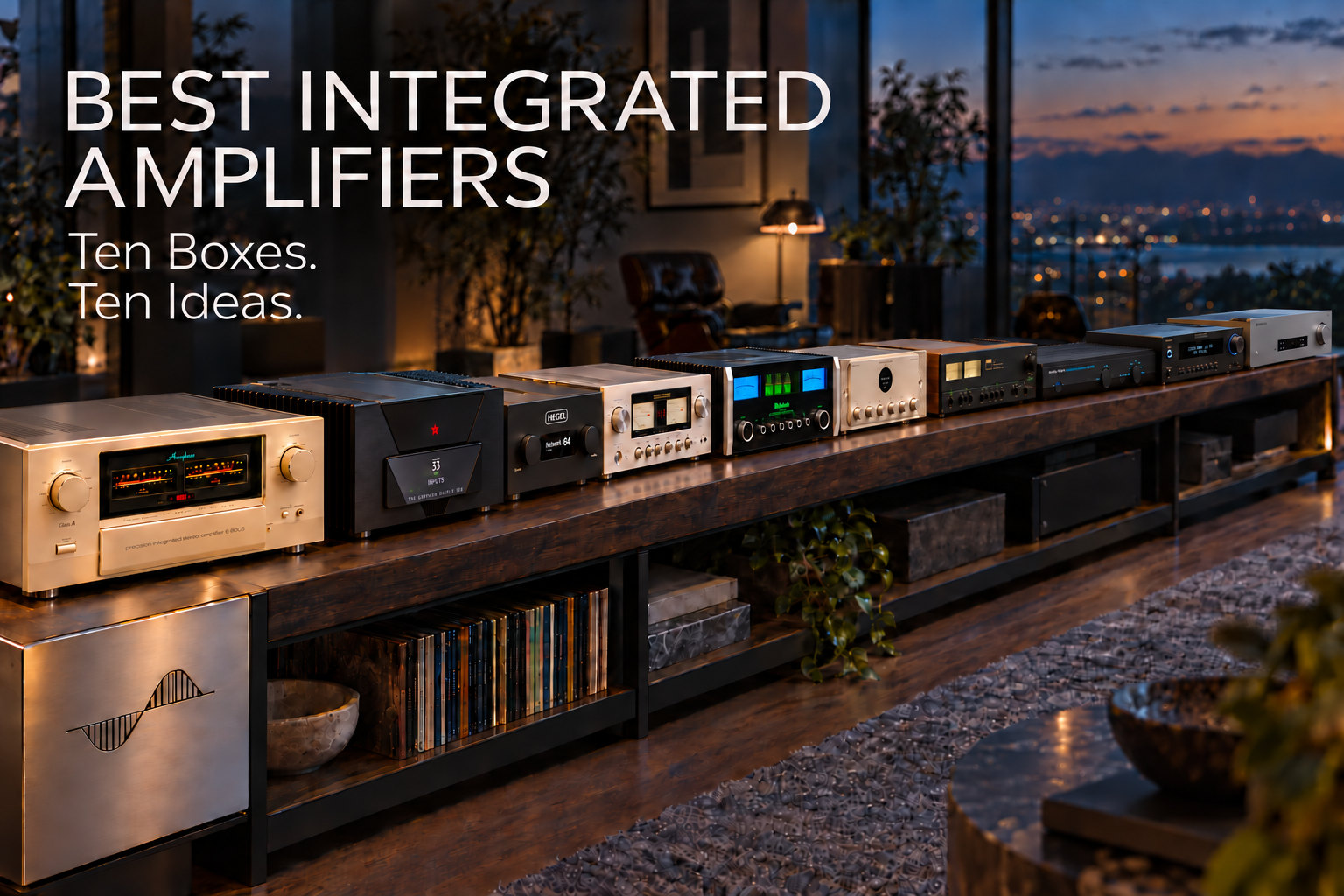
Accuphase asks $21,575 for an integrated amplifier rated at 50 watts a channel. Marantz asks $15,000 for one that put out 340 watts on the SoundStage! bench. Rotel asks $3,699 for one that delivered 225 in the Hi-Fi News lab. If money bought watts, this would be a spreadsheet, and a short one. It does not. In an integrated amplifier, money buys stranger things: class-A heat, empty slots waiting for the next decade's modules, a maker's private conviction about how a cello should sound. Finding the best integrated amplifier of 2026 honestly means asking what each box does that the others cannot, and for whom.
This is the second Sound Lab ranking. The first, on turntables, ran from a $3,300 Technics to a $450,000 TechDAS, and its rules carry over: two lists, one entry per maker in each, no review samples, no sponsors, no affiliate links. So does KD's caveat from March: "The purpose here is not to tell you how something sounds. That is subjective."
How we ranked
The scorecard is the one KD approved in March for this ranking:
- Sonic and engineering merit: what published listening and the test bench say, and whether the design solves a real problem in an original way.
- Real-world recognition: awards, long-running recommended lists and the verdict of owners.
- Functionality and support: inputs, DAC, phono, streaming, upgrade paths, build, and the maker's record of standing behind its products.
- Value and resale, for the best-value list only: what the price buys against the field, and how well the name holds its value second-hand.
The long list began with Stereophile's April 2026 Recommended Components, The Absolute Sound's recent awards, three years of EISA awards and the What Hi-Fi? Awards 2025, then took in lab reports from Hi-Fi News, SoundStage! and Audio Science Review, video reviews and owner threads. As with the turntables, AI did the heavy reading and the scorecard did the ranking; the prices, quotes and measurements cited come from the sources named.
Prices are US list for the base configuration as at 12 June 2026, "about" where dealers disagree. A maker may appear on both lists; three do. Products too new to have been measured or reviewed are listed at the end, unranked.
One more rule, and the hardest to keep: this is not a list of what KD owns. The brand in his rack finishes tenth. He has admitted on camera to precisely the bias a scorecard exists to overrule: with $40,000 invested in McIntosh separates, if someone tells him a $15,000 integrated sounds identical, "my brain physically resists."
Cost no object: the 10 best integrated amplifiers of 2026
In the hunt for the best high-end integrated amplifier, price plays no part; merit, recognition and capability set the order.
| Rank | Model | US price | Topology | Rated power, 8 ohms | Why it is here |
|---|---|---|---|---|---|
| 1 | CH Precision I1 Universal | from $38,000 | Solid state, class AB, modular | 100 W | Most complete; improved by firmware |
| 2 | Gryphon Diablo 333 | $27,800 | Solid state, high-bias class AB | 333 W | Drives anything, with finesse |
| 3 | Hegel H600 | about $13,500 | Solid state, class AB, dual mono | 303 W | Power and streaming in one box |
| 4 | Luxman L-509Z | $14,495 | Solid state, discrete | 120 W | Measured purity, superb phono |
| 5 | Accuphase E-800S | $21,575 | Class A, MOSFET | 50 W | Doubles its power down to 2 ohms |
| 6 | Marantz Model 10 | $15,000 | Class D | 250 W | Class D at reference level |
| 7 | Musical Fidelity Nu-Vista 800.2 | $13,999 | Nuvistor input, solid-state output | 330 W | Unreserved lab and listening verdict |
| 8 | Burmester 232 | $25,000 | Solid state, modular | 95 W | Superb measurements, costly modules |
| 9 | Boulder 866 | about $17,500 with DAC | Solid state, balanced | 200 W | Silence in a compact chassis |
| 10 | McIntosh MA12000 | about $17,500 | Tube preamp, solid-state power, autoformers | 350 W | Everything included |
Ranked on sonic and engineering merit, real-world recognition, and functionality and support; price plays no part. US list prices for the base configuration as at 12 June 2026, 'about' where dealers differ; the Boulder 866 is priced with its DAC. Rated power per channel into 8 ohms.
1. CH Precision I1 Universal, from $38,000
The Swiss I1 is built to be upgraded rather than replaced. The base unit is analogue plus an S/PDIF board; USB, streaming, an MC phono board and an external-clock input take a full build to about $54,000. The class-AB stage is rated at a modest 100 watts a channel, and even the global feedback is adjustable. Stereophile's Jason Victor Serinus called it "one of the most complete, most neutral sounding, most carefully conceived components I've reviewed." The Absolute Sound's Alan Taffel drove Wilson Sasha Vs with it, preferred it most of the time to CH's own A1.5 power amplifier, and reported that a free firmware update took its DAC "from very good to the best I've ever heard." That is the I1's real argument: a component that kept improving after it was paid for. The catch: a fiddly setup, and 100 watts on paper.
2. Gryphon Diablo 333, $27,800
Named for its output: 333 watts a channel into 8 ohms, 666 into 4 and a claimed 1,100 into 2, from a 112-pound Danish chassis with ten output transistors per channel in high-bias class AB, the first 10-plus watts in pure class A. Paul Miller's lab found close to 360 watts into 8 ohms. The Absolute Sound named it a 2025 solid-state integrated amplifier of the year and called it "a devil in a tuxedo"; Stereophile's Sasha Matson concluded that it "can power anything." The reservations live in the options: the $8,400 DAC module has no network streaming, the $6,800 phono module takes balanced XLR inputs only, and there is no headphone socket at any price.
3. Hegel H600, about $13,500
Power, a first-rate DAC and full streaming in one box, for less than half the Gryphon's price. Rated at 303 watts into 8 ohms, it measured 313 in the SoundStage! lab, though only 519 into 4 against 590 claimed. Hegel calls it a mini P30A, after its reference preamplifier. The Absolute Sound gave it the same 2025 solid-state title as the Gryphon, likening its control to "drinking from a water fountain fed directly by the Hoover Dam"; EISA named it best high-end streaming amplifier of 2023–2024; SoundStage! judged its DAC able to "easily rival external DACs costing thousands of dollars." No phono input, and the four-ohm shortfall matters only with the hungriest speakers.
4. Luxman L-509Z, $14,495
Luxman, now in its second century, rebuilt its flagship around discrete circuitry in place of op-amps and a new feedback system, LIFES, said to lower noise and distortion. Stereophile confirmed the rated 120 watts into 8 ohms and 220 into 4 and praised a "low-noise, low-distortion, overload-proof phono input" for MM and MC. It keeps what rivals have dropped: tone controls and a front-panel headphone jack. Ken Micallef heard "an amp of brilliant purity and fluid communication." The dissent comes from the same review, which found the tone-bypassing Line Straight mode "perhaps a little rigid". No DAC.
5. Accuphase E-800S, $21,575
Fifty watts, all class A, and the arithmetic is the point: 50 into 8 ohms, 100 into 4, 200 into 2, and still 300 into a 1-ohm load most amplifiers are never asked to see. Power MOSFETs in a six-fold parallel push-pull arrangement do the work. The Absolute Sound's Editors' Choice in May praised "a liquid, organic sound that is easy to listen to for hours on end" and build quality that "will likely outlive us all." Two slots take optional boards such as a DAC or phono stage. Against it: heat, bulk, $431.50 per rated watt, and no English-language test bench has yet put numbers to the claims.
6. Marantz Model 10, $15,000
The strongest case yet that class D belongs at the top table. Its two modules are Purifi designs adapted and tuned by Marantz, says EISA, which named it high-end integrated amplifier of 2025–2026. Rated at 250 watts into 8 ohms and 500 into 4, it delivered 340 and 650 in the SoundStage! lab; SoundStage! made it a Recommended Reference Component, and John Darko titled his video review The BEST amplifier I've EVER heard. The reservations: Jason Thorpe found the MM/MC phono stage a step below the rest of the amplifier, the remote carries about 45 buttons, and there is no DAC.
7. Musical Fidelity Nu-Vista 800.2, $13,999
The idea dates from 1959, when nuvistors, small metal-clad tubes, arrived to compete with early transistors. Here they run the small-signal stages, and a bipolar class-AB output stage rated at 330 watts does the lifting. Stereophile measured 290 into 8 ohms and 470 into 4, short of the claim, yet John Atkinson recommended it without reservation for its grip on woofers, its retrieval of low-level detail and a sense of almost unlimited power. EISA named it high-end integrated amplifier of 2023–2024. A purist's box: line inputs only, no DAC, no phono stage, no streaming.
8. Burmester 232, $25,000
The 232 drew the most emphatic bench verdict John Atkinson gave anything on this list: superb, with extremely low distortion and noise, and 95 watts into 8 ohms essentially as rated. Jason Victor Serinus heard extremely natural timbres and concluded "Highly recommended." The price structure is the problem. The MC phono module adds $5,000 and the Roon Ready DAC/streamer $10,000, taking the review sample to $40,000, and Atkinson flagged excessive gain from the digital module. Ninety-five watts is modest company at the price.
9. Boulder 866, about $17,500 with DAC
Boulder's integrated was built, the company said at its 2019 launch, with a premium placed on value. It keeps the house's balanced design: three pairs of balanced inputs, 200 watts into 8 ohms with 250-watt peaks, and 700 watts peak into 2 ohms. US dealers now quote about $17,500 with the DAC fitted, up from $14,950 when The Absolute Sound gave it a Golden Ear, Steven Stone arguing that its performance in a smaller room "can equal that of a multiplicity of separate boxes in a larger dedicated room." No phono stage, and less power and fewer features than the Hegel for more money.
10. McIntosh MA12000, about $17,500
The flagship of the brand in KD's own rack. A hybrid: four 12AX7A tubes in the preamplifier, 350 solid-state watts delivered into 2, 4 or 8 ohms through McIntosh's autoformers, 17 inputs including MM and MC phono, a DAC with HDMI ARC, and the blue meters. StereoNET gave it an Applause award, Haute Fidélité its Reference award. It finishes tenth on evidence, not affection: fewer reviews than its rivals and lighter independent measurement. KD lived for years with its 300-watt sibling, the MA9500, and still calls it "one of the best integrated amplifiers ever made. Period." He names it his single best purchase.
Best value: the 10 best integrated amplifiers for the money
The best integrated amp for the money is a different hunt. In KD's words about the turntables, this list is "all about the price to experience or performance ratio." Same scorecard, plus value and resale.
| Rank | Model | US price | Best suited to |
|---|---|---|---|
| 1 | Marantz Model 40n | $2,700 | A one-box system with TV and vinyl |
| 2 | Hegel H190v | about $4,600 | 87 to 88 dB speakers, medium rooms |
| 3 | NAD C 3050 | about $1,700 | Living rooms where bass needs correcting |
| 4 | Musical Fidelity A1 | $1,999 | Sensitive speakers that stay above 4 ohms |
| 5 | Arcam A15+ | about $1,500 | Standmounts and modest floorstanders |
| 6 | Rega Elex Mk4 | about $1,900 | Lively, revealing speakers; vinyl |
| 7 | Pass Labs INT-25 | $8,360 | High-efficiency speakers |
| 8 | Rotel RA-1592 MKII | $3,699 | Inefficient floorstanders, larger rooms |
| 9 | PrimaLuna EVO 400 | $6,495 | Benign speaker loads, tube lovers |
| 10 | Cambridge CXA81 Mk II | about $1,200 | A first serious system |
Ranked by performance per dollar on the same scorecard, with value and resale added. US list prices as at 12 June 2026, 'about' where dealers differ; the NAD C 3050 costs about $2,200 with its BluOS streaming and room-correction module.
1. Marantz Model 40n, $2,700
The most complete $2,700 in hi-fi: 70 watts into 8 ohms (Stereophile measured 74), MM phono, HDMI ARC and HEOS streaming. John Atkinson found excellent measured performance on every input; Kalman Rubinson called it "this century's answer to the AM/FM stereo receiver of the previous one"; John Darko's video called it the best-value streaming amplifier of 2022. The weak spots are small: a headphone output best suited to high-impedance headphones, and Bluetooth limited to the basic SBC codec.
2. Hegel H190v, about $4,600
Trickle-down in the literal sense. Its MM phono input is, in Hegel's words, a scaled-down version of the V10 phono preamplifier, and its 150 class-AB watts come with the same 4,000 damping factor Hegel quotes for the H600, plus Roon Ready and AirPlay. Tom Martin's verdict in The Absolute Sound: "I don't mean for the money; I mean just plain great." His own caveat: it may be confined to speakers of 87 or 88 dB in rooms of 1,500 to 2,200 cubic feet. Moving-coil owners need a step-up.
3. NAD C 3050, about $1,700
VU meters and a walnut-finished cabinet recall NAD's original 3030; inside are 100 watts of HybridDigital UcD class D, HDMI eARC and MM phono. A $400 BluOS module adds streaming and Dirac Live room correction up to 500 Hz. A rare double, with the measurers and the listeners in agreement: Audio Science Review recommended it after measurement, and John Atkinson heard its presentation as very close to NAD's dearer M10. EISA named it integrated amplifier of 2023–2024. The caveats: power dips at 40 Hz, and the meters are "more for fun than accurate power metering", in Amir Majidimehr's words.
4. Musical Fidelity A1, $1,999
The 1980s class-A cult amplifier, rebuilt with a wider chassis, more heatsink and a bigger power supply: 25 watts of class A, MM/MC phono and five line inputs. It was Stereophile's Budget Product of the Year for 2024 and EISA's enthusiast amplifier for 2024–2025. Herb Reichert set it against his reference Pass INT-25, at more than four times the price, and found less detail up top and less control below, but "that supersaturated toaster-glowing 'electrostatic midrange.'" Partner it carefully. On John Atkinson's bench it clipped at 30 watts into 8 ohms but only 16 into 4, and he advised speakers whose impedance stays above 4 ohms. What Hi-Fi? lists "still runs very hot" first among its faults.
5. Arcam A15+, about $1,500
What Hi-Fi?'s stereo amplifier product of the year for 2025: 80 watts of class AB, a DAC, HDMI eARC and "class-leading status", marred only by a missing USB input and a frosted display. Geography sets its place here. The refresh held its £1,199 UK price, but Americans pay $1,499.95, up from $1,099 for the outgoing A15. At the old price it would be fighting for first.
6. Rega Elex Mk4, about $1,900
The purist's pick, with MM phono and a DAC. What Hi-Fi? gave it five stars for "astonishingly revealing sound" and "terrific timing and agility", with the warning in the same verdict: it "needs careful system matching", and "some might want a more muscular sound." Pair it with lively speakers that reward speed, not loads that need shoving.
7. Pass Labs INT-25, $8,360
The dearest value pick, carrying both Stereophile's top class and its value mark. It is essentially Pass's XA25 power amplifier, 25 watts of push-pull class A without degenerative feedback, wedded to a minimal line preamplifier. Herb Reichert called it "my new solid state reference" and heard in it "a subtle radiance". Twenty-five watts and line inputs only choose its partners: sensitive speakers, an outboard DAC and a separate phono stage.
8. Rotel RA-1592 MKII, $3,699
The headroom pick: 200 watts of class AB, measured by Hi-Fi News at 225 into 8 ohms and 425 into 4. Its lab report asked whether it performs like Rotel's own premium Michi X3 in a cheaper case and answered "yes, most definitely!", though the DAC falls behind the Michi's. The Absolute Sound's Editors' Choice in March praised "a lush velvety character and a weighty, well-defined bottom end", at the cost of a little air at the treble extremes.
9. PrimaLuna EVO 400, $6,495
Eight EL34s, hard-wired with no circuit boards in the signal path, switchable between ultralinear and triode at a rated 70 and 38 watts; Stereophile measured 63 in ultralinear at 1 percent distortion. Rogier van Bakel heard less bass control than from solid state and decided it did not matter: "the music chugged and jived in ways that left no room for disappointment." MM phono is a $249 option.
10. Cambridge CXA81 Mk II, about $1,200
The cheapest entry and the most disputed. Eighty watts of class AB, a DAC and Bluetooth, and on the Audio Science Review bench it held full power down to 20 Hz, "where a lot of amplifiers pull back." The same review called the amplifier competent and the DAC average, saturating at its standard 2-volt output, and declined to recommend it. What Hi-Fi? heard a "big, spacious, authoritative sound" but found that it "lacks rhythmic drive and cohesion" and is beaten by its closest rival for outright expression. Buy it for the amplifier; feed it from a better DAC.
What the lists reveal
Read every label as live text
- Price does not predict position
- US price, June 2026 (log scale)
- Position in its list
- Value sweet spot
- Cost no object
- Best value
- CH Precision I1
- Gryphon Diablo 333
- Hegel H600
- Luxman L-509Z
- Accuphase E-800S
- Marantz Model 10
- Musical Fidelity Nu-Vista 800.2
- Burmester 232
- Boulder 866 (with DAC)
- McIntosh MA12000
- Marantz Model 40n
- Hegel H190v
- NAD C 3050
- Musical Fidelity A1
- Arcam A15+
- Rega Elex Mk4
- Pass Labs INT-25
- Rotel RA-1592 MKII
- PrimaLuna EVO 400
- Cambridge CXA81 Mk II
At the top, price does not predict position. The cost-no-object list runs from about $13,500 to $38,000, and the order ignores the money: the Hegel, among the cheapest, is third; the $25,000 Burmester is eighth. Nor does the money buy a better bench verdict. In Stereophile's listings, John Atkinson's measurements earned the same "excellent measured performance" for the $2,700 Marantz Model 40n, the $14,495 Luxman and the $38,000 CH Precision. It does not buy watts either: the Accuphase costs $431.50 per rated watt, the Rotel $18.50.
An "excellent" from the test bench can be had for $2,700. Above that, money buys headroom, heat, slots for the next decade and a point of view.
"That trickle down is where the real value lives," KD said of turntables. In amplifiers it lives where a maker carries its premium designs, separates or flagship integrateds, into a cheaper box. SoundStage! traced most of the H600's trickle-down technology to Hegel's P30A preamplifier, the Pass INT-25 is essentially an XA25 power amplifier, Hi-Fi News found the Rotel performing like Rotel's premium Michi X3 integrated, and John Atkinson heard the NAD C 3050 as very close to NAD's dearer M10.
Seven of the ten value picks sit between about $1,500 and $4,600, and the cost-no-object list starts at roughly three times the top of that band. That band is the sweet spot for an integrated amplifier in 2026. Above it the gains are real, but they arrive as refinement, power reserve and features.
Matching the best integrated amplifier to your speakers
A ranking can say which amplifiers are excellent, not which one your speakers want. KD paid to learn the difference: in the channel's trailer he admits to pairing speakers with the wrong amplifier and wondering why they sounded hollow. Three numbers decide more than the badge: sensitivity, impedance and room size.
Read every label as live text
- Watts needed for 100 dB at one metre
- Every 3 dB less sensitivity doubles the power
- Amplifier power, watts
- 86 dB
- 25.1 W
- 88 dB
- 15.8 W
- 90 dB
- 10.0 W
- 93 dB
- 5.0 W
- 96 dB
- 2.5 W
- 105 dB
- 0.32 W
Every 3 dB of sensitivity halves or doubles the power needed for the same loudness; 10 dB is a factor of ten. In KD's comparison of the Klipsch La Scala and the Wilson Yvette, the horn's 105 dB against the Wilson's 86 dB is a 19 dB gap: the Wilson needs roughly 80 times the power for the same level, which KD rounded to a hundred in the film. Impedance decides whether that power arrives. The Yvette is a 4-ohm load that drops to 3 ohms around 90 Hz.
"The Vette needs power, real power." KD, on the Wilson Yvette
Amplifiers built for such loads keep doubling their output as impedance halves: the Accuphase down to 2 ohms, and still 300 watts into 1. McIntosh's autoformers take another route, delivering the MA12000's full 350 watts into 2, 4 or 8 ohms. The 25-watt class-A designs want the opposite: sensitive speakers whose impedance never strays low.
KD's own system made the point. His 300-watt MA9500 drove the Yvettes until, at around 95 dB, he felt it was "not struggling, McIntosh doesn't struggle, but pushing its limits." Separates followed. The MA9500 had controlled the Yvettes "admirably"; the MC611 monoblocks "command them."
Room size closes the loop. Average listening uses only 2 to 3 watts, Tom Martin reminded readers of The Absolute Sound, but every 3 dB of peak doubles the demand, and a bigger room or a farther seat asks for more. KD's rule from the turntable ranking applies doubly here: "A balanced system will always outperform a system where one component wildly outclasses everything else around it. Always."
New this season: launched in June, not ranked
High End left Munich after 21 years and opened at the Austria Center in Vienna from 4 to 7 June; the organisers counted 23,109 visitors. None of the integrated amplifiers launched there, or in the days before, has yet been measured or independently reviewed, so none is ranked.
- McIntosh MA2375: announced on 3 June as McIntosh's first vacuum-tube integrated in more than a decade, 75 watts a channel from four KT88 output tubes.
- Arcam A50 Signature, $2,999.95: Arcam's 50th-anniversary integrated and its first fully dual-mono class G design, 150 watts a channel, with MM/MC phono and HDMI eARC; due in the third quarter.
- Audio Research SSi250, expected around $18,000: 250 solid-state watts, essentially the LS3 preamplifier and S200 power amplifier in one chassis.
- Cambridge Audio Evo 300, $3,999: 300 watts a channel from Hypex NCOREx class-D modules, with streaming and HDMI eARC.
One absence matters. D'Agostino used Vienna to launch Progression Neo, a preamplifier and stereo and mono power amplifiers replacing the Progression series, with no integrated among them. Until the fate of the Progression Integrated is clear, a strong contender sits this year out. The newcomers enter the scorecard when there is evidence to score.
Frequently asked questions
How many watts does a system really need?
Fewer than spec-sheet wars suggest. A 96 dB speaker reaches 100 dB at one metre on 2.5 watts; an 86 dB speaker needs 25. Then read the impedance curve, and buy headroom for the room you actually have.
What is the best integrated amplifier under $1,000?
No amplifier on either list costs under $1,000 as at June 2026. The nearest is the value list's cheapest entry, the Cambridge CXA81 Mk II at about $1,200: buy it for the amplifier and feed it from a better DAC.
Is a built-in DAC or phono stage worth paying for?
Below the very top, usually yes: SoundStage! judged the Hegel H600's DAC a match for external units costing thousands. For vinyl, check the cartridge first. The Hegel H190v's phono input is moving magnet only, and KD's advice is to start with a good moving magnet anyway. Modular designs from CH Precision, Gryphon, Burmester and Accuphase let you buy the boards later.
Class A, class AB or class D: does it matter?
Less than the arguments suggest. This top ten includes all three, and the class-D Marantz Model 10 sits above a $17,500 McIntosh and a $25,000 Burmester. Class A's true costs are heat and power: both class-A value picks stop at 25 watts. Judge the implementation and the speaker match, not the letter.
Integrated amplifier or separates: which makes more sense?
For most systems, the best stereo amplifier is an integrated. KD's rule, from his $40,000 move from the MA9500 to McIntosh separates, is blunt: "You should not upgrade if your speakers are under $20,000." Separates paid off in his system only once the speakers were as revealing as Wilson's Yvette. And at the very top the gap can close from the other side: Alan Taffel preferred CH Precision's I1, most of the time, to the company's own stereo power amplifier.
More from the Journal
Keep exploring.
Loading articles…