The Journal / Articles & reviews
KEF LS50 Meta Review: Still the Benchmark Standmount, and the Amplifiers That Wake It Up
Almost six years on, the KEF LS50 Meta is still the little box rivals are measured against, provided you feed it the current it asks for.
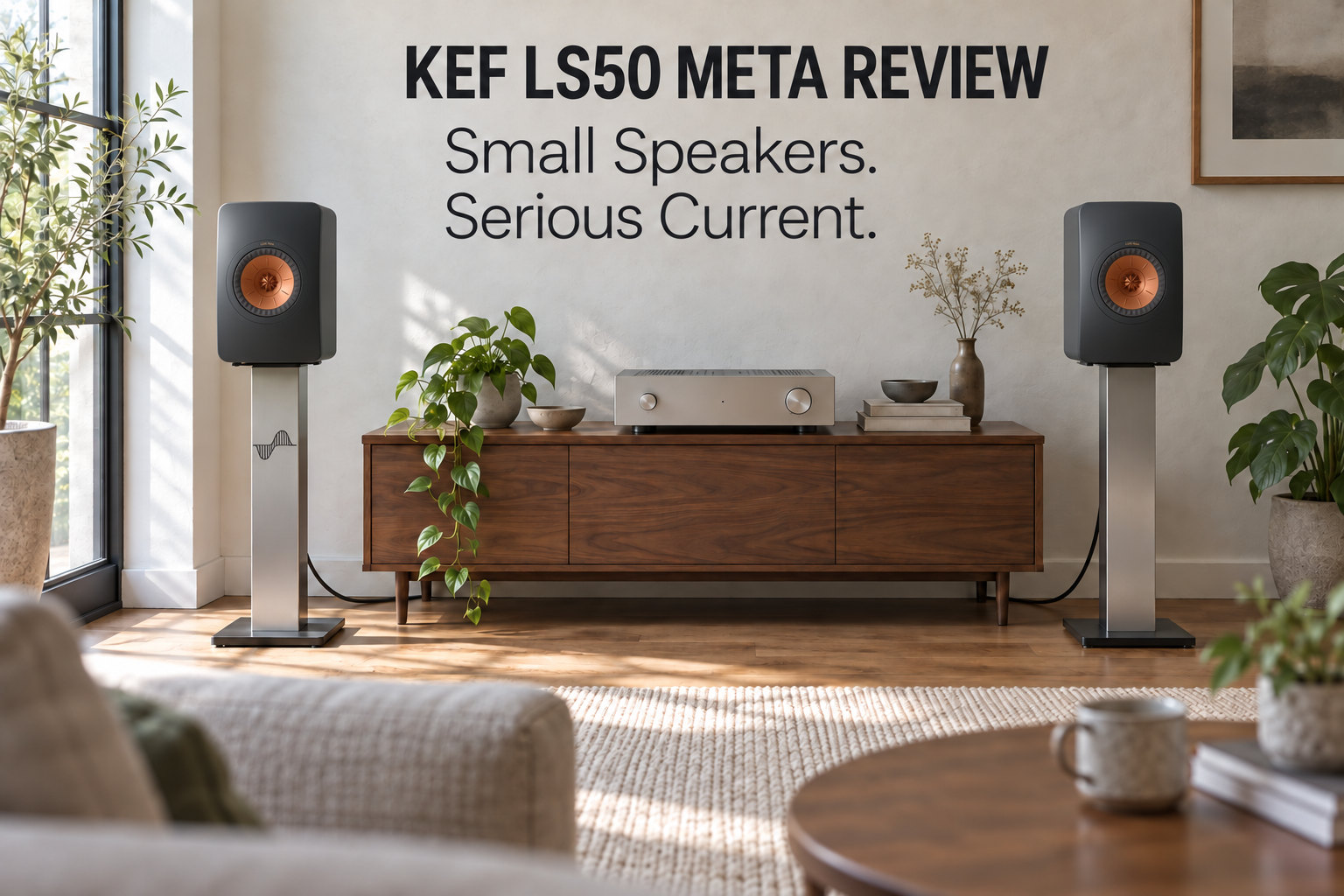
Reviewers are paid to let loudspeakers pass through their rooms. With the original KEF LS50, an unusual number of them refused to let go. Stereophile's John Atkinson bought a pair and made it his primary reference for standmount reviews. Doug Schneider of SoundStage! Hi-Fi reviewed the LS50 in 2013 and was still living with a pair when the KEF LS50 Meta arrived seven years later. John Darko kept his for six years while other speakers came and went. When a trade built on turnover keeps one small box on permanent duty, the box stops being a product and becomes a ruler.
The LS50 Meta, announced in September 2020, is that ruler re-machined. Almost six years on, at $1,599.99 a pair, $100 above its launch price, it is still the speaker every rival near its price gets held against, and deservedly so. It also carries a condition the spec sheet tucks away: this speaker runs on current, and the test benches show exactly why.
Why the KEF LS50 Meta still matters
KEF built the first LS50 in 2012 to mark its 50th anniversary, and did something perverse for a birthday model: instead of a statement floorstander, a minimonitor at $1,500 a pair. Stereophile would later call it "a modern reinterpretation of the LS3/5a", the BBC monitor that taught a generation what a small box could do; StereoNET's Marc Rushton argued the family resemblance ended at the KEF drive units. Either way, it reigned for eight years.
For the Meta, KEF kept the cabinet's size and shape and stiffened its bracing: 302 mm tall, 7.8 kg, a curved composite baffle over damped MDF. The real work went into the driver. The 12th-generation Uni-Q seats a 25 mm vented aluminium dome tweeter in the throat of a 130 mm aluminium cone, crossing over at 2.1 kHz, so treble and midrange leave from a single point. Behind the tweeter sits the part that named the speaker: Metamaterial Absorption Technology, developed with Acoustic Metamaterials Group. It is a disc about 76 mm across and 11 mm thick, threaded with 30 channels, each acting as a tuned Helmholtz resonator. KEF says it swallows 99% of the tweeter's rear-firing sound from about 620 Hz upward, energy a conventional design lets bounce back through the thin dome as distortion.
Read every label as live text
- 25 mm aluminium dome tweeter
- 130 mm aluminium cone
- Conical duct
- Metamaterial absorber: about 76 mm across, 11 mm thick, 30 channels
- Front wave: to the listener
- Rear wave: absorbed
- KEF claim: 99% of the rear wave absorbed from about 620 Hz upward
Beyond KEF, the result became the yardstick. YouTube reviewer Zero Fidelity, who says it is not his own preference, said in 2025 that his reviews of anything between $1,000 and $2,000 feel almost incomplete without an LS50 Meta comparison. Few speakers become a unit of measurement.
What the reviewers agree on
Three things recur: pinpoint imaging, palpable voices and a cabinet that seems to leave the room.
Schneider heard Lou Reed's voice locked dead centre on New York, Fred Maher's drums in their own pocket some 15 ft behind the singer. Then he set the Metas against Focal's $16,999 Diablo Utopia Colour Evo. The Focals went perhaps 5 Hz deeper, played louder and ran hotter at the top; the KEFs imaged more precisely. His verdict: "the little KEFs can't necessarily always win in the big league, but they can play in it." Atkinson heard "a more transparent window into the recorded soundstage" and vocal images that were "especially palpable", Karen Carpenter physically present in the room. Stereophile then named the Meta its Budget Component of the Year for 2021, by 11 points.
Neil Gader of The Absolute Sound found the Meta had "become less visible as a speaker". Ken Kessler of Hi-Fi News called it "KEF's The Godfather Part II. Yes, it's really that good." What Hi-Fi? gave it five stars, a run of Awards and a standing place in its own reference system.
Even the measurement camp signs up. Amir Majidimehr of Audio Science Review, no fan of the original, greeted the Meta's spinorama with "Ah, close to perfection" and recommended it. Atkinson measured dispersion as "very uniform" in both planes; Amir put the vertical behaviour more colourfully: the coaxial driver "cleans the clocks of any standard 2-way speaker". Sit up or slouch, the tonal balance barely shifts.
The only argument is one of degree: "all gain, no loss" for Schneider, 10 to 20% for Darko, "shocking" for Kessler. Gader would not even hint that owners of the original should sell.
Measurements: sensitivity, impedance and bass
| Measure | KEF specification | Independent measurements |
|---|---|---|
| Sensitivity (2.83 V, 1 m) | 85 dB | 84.5 dB (Stereophile); 84.6 dB (Hi-Fi News); 83.2 dB (NRC for SoundStage!); about 83 dB (Erin's Audio Corner) |
| Impedance, nominal | 8 ohms | Close to 4 ohms across much of the midrange (Stereophile; ASR) |
| Impedance, minimum | 3.5 ohms | 3.65 ohms at 220 Hz (Hi-Fi News); 3.7 ohms (ASR; Erin's Audio Corner) |
| Hardest load (EPDR) | Not published | 1.66 ohms at 135–140 Hz; 1.7 ohms at 660–725 Hz (Stereophile) |
| Port tuning | Not published | 50 Hz (Hi-Fi News); 51 Hz (Stereophile) |
| Bass extension | 79 Hz at −3 dB; 47 Hz at −6 dB | 40 Hz at −6 dB (Hi-Fi News); 74.7 Hz at −3 dB, 51.3 Hz at −6 dB (ASR data) |
KEF's published LS50 Meta figures against independent measurements from Stereophile, Hi-Fi News, the NRC for SoundStage!, Audio Science Review and Erin's Audio Corner.
The LS50 Meta's sensitivity holds up: four test benches land between 83 and 84.6 dB against KEF's 85, the spread mostly down to averaging method.
Impedance is the real story. Eight ohms nominal flatters the load: Stereophile and Audio Science Review both show the Meta sitting close to 4 ohms through much of the midrange. The number that matters most is one KEF does not print. Atkinson calculated the equivalent peak dissipation resistance, a measure that folds in phase angle, at 1.66 ohms between 135 and 140 Hz. Put plainly: in a band rich in musical energy, the amplifier's output transistors face the same peak dissipation as if they were driving a resistor of under 2 ohms. Atkinson's conclusion is the whole buying guide: "The partnering amplifier needs to be comfortable driving 4 ohms."
Treat the 8-ohm rating as a courtesy and the 4-ohm reality as the job description.
The bass is what a 130 mm cone and a port tuned near 50 Hz allow: anechoic output 6 dB down between 40 and 51 Hz, depending on the lab's reference. Everything else measures superbly. The cabinet proved "effectively inert", tweeter and woofer hand over cleanly in time, and Atkinson signed off with "superb measured performance, even without taking into consideration the LS50 Meta's affordable price."
Where it falls short
Physics sets the limits, and every reviewer who pushed it found them. On "Limit to Your Love" from James Blake, Atkinson heard the Meta "having to work harder than it would like to". Turned up, Schneider's pair lost "the last bit of effortlessness that bigger speakers can convey". Gader heard Mary Chapin Carpenter's "Shut Up and Kiss Me" lose its drive when the full rhythm section arrived, and noted "a ceiling hanging low over the soundstage". Amir, watching the cone at full stretch, wrote the shortest diagnosis of all: "The driver is simply too small/lacks the excursion for high dynamic range."
Find that ceiling yourself, inside the return window. KD found the edge of his Bowers & Wilkins 800-series floorstanders with a single track: Billie Eilish's "Bad Guy" drove them into clipping above about 95 dB, the story behind the Daily Bad Guy and the clip you always remember. Keep one track you know too well, play it loud, and a 130 mm cone will tell you exactly where it stops.
Then there is taste. Erin's Audio Corner, which measured the Meta on a Klippel scanner, traces the two common complaints to real traits: the "dull" or "dry" verdicts to a shallow upper-midrange dip that sounds laid-back beside brighter rivals, and the lack of envelopment to dispersion of about ±50 degrees, which trades spaciousness for focus. More power does not cure taste. YouTube's cheapaudioman tried a 150-watt Cambridge Audio amplifier and Emotiva monoblocks, still found it good, fine and, in his word, boring, and judged it too dear at $1,600 beside ELAC's Uni-Fi 2.0, very similar to his ears at about a third of the price.
Room size is the last limit, though it arrives later than the box suggests. A 60-watt Hegel drove Schneider's pair loud without strain in his 19 by 15 ft living room; in a larger room with 10 ft ceilings, Gader simply moved them a few inches closer to the back wall to recover their midbass weight. Placement splits the experts: What Hi-Fi? wants them about 50 cm into the room, Rushton firing straight ahead, Amir pointed at the listener. Start straight, toe in until the centre image locks, then follow KD's rule to measure first, and do it for free: a microphone at the seat shows what the room is doing to that bass.
Best amplifier for the LS50 Meta: current before watts
KEF recommends 40 to 100 watts. The reviewers translate. Rushton: "you'll need a gutsy solid-state amp to really get the best from it." Kessler: "This will not be happy with a 30W/ch integrated."
KD laid out the arithmetic in his Klipsch La Scala versus Wilson Yvette comparison: 19 dB separate the 105 dB horn from the 86 dB Wilson, so the La Scala needs roughly a hundredth of the power for the same level. On paper the LS50 Meta sits 20 dB below the La Scala, a hundred times the power, and like the Yvette, whose 4-ohm load drops to 3 ohms, it wants current rather than brochure watts. Watts into 8 ohms tell you almost nothing here. Look for output that climbs as impedance falls, a stated minimum load of 2 ohms and a power supply built for the dips.
How much is enough remains a live argument. On AVForums, an owner of the 40-watt Naim Uniti Atom insists the Metas "certainly are not underpowered"; another member answers that punch and bass definition are exactly what 40 watts gives away. Class D divides opinion too: Schneider did his critical listening through a Purifi Eigentakt power amplifier, while Zero Fidelity hears cheap, clean class D as too thin a match and prefers warmer partners such as Hegel and Unison Research. Thin and cheap is the risk, not the topology.
One brand recurs across reviews and forums alike. Schneider and Darko used Hegel's H95. One AVForums member says it "will drive them fine" but that the H120, since replaced by the H150, "will do noticeably a better job". One StereoNET member reports KEF's Australian distributor, Audio Connect, steering him to the H120, the H190 or Arcam's SA30.
| Budget | Amplifier | Rated power | Who backs it | What it brings |
|---|---|---|---|---|
| About $500 to $600 | NAD C 316BEE V2 | 40 W into 8 or 4 ohms | Darko Audio | Rich, punchy mid-bass; least resolving here |
| About $1,200 | Cambridge Audio CXA81 (now Mk II) | 80 W into 8 ohms, 120 W into 4 | What Hi-Fi? | The magazine's suggested partner |
| About $2,000 | Hegel H95 | 60 W into 8 ohms, stable to 2 | SoundStage! Hi-Fi; Darko Audio; one AVForums member | More resolution than the NAD |
| About $3,600 | Hegel H150 (replaced the H120 in late 2025) | 75 W into 8 ohms, stable to 2 | One AVForums member (for the H120) | The H120 did "noticeably a better job" than the H95 |
| About $4,200 | Hegel H190v | 150 W into 8 ohms, stable to 2 | Owners of the earlier H190 on StereoNET and AVForums | "Outstanding" to one StereoNET owner; a little too clean for one AVForums owner |
Pairings named in reviews or by forum members, with approximate US prices and manufacturers' power ratings.
The ceiling is high. Atkinson reviewed the Meta through Parasound JC 1+ monoblocks, $16,990 a pair at their 2020 launch and more than ten times the price of the speakers. The speaker keeps improving as the amplifier does; the bass limit stays where the cone puts it.
KEF LS50 Meta vs LS50 Wireless II and R3 Meta
The LS50 Wireless II costs $2,999.99, $1,400 more, and builds in what the passive speaker leaves you to buy: 380 watts of amplification in each cabinet, streaming, HDMI eARC and a ±3 dB response KEF rates down to 45 Hz, depending on EQ, against the passive model's 79 Hz. Darko lived with both for weeks. The active pair had more low-end weight, detail and dynamic snap; the passive pairings sounded smoother up top and more cohesive, and he refused to call them inferior. His pastry metaphor sticks: the active speaker separates its layers like filo, the passive pairing holds together like shortcrust. Buy the Wireless II for a television, a desk or all-in-one simplicity. Buy the Meta to keep the upgrade path open: the Wireless II's amplification can never be changed.
The R3 Meta costs $2,499.99, $900 more, and is a different animal: a three-way, 422 mm tall and 12.4 kg, with a 165 mm bass unit beneath its Uni-Q, rated at 87 dB and 6 dB down at 38 Hz. What Hi-Fi? hears "notably more in terms of low-frequency reach, refinement and openness", though "you might miss out on the LS50 Meta's lovely sense of integration". Erin's comparison shows the R3 Meta filling in the presence region the LS50 Meta leaves slightly shy. It is the right call for a bigger room, louder habits or anyone who hears the LS50 Meta as polite. It is no easier a load: 4 ohms nominal, 3.2 minimum, though its 87 dB sensitivity asks for a little less power.
Verdict
Buy the LS50 Meta if your room is small to medium, your seat is fixed, and voices, space and focus matter more than the last octave, and only with an amplifier that stays calm at 4 ohms. Add a subwoofer if you play bass-heavy music loud, as both StereoNET and ASR advise. In that setting nothing at $1,600 does the disappearing act more convincingly, and the speaker rewards better electronics far beyond its own price.
Spend the money elsewhere if you want concert levels and deep bass in a large room, amplification and streaming inside the cabinets, a brighter, more forward sound, or if your amplifier is a 30-watt integrated you intend to keep. And watch the price: it has dipped to about $1,000 in past sales.
The LS50 Meta is still the ruler. Feed it current, and it will measure everything else honestly, including the amplifier you chose.
More from the Journal
Keep exploring.
Loading articles…