

The Journal / Articles & reviews
Why Is McIntosh So Expensive? Blue Meters, Binghamton and the Economics of Staying Power
Sixty years of blue meters, seventy at one Binghamton address and used prices that hold: the case for and against the McIntosh amplifier premium.
In April 1951 a small amplifier company from Silver Spring, Maryland, moved onto the second floor of an old building at 320 Water Street in downtown Binghamton, New York. Roger Russell, who joined the firm as an engineer in 1967 and later wrote a detailed history of it, kept the worry of the day on record: some people wondered whether the old floor could support the heavy equipment.
Why is McIntosh so expensive? Start with that floor. A McIntosh amplifier has always been sold by the pound, and the company was born of a grievance, not a look. Frank McIntosh had spent ten years at Bell Telephone Laboratories before he ran a small consultancy near Washington that designed radio stations and sound systems. The work demanded high power at low distortion, and nothing on the market could supply it; most amplifiers, in Russell's account, "failed to meet their published specifications." In 1946 McIntosh hired Gordon Gow as an engineering assistant to help build one that would. The result was the 50W-1: 50 watts from 20 Hz to 20 kHz at under 1 percent distortion. US patent 2,477,074, the first of five on its output circuit, was granted to Frank H. McIntosh on 26 July 1949, the year the company was incorporated.
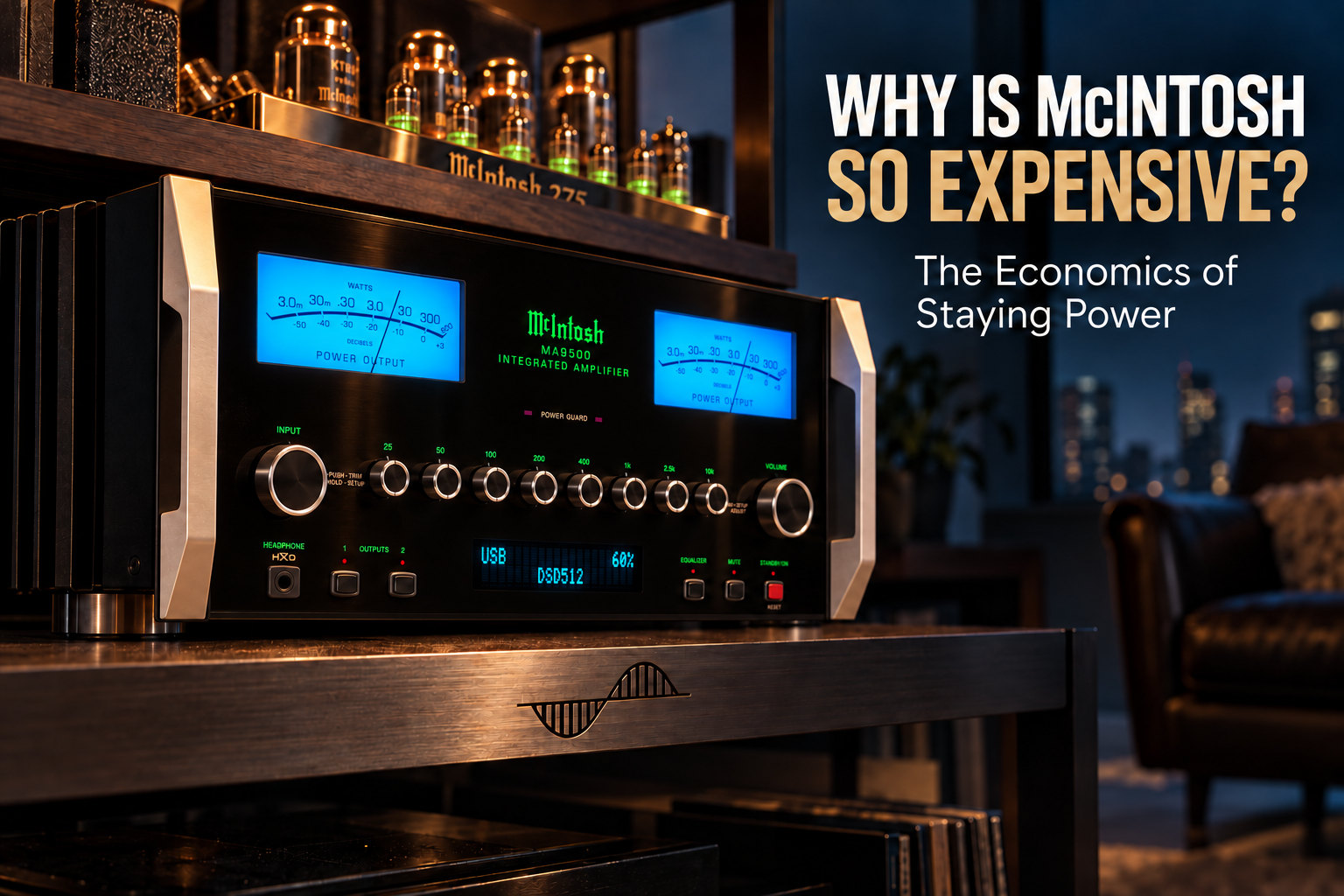
Seventy-seven years on, nobody asks whether a McIntosh works. They ask about the bill: about $5,000 for the cheapest integrated amplifier, about $14,000 for the MA9500, $15,000 for the all-tube MA2375 that arrived this week. The short answer is that McIntosh still builds the way it decided to in 1949 and 1951, heavy and by hand in one New York factory, and it charges for every pound. The long answer runs through iron, glass, six owners and a used-market price list, and not all of it flatters the brand.
Read every label as live text
- 1942
- 1950
- 1960
- 1970
- 1980
- 1990
- 2000
- 2010
- 2020
- 2026
- 1946 - Gordon Gow joins to develop a new amplifier
- 1949 - US patent 2,477,074 granted (26 July); 50W-1: 50 W, 20 Hz-20 kHz, under 1% distortion
- 1961 - MC275 introduced: 2 x 75 W
- 1967 - MC2505: first McIntosh separate solid-state power amplifier; glass front panel, blue output meters, autoformers
- 1969 - McIntosh amplifiers at Woodstock
- 1974 - Grateful Dead 'Wall of Sound' debuts on 48 MC2300 amplifiers (23 March)
- 2022 - MA9500 announced at $12,000 (February)
- 2026 - MA2375 all-tube integrated, 75 W per channel (3 June)
- 1942 - Frank McIntosh runs a consultancy near Washington, D.C., designing radio stations and sound systems
- 1949 - Company incorporated (January)
- 1951 - Moves to 320 Water Street, Binghamton, New York (April)
- 1956 - New plant built at 2 Chambers Street, Binghamton
- 1977 - Frank McIntosh retires; Gordon Gow becomes president
- 1990 - Clarion buys McIntosh for $28.6 million
- 2003 - D&M Holdings (May)
- 2012 - Fine Sounds, Milan (October)
- 2014 - Management buyout; the group later becomes McIntosh Group
- 2022 - Highlander Partners buys McIntosh Group (June)
- 2024 - Bose completes purchase of McIntosh Group (15 November)
- 2025 - Price increases of 10-18% reported
Why is McIntosh so expensive? The patents behind the look
The blue glow sells the brochure. The business was built on transformers.
The Unity Coupled circuit attacked the weakest link in a 1940s tube amplifier: the output transformer that matches high-impedance tubes to a low-impedance loudspeaker. In Russell's figures, a conventional push-pull pair of 6L6 tubes wanted to see 4,000 ohms, so driving an 8-ohm speaker took a 500:1 impedance ratio and a 22:1 turns ratio. The leakage inductance and stray capacitance of all those turns rolled off the treble and added distortion where one tube handed over to the other. McIntosh and Gow wound the primaries bifilar, two wires side by side, linking each tube's plate to the opposite tube's cathode. The effective load fell to 1,000 ohms, the impedance ratio to 125:1, the turns ratio to 11:1. For a listener, that meant a tube amplifier that kept its bandwidth and low distortion at full power. The name came later, from a contest McIntosh advertised in High Fidelity in 1954, and McIntosh still uses it for the output transformers of today's MC275 and the new MA2375.
The second pillar arrived in 1967 with the MC2505, McIntosh's first separate solid-state power amplifier, and its autoformer. Transistors can drive a speaker directly, Russell explains, but an output stage designed for 8 ohms can double or quadruple its heat dissipation into 4 or 2 ohms, and speakers rated at 8 ohms can dip to 4 at some frequencies, some 4-ohm designs lower still. McIntosh designed its output stages for one low optimum load, about 2.1 ohms in Russell's account, and put a tapped autotransformer between them and the speaker. Connect each speaker to its matching tap, and the transistors see the same load every time.
Read every label as live text
- One load, three speakers
- 300 W delivered directly, without an autoformer
- McIntosh MA9500: measured dynamic power through the matching tap
- Output stage: designed for one optimum load (about 2.1 ohms)
- 8 Ω
- 4 Ω
- 2 Ω
- Same load seen by the transistors
- 8 Ω
- 49.0 V
- 6.1 A
- 4 Ω
- 34.6 V
- 8.7 A
- 2 Ω
- 24.5 V
- 12.2 A
- Current rises as impedance falls, and so does heat in the output stage. Values are rms, from P = V²/R.
- W
- 0
- 250
- 500
- 750
- 1,000
- 1,250
- 597
- 8 Ω
- 557
- 4 Ω
- 582
- 2 Ω
- 1020
- 1 Ω (2 Ω tap)
- Rated 300 W
- Hi-Fi News lab report, 2022
The bench agrees. When Hi-Fi News measured the MA9500 in 2022, its dynamic output barely moved with the load: 597 watts into 8 ohms, 557 into 4 and 582 into 2, each through the matching tap, and 1,020 watts into a single ohm through the 2-ohm tap. Continuous output was 430 watts against a 300-watt rating. A published specification beaten by more than 40 percent is Frank McIntosh's founding grievance, answered in copper and steel. The autoformer also shunts a DC fault away from the speaker's voice coil. Stereophile's John Atkinson, measuring the MC462 power amplifier in 2019, found that its output transformers did not compromise low-frequency reproduction and called it "an extraordinarily well-engineered, exceptionally powerful amplifier."
The bill arrives in three places. Russell concedes that the autoformers "added extra cost, weight and took up extra space", and the MA9500 weighs 45.8 kg, about 101 pounds. The wrong tap is punished: Atkinson's MC462 delivered 516 watts into 8 ohms from its 8-ohm tap, beating its 450-watt rating, but only 190 watts into the same load from its 2-ohm tap. And every one of those transformers is wound by hand and paid for in Binghamton.
Then the meters. Russell, arriving for his job interview on a cold February day in 1967 with snowflakes in the air, saw the MC2505 on the production line "with a gorgeous illuminated, black glass panel and blue meters." It was, he wrote, love at first sight. The meters were engineered, not merely styled. The problem was rise time, how fast a needle could follow real music; Gow's experiments ran from a starting pistol to the fastest rise time they found, two pins struck together. The MC2505's drive circuit made the needles track fast waveforms to better than 90 percent accuracy, then stretched the peaks so an eye could catch them. Asked in 2021 about the blue meters and the green logo, McIntosh's long-time president Charlie Randall answered with a smirk: "Don't quote me on this 100%, but there was definitely some psychology behind it all. Something about creating a very special feeling for our customers that nobody else can deliver." Strip out the psychology and the meters still give an owner a live account of how hard the amplifier is working. No spec sheet does that.
One factory, built by hand
The floor question was settled in 1956. McIntosh built its own plant at 2 Chambers Street, just off Conklin Road, and by the company's account construction took eight months. The concrete for the new floor, Russell records, came from the McIntosh Concrete Company, a local firm with no connection to the lab. Seventy years on, the address has not changed, and in essentials neither has the method.
The oldest and busiest machines in the building, Russell wrote, were the transformer winders, running practically every working day. Bifilar windings came off two reels at once, cores went on, and each transformer was sealed into a steel can filled with tar. On a 2021 visit for ecoustics, Ian White found transformers still wound by hand, one worker telling him she would make "over 1,000 transformers this month by hand." Every finished unit was bench-tested, heatsinks were bought in, and the plant ran five or six days a week with, by White's estimate, a few hundred people. Beside the lunchroom, technicians were restoring vintage and used McIntosh audio gear, and Randall explained why that bench exists: "Imagine driving across the country with your amplifier on the front seat because you're too afraid to ship it via FedEx or UPS. Our customers value their equipment that much."
That is where a large share of the money goes: American labour, hand assembly, heavy parts, one plant and a service bench that still opens decades-old chassis. It is also where the exposure lies. Stereophile reported in 2025 that even this factory relies on some imported parts and sells much of its output overseas, leaving it open to tariffs in both directions.
The care reaches the doorstep: KD's MA9500 arrived box within a box, bolted to a wooden base and hand-wrapped, and it took four people to carry. His shorthand for what came out of the crate is "built like a tank, sounds like life itself." On camera he put the rest in one line: "specifications have never told the whole story of McIntosh."
Who owns McIntosh Labs now
Frank McIntosh ran the company more like a family business than a corporation until he retired in 1977; Gow ran it until his death in June 1989. In 1990, the year McIntosh died, the Japanese car-audio maker Clarion bought McIntosh Laboratory for $28.6 million. The carousel followed. D&M Holdings in May 2003. Milan's Fine Sounds in October 2012. A 2014 management buyout led by Fine Sounds chief Mauro Grange and McIntosh president Charlie Randall, after which the group took the McIntosh name. Dallas private-equity firm Highlander Partners in June 2022. Then Bose, of Framingham, Massachusetts, which completed its purchase of McIntosh Group, Sonus faber included, on 15 November 2024. Six owners in 34 years, and the factory never moved.
Bose's logic was candid. "There are places today where the Bose brand probably can't go," chief executive Lila Snyder told CNBC, and McIntosh would keep building in Binghamton. McIntosh Group chief executive Daniel Pidgeon talked about tapping Bose's expertise as "a pioneer in automotive audio." Thirty-four years after Clarion, car audio was back in the room.
What moved first was the price. Months after the sale, Stereophile reported McIntosh increases of 10 to 18 percent. Since its 2022 launch, the MA9500 has gone from $12,000 to about $14,000. What has not moved is the vocabulary: this week's MA2375 is a tube amplifier with unity-coupled output transformers and blue watt meters. If Framingham meant to dilute Binghamton, it has an odd way of showing it.
The resale argument
Resale value is not a law of nature. In the 1970s, Sam Tellig remembered in Stereophile, "used Mac tube amps went for a song": tubes were considered obsolete, tube factories were closing and McIntosh was said to be running short of spares. The value came back with the collectors and stayed. The MC275 sold for $444 under a December 1963 price list, when, as Tellig recalled, a stripped new Chevy cost $2,000. A new MC275 now costs about $7,500, and Tellig's name for it still fits: "the Count Dracula of power amps. It refuses to stay dead."
The modern numbers are firmer than forum folklore. Between January and May this year the US pre-owned specialist The Music Room listed used MA9500s at $9,699 to $9,999, two more still sealed in factory packaging at about $10,400 to $10,500, and, in late May, a used MA12000 at $13,799. Against new prices of about $14,000 and $17,500, that is around 70 percent for a used MA9500 and nearly 80 percent for the MA12000. Measured against the MA9500's 2022 launch price of $12,000, the used asking prices equal 81 to 83 percent of what a first owner paid. A dealer's asking price contains a margin; a trade-in or private sale nets less.
Three forces hold the floor up: list prices that keep rising and pull used prices higher, a look that has not dated in sixty years, and a factory that still services what it built.
The dissent deserves a hearing. In a 2012 What's Best Forum thread, one member granted that McIntosh resale was "above average but they sell a lot" and predicted that "the long term resale value wont be strong"; another rated FM Acoustics first for resale "by a light year." Fourteen years on, the volume argument has aged worst: plenty of units means plenty of buyers, and that liquidity is part of why McIntosh resells.
Price it in as a discount on the cost of ownership, never as an investment. Suppose a $14,000 McIntosh amp nets $8,400, 60 percent of its price, in a private sale five years later: it has cost $5,600, or about $93 a month. Buy the volume models that trade easily, keep the box and the paperwork, have it serviced, and the arithmetic holds. Buy a two-year-old one from a dealer with a warranty, and someone else has paid for the steepest part of the curve.
McIntosh amplifier prices: where the premium does not buy sound
Start with watts. At the top of the range, McIntosh is not gouging on power. The MA9500's 300 watts at about $14,000 sit between Hegel's H600, about $13,500 for 303 watts, a DAC and network streaming, and Marantz's Model 10, $15,000 for 250 watts into 8 ohms and no DAC. Inside McIntosh's own catalogue the arithmetic collapses on purpose: the MA2375 costs $1,000 more than the MA9500 and delivers a quarter of the power. Nobody buys either for watts per dollar.
Features are thinner than the prices suggest. Nine models in McIntosh's integrated range are sold in the US, counting the MAC7200 receiver; a tenth, the MA7200, is reserved for other markets. Only the MSA5500 streams on its own. The MA9500 carries an ESS-based DAC module but, as Hi-Fi News pointed out, no network connection, so a $14,000 amplifier still needs a streamer. The autoformer, the brand's best engineering argument, starts at about $9,500.
| Model | Type | Power per channel | Output stage | US list price, about |
|---|---|---|---|---|
| MA252 | Hybrid: tube preamp, solid-state power | 100 W into 8 ohms, 160 W into 4 | No autoformer | $5,000 |
| MA5300 | Solid state | 100 W into 8 ohms, 160 W into 4 | No autoformer | $7,000 |
| MSA5500 | Solid state, streaming built in | 100 W into 8 ohms, 160 W into 4 | No autoformer | $8,000 |
| MA352 | Hybrid: tube preamp, solid-state power | 200 W into 8 ohms, 320 W into 4 | No autoformer | $8,000 |
| MAC7200 | Solid-state receiver | 200 W into 2, 4 or 8 ohms | Autoformer | $9,500 |
| MA8950 | Solid state | 200 W into 2, 4 or 8 ohms | Autoformer | $10,500 |
| MA9500 | Solid state | 300 W into 2, 4 or 8 ohms | Autoformer | $14,000 |
| MA2375 | All tube | 75 W into 4, 8 or 16 ohms | Unity Coupled output transformers | $15,000 |
| MA12000 | Hybrid: tube preamp, solid-state power | 350 W into 2, 4 or 8 ohms | Autoformer | $17,500 |
Power as rated by McIntosh; prices are approximate US list prices, and dealers may discount. The autoformer starts with the MAC7200, and only the MSA5500 streams on its own.
Then the sound. The most durable myth is that every McIntosh is warm. Hi-Fi News heard the solid-state MA9500 as "a long way from the famous McIntosh 'valve sound' of yesteryear", "spry and lean, lacking much romantic bloom." KD, who lived with one for years, calls it bold and authoritative, musical enough to play for hours without fatigue. Rooms, speakers and ears differ, and neither account describes the syrup of the stereotype. Noise, by the magazine's measurement, is "moderately low": good, not class-leading.
And there is a ceiling. With Wilson Audio Yvettes playing at around 95 dB, KD felt his MA9500 was "not struggling, McIntosh doesn't struggle, but pushing its limits." The step past that ceiling is separates, at tens of thousands of dollars more. The glass and the meters are paid for in every unit, and neither makes a sound.
McIntosh MA2375: the tube integrated returns
On 3 June McIntosh introduced the MA2375, in its own words the company's first vacuum-tube integrated amplifier in more than a decade. It runs twelve tubes: four KT88 output tubes and four 12AT7 drivers in the power section, two 12AX7A and two 12AT7 in the preamplifier. Unity Coupled Circuit output transformers deliver 75 watts per channel into 4, 8 or 16 ohms, the same rating and output tubes as the MC275. There is an MM/MC phono stage, a five-band analogue equaliser, a headphone amplifier with crossfeed and a pair of blue watt meters. There is no DAC. It weighs 93 pounds. McIntosh announced no price; a US dealer, Audio Advice, listed it at $15,000 on launch day, Gear Patrol reported.
The signal is hard to miss. One of the company's first major home-audio announcements under Bose, as CE Pro noted, is a machine built on a 1949 patent family and priced $1,000 above the 300-watt MA9500. McIntosh is selling heritage you can touch: glass bottles, wound iron, swinging needles. No independent review exists yet, so the case rests on the formula, which makes the MA2375 a speaker-matching decision first. Seventy-five tube watts belong with sensitive loudspeakers, not with power-hungry ones.
Is McIntosh worth it for you?
The answer depends less on the amplifier than on the speakers it will drive. Price the speakers first.
- Speakers under about $5,000: no. The cheapest McIntosh integrated costs as much as the speakers, and the system ends up with one hero component on a weak foundation. Spend on the speakers and the room, and measure the room first, for free.
- Speakers from $5,000 to $10,000: only if you mean to keep the amplifier for a decade. The MA252 and MA352 hybrids are the sensible way in, and the build, the resale and the service bench are what you buy over a rival.
- Speakers from $10,000 to $20,000: the sweet spot. An autoformer integrated, the MA8950 or MA9500, earns its keep with speakers that dip low in impedance and owners who play loud.
- Speakers above $20,000, and highly revealing: separates earn an audition. KD's rule from the channel's MA9500-to-separates film is blunt: "You should not upgrade if your speakers are under $20,000."
- Sensitive speakers and a love of tubes: the MA2375 is the purest McIntosh in the catalogue, but let the first reviews land before spending $15,000.
- Value hunters: a two- to four-year-old autoformer integrated from a dealer with a warranty is the best-value McIntosh there is.
KD's verdict on the amplifier that started his McIntosh years has not softened:
The MA9500 was and still is one of the best integrated amplifiers ever made. Period.
He explains why he calls it his single best purchase: not for what it cost, but for what it carried. That is the honest case for the premium. Frank McIntosh built his first amplifier because the others did not keep their promises. Seventy-seven years later the company still sells the same thing: a power rating that turns out to be conservative, in a box heavy enough to make people worry about the floor.
More from the Journal
Keep exploring.
Loading articles…