

The Journal / Articles & reviews
The Upgrade With No Gear in It: What a New Listening Room Did to the Same System
Nothing in the signal chain changed; the music listening room around it did, and the system I thought I knew turned out to have far more to give.
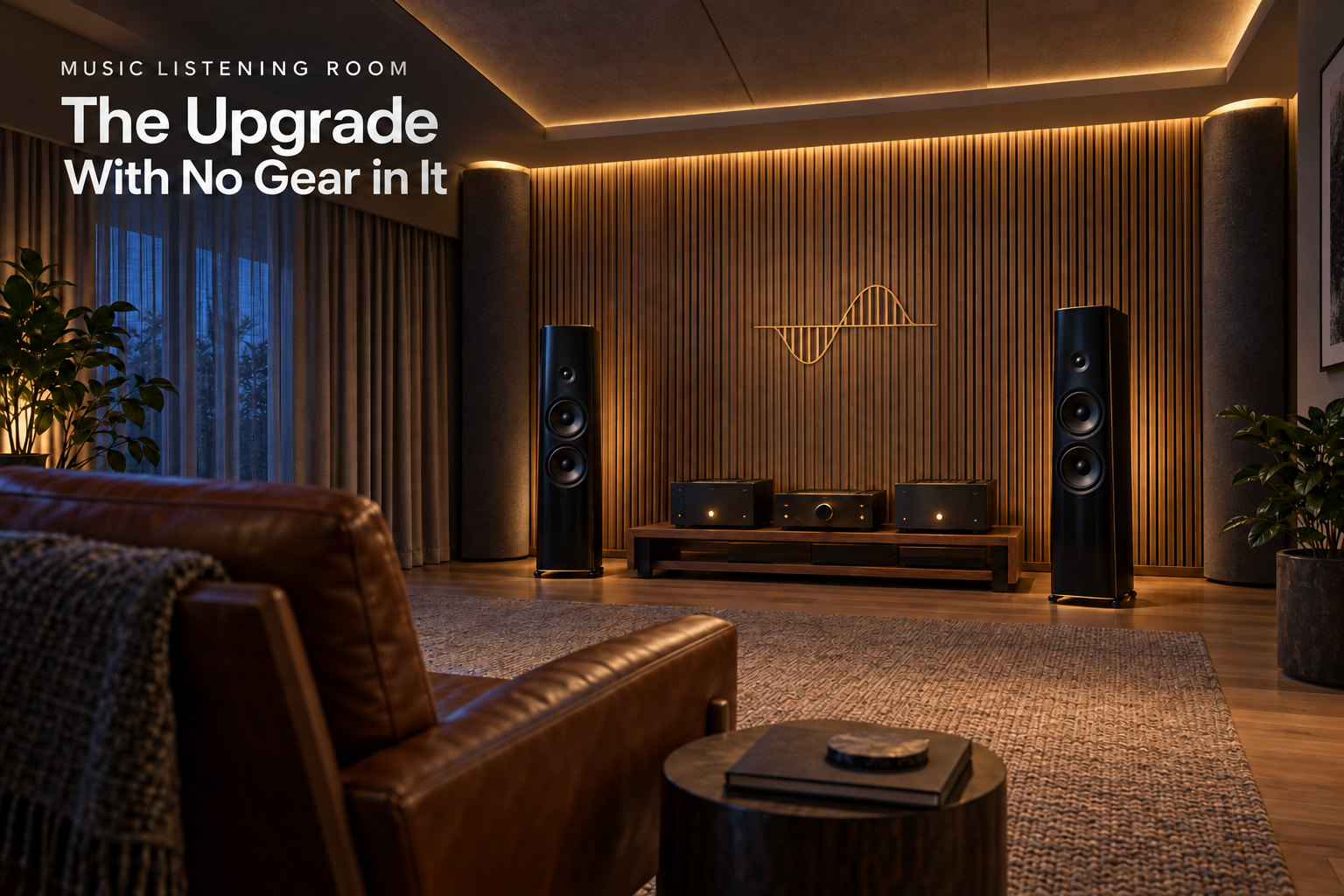
In my first serious listening session in the new room, the helicopter on The Wall finally flew.
I had made sure I was alone for it. The music listening room was finished, the crews were gone, and I wanted my first impressions to be mine and uninfluenced: no partners from The Sound Lab, no distractions. So I let the 24 seconds of rotor noise that open "The Happiest Days of Our Lives" begin, and for the first time in my system the helicopter appeared high on the ceiling, to my right. It came closer, toward my listening position, then moved out to the left and kept going until it vanished. And it stayed high the whole way, because at the end of the day it is a helicopter, and it is flying. The soundstage had height: real, dimensional, exactly as it should be.
Nothing in my signal chain had changed. Same Wilson Audio Yvettes, same McIntosh C12000 preamplifier, same MC611 monoblocks, same Transparent cables, same sources. Only the room changed, and the power feeding it. It is how I opened the film that showed you this room:
I thought I knew what my Wilson Audio Yvettes and my McIntosh separates could do, and I was wrong. They had more to give, a lot more. I just never gave them the room to prove it.
The room I was cursed with
My previous listening room was around 800 square feet, which sounds generous until you learn it was L-shaped. One leg held the entrance and the common area; the small leg was cramped with the entire audio system. One electrical circuit, shared by everything. One possible speaker position, dictated by the layout. The listening seat sat three and a half metres from the speakers with zero gap to the back wall. The left speaker was exposed to a massive open area; the right one was pushed against a full glass wall leading to the balcony. Beautiful views, beautiful size, a nightmare by every audiophile standard.
The Yvette's own manual warns that a speaker placed too close to a sidewall suffers a strong primary reflection, which cancels some frequencies and changes the tonal balance of the music. My right speaker was not close to a sidewall. It was against one, and the wall was made of glass.
I said it publicly, many times, to people in the industry: I am cursed with the worst room possible.
I did not accept the curse quietly. I bought the McIntosh MEN220, a room-correction processor built under licence from Lyngdorf around its RoomPerfect technology. When I first applied it, the correction measured 37%, which, as I said when I unveiled the new room, is the highest correction ratio we have ever recorded in any room. Then came acoustic panels, absorption and diffusion, and the correction dropped to the mid-teens. The problems stayed. A processor can compensate for a room's geometry. It cannot move a wall.
And correction sends its own bill. The MEN220 improves imaging, soundstage, levels and timing, but it is a digital processing system. Place it in a pure analogue chain and everything is converted to digital on the way through, and I could hear what went missing: the airiness of the tubes, the long tails, the shimmer on metal instruments, the dynamics. Better balanced, perhaps more correct, but less alive.
Choosing a room, not a component
Here is the truth no brochure will print. Changing a preamp is a discussion. Changing the room around your system is a different conversation altogether, and most of us never have it. We take the room we are given, call it an audiophile listening room, and spend years negotiating with it through gear. I did exactly that, upgrade after upgrade, chasing problems no box could fix.
The biggest problem in my system was not a component. It was the room, and that had to change first. So when the opportunity came, I already had a plan, and the first line of my listening room design had nothing to do with panels, cables or electronics. It was a shape.
I wanted a butterfly layout: a living room of 1,000 square feet or more and, crucially, rectangular, with the other rooms branching off to the left and to the right. That shape had one job, and the job was freedom. No more being forced into a single position by the walls. In the old space, the floor plan placed my speakers. In the new one, I wanted my ears to place them.
Read every label as live text
- Before: L-shaped, about 800 sq ft
- Entrance and common area
- System leg
- One possible speaker position
- Left speaker: exposed to a large open area
- Right speaker: against a full glass wall (balcony beyond)
- 3.5 m
- Seat: zero gap to back wall
- 1 shared circuit
- After: rectangle, 1,000 sq ft or more
- Rooms branch left
- Rooms branch right
- Mild absorption under natural-wood panels
- Corner bass traps
- Custom ceiling absorption (overhead)
- Thick layered curtains on windows and openings
- Zone of neutrality, one per speaker
- 2 x 40 A dedicated circuits, one per monoblock
- Separate filtered circuit: preamp, DAC, sources
- Schematic, not to scale
Five steps to a music listening room
The room project is why the channel went quiet between November and February, and the film that explained the silence shows the result on camera. Step one was the layout. Step two was power, and it was non-negotiable: new lines pulled directly from the main power board in thick copper, two dedicated 40-ampere circuits, each feeding one MC611 monoblock and nothing else. The C12000, the DAC and the sources share a separate circuit filtered through the IsoTek conditioning I already owned. Everything terminates on brand-new outlets and switches, with no reliance on the old wiring.
Step three was acoustics, measured and balanced for a space that still had to work as a living room. Step four was the look: paint, fabrics and light chosen to sit with the system and the furniture. The table has the detail.
Step five was the execution: about 10 to 14 days end to end, several crews working in parallel on the electrics, the construction, the treatment and the finishing. When the crews left, a local dealer moved and installed the system. Not a moving company. Conventional movers are not equipped for this kind of equipment, and good luck getting money out of their insurance.
| Step | What was done | Why |
|---|---|---|
| 1. Layout | Butterfly layout; rectangular living room of 1,000 sq ft or more; other rooms branching left and right | Freedom to place the system where it sounds best |
| 2. Power | Two dedicated 40 A circuits from the main board, one per MC611 monoblock; a separate circuit through IsoTek conditioning for preamp, DAC and sources; all-new outlets and switches | Each amplifier on its own line; nothing else on the amplifier circuits; no old wiring |
| 3. Acoustics | Mild absorption behind the system under natural-wood panels; corner bass traps; custom ceiling absorption; thick layered curtains | Control pressure at high volume and outside noise without deadening a living room |
| 4. Aesthetics | Paint and fabrics matched to system and furniture; discreet LED and cove lighting | A room you want to sit in for hours |
| 5. Execution | About 10 to 14 days, several crews in parallel; system moved and installed by a dealer | Done once and done right |
What was done, in what order and why. The room and its power changed; the signal chain did not.
And here is what surprised me most: you do not need to build from scratch. A fully furnished room, roughly two weeks of work and a reasonable investment can get you very close to a dedicated listening room.
You do not need six figures. You need a plan, the right room shape and the discipline to execute.
Placement, with real choices
I judged nothing at first. The system played for 10 to 20 hours on the new circuits; I wanted the capacitors charged and properly warmed. Then came the speakers, and for that I followed WASP, the Wilson Audio Setup Procedure.
If you have never seen it done, it looks slightly ridiculous, and it works. The instrument is your own voice and a roll of tape. You stand against the wall behind where a speaker will go and talk out into the room at a steady, moderately loud volume. Against the wall your voice sounds heavy and chesty. Walk slowly forward and it frees up; then, at some point, it changes, sounding more tonally correct and becoming easy for someone in the listening seat to locate. That is the inner edge of what Wilson calls the zone of neutrality, the area where the speakers interact least with the room's boundaries. Tape on the floor. Keep walking until your voice starts to lose focus again: the outer edge. Repeat from the side wall, and the tape marks form a rectangle for each speaker. In Wilson's manual, the gap between the inner and outer marks usually runs from eight inches in small, interactive rooms to three feet in large, more neutral ones.
In my old room, WASP gave me almost no room to move. Here, I had real choices, and it did not take long to find the spot where the speakers' best position and the room's aesthetics made their concessions to each other.
What changed on records I know by heart
The helicopter was only the opening act.
Dave Brubeck's "Take Five", from Time Out: Paul Desmond's tune in five-four, cut at Columbia's 30th Street Studio in New York in July 1959. The quartet was more organic and alive than ever, the instruments filling the room at proper scale and in proper positions, the imaging perfect. And in Joe Morello's drum solo the kick drum was room-filling for the first time. The drummer did not get louder. The room stopped fighting the bass.
Then the Cowboy Junkies and "Mining for Gold", the a cappella opening of The Trinity Session, an album made in Toronto's Church of the Holy Trinity in late 1987 with the band circled around a single microphone. In the new room you can hear the church. The ambient noises, the fans, the background elements, all there at the right size and in the right position, everywhere around you. You are in the church. The sense of space was no longer a suggestion. It was a reality.
Then the bass test: "Giorgio by Moroder", Daft Punk's nine-minute portrait of the producer in his own voice, from Random Access Memories. Tracks like this do not just test how low a system goes. They test whether the bottom end has three dimensions, and they can overload a room badly enough to damage the imaging. The new room took it without flinching. The bass was textured, dimensional, arriving from multiple angles, the room acting as a speaker itself, controlling the low end and making the speakers disappear. For the first time I had the feeling of wearing headphones, that enveloping, intimate quality, but with the physical substance and pressure of real bass that headphones simply cannot deliver.
I owe you a footnote. When I put the Yvette against the Klipsch La Scala, I said the Yvette's low end would be dominated by the room's properties, and that I bought them because I had the foundation: the electronics, the sources, the cables, my room treatment. The first half was truer than I knew. As for the foundation, I had the treatment. I did not yet have the room.
Still a living room
None of this looks like a studio, and that is deliberate. If the room looks like a recording studio, it does not feel like home. And if it does not feel like home, you will not enjoy sitting there for hours. Part of the listening ritual is what the eyes see while the ears work.
And I know the other danger first-hand: you can over-treat a hifi listening room. I have done it more than most, and a room treated to death becomes exactly that, lifeless. Here the treatment is mild where the eye lands and serious where it rarely does: wood on the wall behind the system, curtains that read as curtains, and the heavy work overhead, in the ceiling.
Since that first session there have been many more: critical listening, casual listening, sessions spent adjusting. Every one of them confirms the same thing. The new room brought back the excitement of this hobby.
Before you spend $5,000 on a component
My system sounds like a different system. More precisely, it finally sounds the way it always could; my old room was holding it hostage. The improvement is not subtle. It is transformative.
So here is the rule. If you are about to spend $5,000, $10,000 or $20,000 on a new component and your room has obvious problems, stop. Fix the room first. The return on investment is not even comparable.
You do not need a new room to begin. The ladder of listening room ideas I laid out in the first film I made about the room still stands. Move the speakers first, because positioning costs nothing. Spend no more than $500 to start on first-reflection absorption and diffusion, one panel at a time. Put a similar amount into corner bass traps. Measure before you put serious money anywhere else: free software such as REW and a microphone will show you the problems, and even a hand clap tells you whether the room echoes. And when the day comes for new speakers, treat the room first and choose the speakers to suit it, never the other way around.
They cannot sell you a room. That is exactly why it is the one upgrade nobody pushes, and the first one I would make again.
More from the Journal
Keep exploring.
Loading articles…