The Journal / Articles & reviews
Vinyl vs Digital: Which Actually Sounds Better? The Answer I Gave Omar
My friend Omar heard my records and my streamer and asked which was better; the honest answer needed a different word.
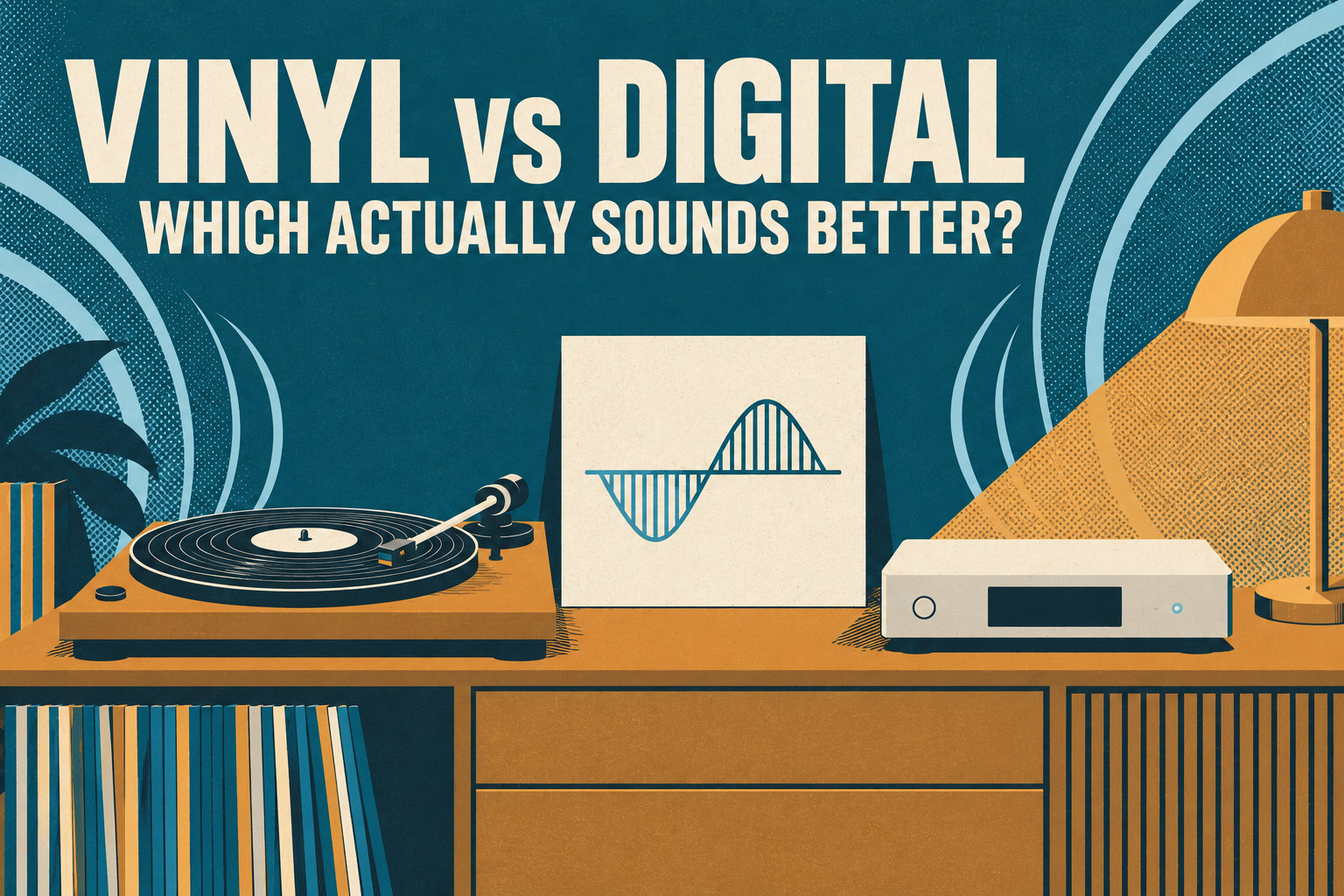
"I feel I like records more, but I think the CDs and the streamer have better quality." My dear friend Omar wrote that after hearing my vinyl collection, which he called a unique experience, and my streamer, on which everything was crystal clear and detailed. He sent it to KD Answers with one question: "What would you say is better?"
So, does vinyl sound better than digital? Omar had found the honest answer without noticing it. He preferred one format and trusted the other, and he was right both times. I answered him in October 2025 in my KD Answers film on vinyl versus digital, called it another can of worms, and promised to tackle it "in a politically correct manner", without touching the word better. Here is the long version: where each format wins, why vinyl is hit or miss, and the word I use instead.
Liking vinyl, trusting digital: Omar's question
I suspect most people who ask whether vinyl is better than digital are asking Omar's question. A record gave them something a stream did not, and they know the stream wins on paper. The two impressions seem to cancel out. They do not. They answer two different questions: which one moves me, and which one is accurate?
Let me declare my own bias first: I am invested in both formats. My library holds over 300 standard 33 rpm records, over 30 at 45 rpm and over 30 one-step pressings, alongside over 250 SACDs, over 1,000 CDs and over 100 purchased DSD albums. I came back to vinyl after more than a decade away, and within weeks I was spending far too much on reference albums and classic pressings.
Both formats play on one system. The vinyl side is a McIntosh MT5 turntable with a Sumiko Starling moving-coil cartridge, into the phono stage of the McIntosh C12000 preamplifier. The digital side is a McIntosh MCD12000 SACD/CD player and DAC, fed by a HiFi Rose RS130 transport, with Qobuz for streaming. From the preamplifier on, everything is shared: the MC611 monoblocks, the Wilson Audio Yvette speakers, the room. When one format wins here, the amplifiers are not the reason.
Both camps are right, and both are wrong
The vinyl camp has five arguments. The ritual of pulling out a record and dropping the needle, the big sleeve in your hands, the album heard whole, the collection on the shelf: four of them are not about sound at all. The fifth is the warm, attractive character some listeners prefer, and Harry Pearson, founder of The Absolute Sound, put it bluntly: "LPs are decisively more musical. CDs drain the soul from music."
The digital camp answers with fidelity. Digital captures wider frequency and dynamic range without the physical limits of a needle in a groove. It never wears, never crackles, puts millions of songs on your phone and plays the music exactly as it was mastered. Then it attacks: the warmth people love is harmonic distortion; the sampling is mathematically exact under the Nyquist theorem; and many modern records are cut from digital masters anyway, so the buyer gets a digital recording with vinyl's limitations added on top. The analogue camp plays its last card: sound is continuous, and so is the chain from microphone diaphragm to stylus, so it stays truer to the original event.
Actually, both are right, but both are also wrong.
I told Omar that, and I still mean it. The digital chain is not a transparent window, whatever the marketing says. The digital-to-analogue converter, its filtering and the way it rebuilds a waveform from discrete samples all add their own character. And still, digital is measurably more accurate to the master tape. Yes, it is.
The analogue chain is not pure either. Bass has to be restrained when the record is cut, or the stylus would jump out of the groove. Treble is boosted by up to 20 dB in cutting and pulled down again in playback through the RIAA curve. The stylus has mass, so it cannot follow the groove perfectly, and it mistracks most on the inner grooves. Every physical transfer adds its own distortion, however small.
Vinyl vs CD on paper: what digital does better
On paper this is not a contest. A CD stores 16-bit samples 44,100 times a second, and the Red Book standard, first published in 1980, specifies an upper frequency limit of 20 kHz. A 16-bit recording typically offers 90 to 95 dB of dynamic range. A perfect LP would manage about 70 dB in theory, and real records are commonly quoted at 60 to 70 dB. That is a gap of 20 dB or more before the first pop.
The groove forces compromises a file never has to make. Deep bass is summed to mono, typically below about 100 Hz, because stereo bass moves the stylus vertically and can throw it out of the groove. Distortion rises and treble clarity falls as the stylus nears the label, because it travels a shorter distance on each turn. Even left-right separation is modest: the Audio-Technica VM95SH, a moving magnet I rate highly, is specified at 23 dB of channel separation at 1 kHz.
| Measure | Vinyl LP | CD (16-bit, 44.1 kHz) |
|---|---|---|
| Dynamic range | About 70 dB in theory; 60 to 70 dB commonly quoted in practice | 90 to 95 dB, typical for 16-bit |
| Treble | Boosted by up to about 20 dB when cut, reduced in playback (RIAA curve) | 20 kHz specified upper limit; 22.05 kHz Nyquist limit |
| Deep bass | Typically summed to mono below about 100 Hz when cut | No groove to protect; stereo throughout |
| Channel separation | 23 dB at 1 kHz (VM95SH spec) | Two discrete channels |
| Wear and surface noise | Pops and crackle possible; the record wears | None from playback |
Vinyl LP against 16-bit CD on paper. Sources: the Red Book CD standard (first published 1980, adopted by the IEC in 1987); Mackie on the RIAA equalisation curve; Rob Kleiner (Studio Edison), vinyl mastering glossary; Audio-Technica AT-VM95SH published specification. LP dynamic range is the commonly quoted range, not a single standard figure.
Then there is consistency. Every stream of a given master is the same file. A record is only as good as its stamper, and every copy from a bad one carries the same defect. In my April 2026 film on modern pressings I played four albums from one famous catalogue on the same MT5, phono stage, amplifiers and speakers, every one cleaned in my Degritter MkII first. One had minor clicks. Two had textbook non-fill. The premium anniversary edition, $80 at the time, was the worst of the four. Add the catalogue and the convenience, and for casual listening the argument is over.
Why does vinyl sound better to some listeners?
Vinyl can sound more real because its small imperfections resemble the way physical objects make sound. I said in the film that vinyl "might" sound more convincing, and called it our main belief that its continuous, physical, mechanical nature creates a more convincing illusion: a belief about perception, not a measurement.
My argument separates technical accuracy from perceptual realism. A vinyl chain adds things that were never in the recording: subtle harmonic distortion from the cartridge's coils moving through magnetic fields, tiny random variations from physical friction, complex resonances through the tonearm and cartridge body. Live sound in a real space is full of the same kind of random micro-variations. Our brains evolved to process sound made by physical objects in motion, so vinyl's noise floor and distortions might trigger the pattern recognition that says a real object is making this sound. The second- and third-order harmonic distortion vinyl adds is similar to what acoustic instruments produce naturally.
Now the uncomfortable part. In July 2022 the record-store owner and YouTuber Michael Esposito reported that Mobile Fidelity Sound Lab used DSD digital files, made from the original analogue tapes, to create the vinyl masters for many of its releases. The label's own staff confirmed it in a follow-up video, even for the UltraDisc One-Step releases marketed as coming straight from the original master tapes. The records had not changed; only what people knew about them had. If one of those pressings convinced you before July 2022, it convinced you with a digital file in the chain.
The system that lets a great pressing breathe is the same one that punishes a bad one: the better the system, the less forgiving the record. Inclusions and contamination that a $300 turntable shrugs off, a reference system exposes. When the pressing is right, vinyl does something streaming cannot. And the better the front end, the further a great pressing goes: when I moved up to the Sumiko Starling, my best 45 rpm pressings, Miles Davis and Buena Vista Social Club among them, went a level higher. When the pressing is wrong, nothing saves it. Vinyl is more complicated and hit or miss. Digital makes everything easy.
Better means more believable
My reply to Omar is that what is better is what is more believable.
That is my definition on this channel: better is whatever is more convincing as live sound, as I set out in what better means at The Sound Lab. Believability depends first on the system, and only then on the record: the medium, then the pressing.
Believability does not belong to vinyl alone. The closest thing to a master tape I have heard was digital: auditions of the dCS Lina, a dCS Varese system and the MSB Select, each different from the others and none coloured. Realism is the target, and digital can reach it now, at a hefty cost. Accuracy and believability are separate scores. Digital wins the first outright. The second is decided in your room.
Casual or critical: is vinyl better than digital for you?
For casual listening, the odds are that a digital system will sound better most of the time. For critical listening on a revealing system with a carefully curated record collection, vinyl will be more believable and therefore more pleasing. That was my whole answer to Omar in two sentences, and it is why I choose the format by the job, not by loyalty.
Casual listening is music while you work, cook or read. Digital is simply better at that job: nothing to clean, nothing to flip, no surface noise. Critical listening is the seat in front of the speakers and a full side with nothing else happening. That is where vinyl can earn its complications.
| Listening job | System | Records | What usually wins | Why |
|---|---|---|---|---|
| Casual: background, discovery, playlists | Any | Any | Digital | Convenience, no surface noise, millions of tracks, no wear |
| Critical listening | Revealing | Carefully curated pressings | Vinyl | More believable, and therefore more pleasing |
| Critical listening | Revealing | Bought without research | Hit or miss | A revealing system exposes every pressing defect |
| The ritual: artwork, whole sides, collecting | Any | Any | Vinyl | The experience, not the specification |
KD's answer to Omar (KD Answers 002, October 2025): for casual listening digital usually sounds better; for critical listening on a revealing system with curated pressings, vinyl is more believable.
A fair vinyl vs digital test at home
- Pick an album you own on record and in digital, and research the pressing before you blame the format. Read the dead wax for plant, cutting engineer and stamper, and look it up on Discogs and the Steve Hoffman forums.
- Clean the record properly. Cleaning reveals the pressing; it cannot fix it.
- Match the volume as closely as you can.
- Remove the visual cues: let someone else do the switching, so you judge the sound and not the source.
- Play a whole side, outer grooves to inner, then the same tracks from the digital source.
- Name your biases. I am biased. You are biased. You paid for that record, and your brain wants it to win.
- Repeat with a second album before you crown or bury a format. One pressing tells you about one stamper, not about vinyl.
Omar liked the records and trusted the streamer, and both instincts were right. My answer has not changed since October 2025: digital for the casual job, vinyl for the critical one, once the system and the pressing have earned it. The real test is simpler than any table: which one made you want the next song? I ended the film the way I will end this: what is your trade-off?
Frequently asked questions
Does vinyl sound better than CD?
Not on paper: 16-bit CD offers 90 to 95 dB of dynamic range, against the 60 to 70 dB commonly quoted for records. On a revealing system with a great pressing, vinyl can still be more believable.
Why do some people prefer the sound of vinyl?
The ritual and the artwork play a part. Vinyl's low-order harmonic distortion and tiny random variations may also read to the brain as a real, physical event.
Is vinyl better than digital for everyday listening?
Usually not. For casual listening, digital wins on convenience, consistency and the absence of surface noise.
More from the Journal
Keep exploring.
Loading articles…