

The Journal / Articles & reviews
Why $30,000 Speakers Can Sound Hollow: Amplifier Matching, Sensitivity and the AV-Receiver Trap
86 dB against 105 dB is about eighty times the power, and a 3-ohm dip is the trap no wattage figure shows: the wrong pairing can make great speakers sound broken.
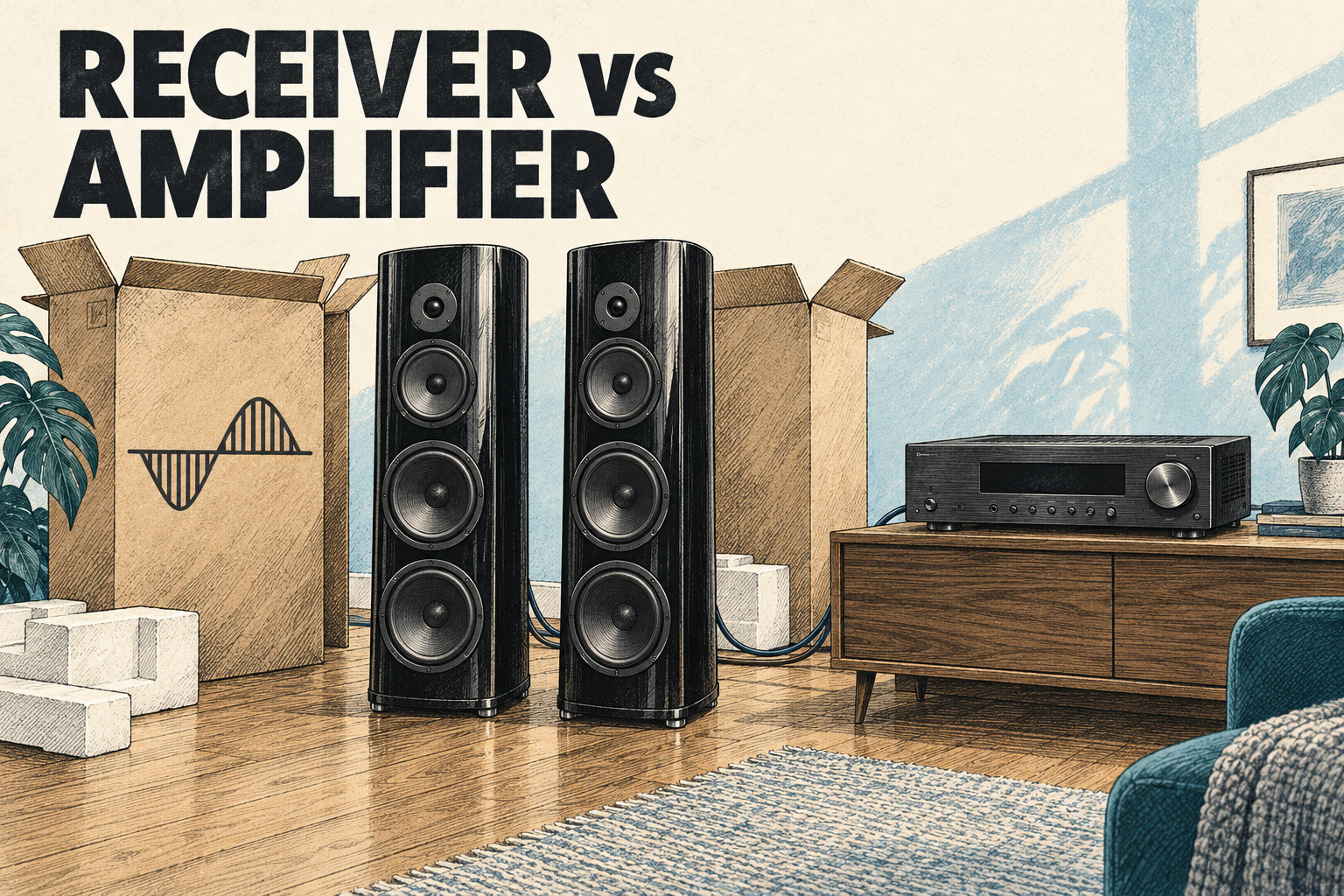
The boxes were ridiculous: big, sturdy, heavy, yelling premium in every sense. Out came a pair of Bowers & Wilkins 800 Series Diamond D4 floorstanders, a childhood dream, and they stood in my living room like sculptures. I wired them to the flagship Yamaha receiver that had powered my Klipsch for years, pressed play, and about $30,000 of speakers sounded hollow. Not on one song. On every song.
That first listen was my most expensive receiver vs amplifier lesson, and it ended with a phone call I am still not proud of. The speakers were not broken. The pairing was. Here is the physics I should have read before the delivery: what speaker sensitivity and speaker impedance mean, why the watts printed on a receiver tell you so little, and how to match an amplifier to speakers before the boxes arrive, not after.
Sculptures in the living room, hollow on every song
For more than a decade I ran a home-theatre system that also played music: Yamaha, Denon and Marantz receivers, then Klipsch Reference Premiere floorstanders on a Yamaha flagship. The Klipsch were dynamic, loud and vivid, general-purpose living-room speakers, and the receiver drove them without complaint.
So when the Diamonds arrived, I did the obvious. Klipsch out, B&Ws in, same receiver, Apple TV streaming over HDMI, ready for some "critical listening". The B&Ws sounded nothing like the Klipsch: more detail, higher definition. And underneath the detail, nothing. The sound was hollow. It felt empty.
I tried again and again, even reconnecting the Klipsch to check my ears, and the same feeling came back on every song. When I retold that first listen in my room-acoustics film in October 2025, I used harder words: harsh, no soundstage, elements missing. My first thought was that the dealer had cheated me. The room may have played a part, but what had really changed was the load on a receiver built for a different job.
The call I am not proud of
I picked up the phone and started yelling. The speakers were defective, I told my dealer, and he had to replace them. He tried to calm me down, then reminded me of his warning before the sale: these speakers were not made for my chain. He offered to take them back, as any legitimate dealer would, but insisted that to really hear them I needed matching electronics.
The warnings had started at the audition. When I asked about the anaconda-thick cables on his demo pair, he looked at me: "What the hell cables are you using?" When I told him, he tried to talk me out of the purchase: "You are still a virgin, stay a virgin." If I bought these speakers, he said, I would discover everything: sources, cables, amplifiers. He was a friend, an honest one, and I decided he was wrong. Yamaha had been my go-to receiver for years. There had to be something else.
So I called the B&W distributor and the company's headquarters. The support was excellent. The question was not what I expected. They could see my registration and asked why I had been sold these speakers at all. Had nobody told me about the limitations of my amplification stage? After that call and a little research, the conclusion was simple: I had royally messed up.
I ordered a McIntosh MA9500 integrated amplifier for same-day delivery, solid state because I did not want the complexity of tubes. It took four people to carry it. The first three songs were "Giorgio by Moroder", "What a Wonderful World" and Dominique Fils-Aimé's "Birds", and it was a revelation: music that surrounds you, music you can feel. I hugged my dealer and broke into tears.
In fairness to the receiver, it was not a clean experiment: the source changed too, an Eversolo A6 Master Edition over AudioQuest Yukon balanced cables instead of the Apple TV over HDMI. But the dealer and the distributor had pointed at the same place, and in my cables film I said it without hedging: "The dealer was right." The Diamonds demanded better electronics.
I've paired thirty thousand dollars worth of speakers with the wrong amplifier, and wondered why they sounded hollow.
I said that in my channel trailer in February 2026.
Speaker sensitivity explained: 86 dB against 105 dB
Sensitivity is how loud a speaker plays from a fixed input at one metre: one watt, or 2.83 volts, which is one watt into 8 ohms. It decides how hard your amplifier works for every decibel, so read it first on any spec sheet.
The cleanest illustration is my La Scala against Yvette film from November 2025. The La Scala is rated at 105 dB, enough for concert levels from a 10-watt tube amplifier; the Yvette at 86 dB. The gap is 19 dB, and on air I said the La Scala produces the same sound pressure with roughly a hundredth of the power. The exact arithmetic is a little kinder: every 3 dB doubles the power and every 10 dB multiplies it by ten, so 19 dB is a factor of about 79. Call it eighty. I wrote the short version in 19 dB, or a hundred times the power; the rounding rescues nobody with a small amplifier.
Read every label as live text
- Same level as 1 W into a 105 dB speaker (105 dB at 1 m)
- 100 dB peaks at a 3 m seat (one speaker, free field)
- Speaker sensitivity (dB)
- 105 dB
- 1 W
- 2.8 W
- 98 dB
- 5 W
- 14 W
- 92 dB
- 20 W
- 57 W
- 86 dB
- 79 W
- 226 W
- Amplifier power (W)
Hold 105 dB at one metre, what one watt buys from the La Scala, and the bill reads: 1 W at 105 dB sensitivity, 5 W at 98 dB, 20 W at 92 dB and 79 W at 86 dB. Same loudness. Seventy-nine times the work.
Two cautions. Sensitivity is not a virtue on its own: the La Scala asks almost nothing of an amplifier, yet in my audition its bass took a day off. And read the small print: a rating at 2.83 volts means one watt into 8 ohms but two watts into 4 ohms, which flatters a 4-ohm speaker by 3 dB.
How many watts do I need?
You need enough clean power to reach your loudest peaks at your own seat, and sensitivity sets that number. Distance is the second lever: in free space the level falls about 6 dB each time you double your distance, and winning 6 dB back costs four times the power.
Sit three metres away and ask one speaker for 100 dB peaks at your ears. It must produce about 109.5 dB at one metre. A 105 dB speaker needs about 2.8 W, a 98 dB speaker about 14 W, a 92 dB speaker about 57 W and an 86 dB speaker about 226 W. A second speaker gives back roughly 3 dB and a real room a little more. Halve the figure for a pair and the 86 dB speaker still asks about 113 W per channel for its peaks: three-quarters of a premium receiver's honest 150 W, before a 3-ohm dip enters the picture.
Speaker impedance, dips and current: why the watts on the box mislead
Speaker impedance is the electrical load the amplifier sees, and it moves with frequency. The nominal figure on the box is a label; what the amplifier must survive is the minimum, which often sits in the bass.
| Speaker | Sensitivity | Nominal impedance | Minimum impedance | Bass extension |
|---|---|---|---|---|
| Klipsch La Scala | 105 dB (2.83 V, 1 m) | 8 ohms | 4.2 ohms (70–300 Hz) | 51 Hz (±4 dB) |
| B&W 800 Series Diamond D4 floorstanders | 89–90 dB (2.83 V, 1 m) | 8 ohms | 3.0 ohms specified; 2.55 ohms measured on the 804 D4 | varies by model |
| Wilson Audio Yvette | 86 dB (87.6 dB estimated by Stereophile) | 4 ohms | 2.94 ohms at 90 Hz | 20 Hz |
On paper the B&W D4 floorstanders look easier to drive than the Yvette; their impedance minimum, 3.0 ohms specified and 2.55 ohms measured on the 804 D4, is the trap.
Sources: makers' specifications; John Atkinson's measurements for Stereophile (Yvette, April 2019; 804 D4, December 2021); La Scala dip and Yvette extension from my November 2025 film.
Look at the middle row. On paper the D4 floorstanders are easy: 8 ohms and 89 to 90 dB, better than the Yvette on both counts. The trap is the minimum. Bowers & Wilkins specifies 3.0 ohms; when Atkinson measured the 804 D4, he found 2.55 ohms between 121 and 131 Hz and an effective resistance of 1 ohm from 88 to 110 Hz. His verdict: it "must be used with amplifiers that don't have problems driving 2 ohms". An 8-ohm power rating tells you nothing about any of that.
Ohm's law makes the trap visible. To deliver 100 W into 8 ohms, an amplifier swings about 28 volts and supplies about 3.5 amps. Put the same 28 volts across a 3-ohm dip and the speaker draws about 9.4 amps, roughly 267 W at that frequency. The speaker does not negotiate: it draws the current it asks for, or the amplifier runs short. That is the kind of load my receiver was asked to drive.
The Yvette needs power, real power.
I said that in the La Scala film. Atkinson's measurements confirmed Wilson's 2.94 ohms at 90 Hz, found 5 ohms at –47° of phase at 57 Hz, and concluded that the Yvette "will sound best with amplifiers that are comfortable driving 4 ohm loads". Lines like that beat any wattage printed in bold.
Receiver vs amplifier: two different jobs
A receiver is a home-theatre hub: surround decoding, video switching and many channels of amplification in one chassis. An integrated stereo amplifier has one job, two channels, and everything in the box serves them. The MA9500 that replaced my receiver is rated at 300 W per channel.
Take one premium example: Yamaha's RX-A6A, a 9.2-channel Aventage receiver, is rated at 150 W per channel into 8 ohms, 20 Hz to 20 kHz, 0.06% distortion, two channels driven. The same sheet quotes 185 W (one channel, 1 kHz, 0.9%) and 220 W (maximum effective output, 10%). Three numbers for one amplifier. The honest one is the smallest, and even that is measured into 8 ohms with seven of nine channels resting.
None of this makes a receiver a bad product. My own Yamaha drove the Klipsch happily through my PlayStation 3 receiver years, and even my Transparent speaker cables would have been wasted on my old receiver and the Klipsch; I know because I tried. The B&Ws were another animal. As I put it in the La Scala film, "There is a chaos between just plugging them into anything versus using the right electronics."
The numbers give a rule of thumb. Eight-ohm speakers that stay above about 4 ohms, sensitivity in the 90s, film before music: a good receiver is a sensible home. A minimum near 3 ohms, sensitivity in the 80s, or critical stereo listening: give the front pair a dedicated stereo amplifier.
Matching an amp to speakers in five steps
- Start with sensitivity. Take your peak level at the seat, add about 6 dB per doubling of seat distance beyond one metre, subtract the sensitivity and convert: 3 dB doubles the power, 10 dB multiplies it by ten.
- Find the minimum impedance, not the nominal. For a speaker that drops near 3 ohms, like the B&W Diamonds or my Yvettes, choose an amplifier specified into 4 ohms, better still 2, and comfortable there.
- Know your room. A more revealing speaker makes an untreated room's problems bigger, not smaller, and boomy bass is a room problem no amplifier fixes. A big room with a far seat needs more power for the same peaks.
- Be honest about your listening level. My MA9500 controlled my Yvettes admirably, yet at around 95 dB I felt it, for the first time, working at its limits: not struggling, but pushed.
- Audition, and keep the right to return. Never buy because a reviewer told you to, or because the price suggests quality. If you did not hear the difference, return it.
Signs of a mismatch, and the Bad Guy test
| What you hear | Likely cause | First check |
|---|---|---|
| Hollow, empty sound with plenty of detail | Amplifier not suited to the load | Minimum impedance against the amplifier's 4-ohm rating |
| Harsh, no soundstage, elements missing | A revealing speaker exposing room and electronics | Positioning and first reflections, then the amplifier |
| Crescendos flatten and stop growing | Amplifier near its limit at your level | Watts needed for your peak level and seat |
| Bass turns hard above about 95 dB | Clipping: the pairing has hit its ceiling | Repeat at a measured level and note where it starts |
| Boomy bass whatever the amplifier | The room | Measure and treat before buying electronics |
Five things you may hear, what usually causes them and the first thing to check before buying anything.
Keep two episodes apart. The hollow sound on the receiver was there on every song. The clipping came later, once the B&Ws were on a more revealing amplifier: on the deep, detailed bottom end of Billie Eilish's "Bad Guy", they would clip above about 95 dB SPL. It had to be loud, but once you hear it, you cannot unhear it. That is the story of Bad Guy and the clip you always remember, and it sent me looking for a better match for my McIntosh electronics. At my Yvette audition, on McIntosh MC3500 tube monoblocks, the same track came through with no compression and no distortion.
Use the song as a test. Raise the level in small steps, check it on a meter, and listen for the moment the bass stops growing and starts hardening. Above that line, you are asking the pairing for something it does not have.
The B&Ws were never defective. They were honest about the chain behind them, and it took a dealer, a distributor and four people carrying a McIntosh to make me listen.
Frequently asked questions
Can an AV receiver drive high-end speakers?
Sometimes: if the speakers are sensitive and stay above about 4 ohms. B&W rates its D4 floorstanders at 89 to 90 dB with a 3.0-ohm minimum, and mine sounded hollow on a flagship receiver.
How many watts does an 86 dB speaker need?
About 226 W for 100 dB peaks from one speaker at three metres, or about 113 W per channel for a pair. A 105 dB speaker needs about 2.8 W for the same peaks.
Is higher speaker sensitivity always better?
No. It means less power for the same level, not better bass: the 105 dB La Scala needs about an eightieth of the Yvette's power, yet its bass took a day off in my audition.
More from the Journal
Keep exploring.
Loading articles…