

The Journal / Articles & reviews
Marantz vs Denon: Same Owner, Different Sound, and the Story Behind Two Great Names
They share an owner and a factory floor for their best models; they still do not sound alike, and the reason runs back more than seventy years.
Kew Gardens, Queens, 1953. In the cellar of a family house, at his wife's urging, an amateur classical guitarist with no formal training in electronics is building a first run of one hundred preamplifiers, a design he calls the Audio Consolette. Before that batch is finished, orders for six hundred of its production version, the Model 1, are already waiting.
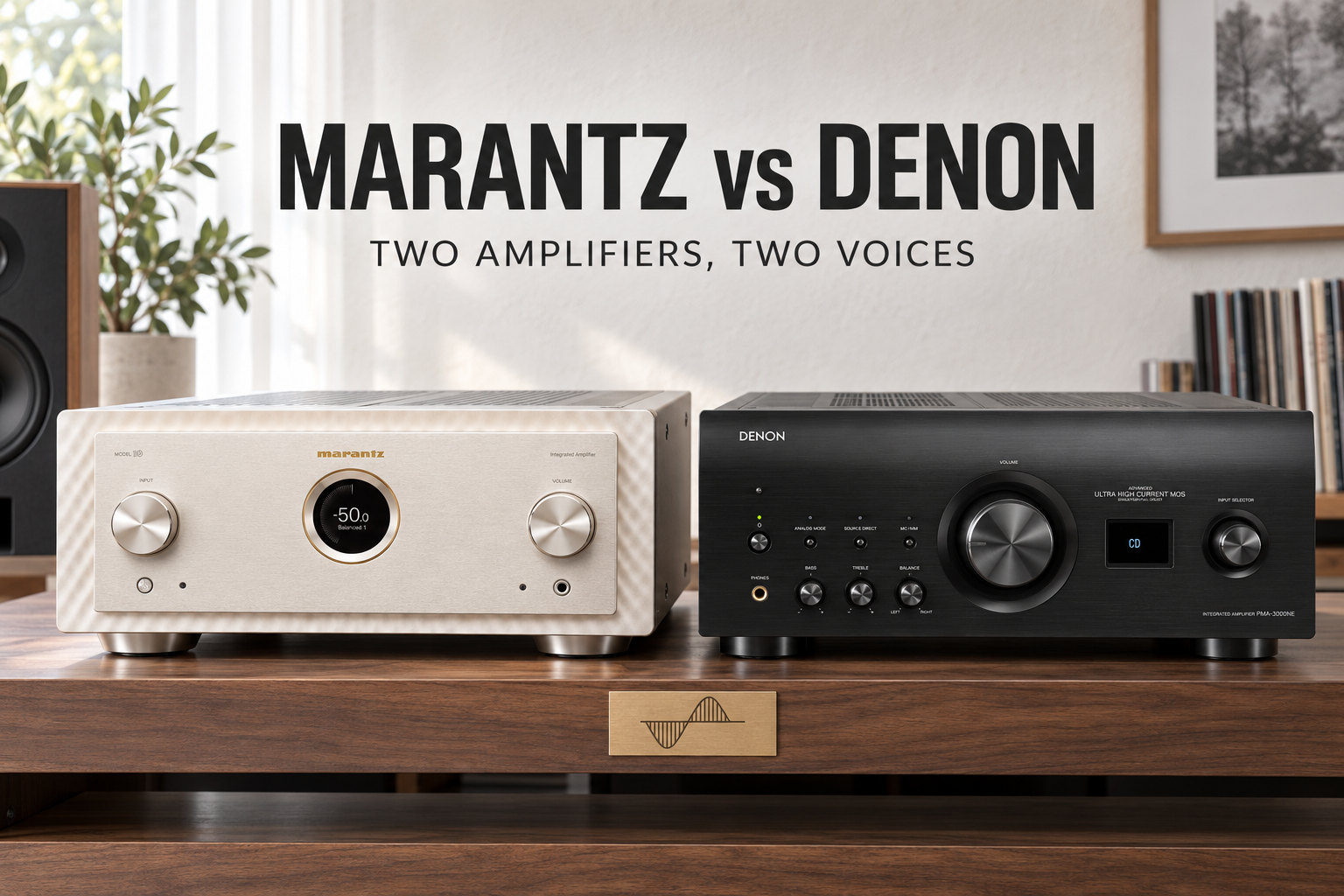
That cellar is the right place to start any Marantz vs Denon comparison, because the question most buyers ask, whether the two are really the same company, has a two-part answer. On paper, yes: Denon and Marantz have shared an owner since May 2002, have belonged since September 2025 to Harman, a Samsung subsidiary, and build their higher-end models at the same Japanese works. In the ear, no: each brand keeps its own Sound Master, and reviewers and owners tend to describe Marantz as the smoother, more musical voice and Denon as the more dynamic one. The short verdict: Denon for channels and power per dollar, Marantz for stereo character and a far higher stereo ceiling, and your speakers to break the tie.
History of Marantz: a guitarist's preamp
Saul Bernard Marantz was a serious music lover and, in Robert Harley's 2017 profile for The Absolute Sound, "a natural tinkerer". Marantz's own timeline files the Audio Consolette under 1953, though it has Saul creating the design a year earlier. Its production version, the Model 1, was the first preamplifier to offer the new RIAA phono equalisation curve, while still carrying older ones such as Columbia's and the 78.
Then came Sidney Smith, an out-of-work designer who answered an ad for the Model 1, and a fourteen-year partnership that gave Marantz its three immortals: the Model 7 preamplifier (1958), the Model 9 power amplifier (1960) and the Model 10B tuner (1964).
The last of the three broke the company. The 10B's development costs, Harley writes, "could never be amortized", and in 1964 Saul Marantz sold to Superscope for $3 million. Harley's verdict: "It was Marantz' uncompromising quest for quality that put the company in financial peril and forced the sale." Production later moved to Japan through a partnership with Standard Radio Corporation, and in 1980 Philips bought the Marantz brand, its dealer network and its overseas assets, adding the US and Canadian trademarks in 1992.
The Philips decades gave the Marantz sound a name and a face. Ken Ishiwata, the company's Sound Master, reworked existing models into KI Signature versions, among them the CD-63 MkII KI Signature, which Marantz's timeline still calls "the most musical CD player Marantz ever produced". The adjective in that line matters more than the model number: musical is what Marantz has been selling ever since.
Denon's other life: records, radio and the first digital masters
Denon did not begin with a preamplifier. It began with records. Denon dates its lineage to 1910, when the American entrepreneur Frederick Whitney Horn established Japan's first record company, Nippon Chikuonki Shokai. In the 1930s, by Denon's own account, the business began making equipment for NHK, the national broadcaster, and in 1945 a recording made on a Denon DP-17K carried Emperor Hirohito's voice to the Japanese public.
The Denon brand itself dates from 1947, when Nippon Columbia merged with Japan Denki Onkyo. Denon is a contraction of Denki Onkyo, and the full company name translates as Japan Electric Sound Company. For decades Denon was a brand of Nippon Columbia, record label included. So both founding dates in circulation are right: 1910 is the lineage, 1947 is the name.
That double life, half record label and half broadcast engineer, explains Denon's two best-known achievements. In 1964 it delivered the DL-103 moving-coil cartridge to NHK, a broadcast tool that became a hi-fi fixture; when Stereophile's Herb Reichert reviewed the Marantz MODEL 30 in December 2020, a Zu-modified DL-103 was among the cartridges feeding its phono stage. In 1972 Denon announced the DN-023R, which it calls the world's first digital recorder. Its first commercial recording, according to Positive Feedback's history of Denon PCM, was the Smetana Quartet playing Mozart, taped in April 1972 at Aoyama Tower Hall in Tokyo; Nippon Columbia had already issued an LP from a digitally made tape, Steve Marcus and Jiro Inagaki's Something, in January 1971.
Denon also lists the first CD player for professional use among its firsts and, in 1985, the AVC-500, by its own account the world's first AV amplifier. Take Denon at its word and the ancestor of the box most listeners now start with, the AV receiver, was a Denon idea, and the brand still speaks most fluently in channels.
Are Denon and Marantz the same company?
Yes, at ownership level: the two brands have had one owner since May 2002. The paths converged in 2001. Marantz Japan bought the Marantz brand and all its overseas sales subsidiaries, and Denon was spun off as a separate company, 98% held by Ripplewood Holdings and 2% by Hitachi. In May 2002 Denon Ltd and Marantz Japan merged to form D&M Holdings, and Marantz joined Denon at Shirakawa, about 185 km north-east of Tokyo, where the two still share the site that develops and builds their higher-end models.
Read every label as live text
- MARANTZ
- DENON
- 1953
- Audio Consolette (Saul B. Marantz, Kew Gardens, Queens)
- 1964
- sold to Superscope
- $3 million
- 1980
- Philips buys brand, dealer network, overseas assets
- 1992
- Philips adds US and Canada trademarks
- 2001
- Marantz Japan acquires the brand
- 1910
- lineage begins (Nippon Chikuonki Shokai, Japan's first record company)
- 1947
- Denon brand (Nippon Columbia + Japan Denki Onkyo)
- 1972
- DN-023R digital recorder
- 2001
- spun off (Ripplewood Holdings 98%, Hitachi 2%)
- May 2002
- D&M Holdings
- 1 Mar 2017
- Sound United
- 11 Apr 2022
- Masimo
- $1.025 billion
- 23 Sep 2025
- Harman, a Samsung Electronics subsidiary
- $350 million agreed 6 May 2025
After that, the owners changed faster than the products. Sound United completed its purchase of D&M Holdings on 1 March 2017. Masimo, a healthcare company, closed its acquisition of Sound United on 11 April 2022 at a purchase price of $1.025 billion. On 6 May 2025 Masimo agreed to sell the audio business to Harman International for $350 million in cash, about a third of what it had paid three years earlier, and Harman completed the deal on 23 September 2025.
So who owns Marantz in July 2026? Harman, a wholly owned subsidiary of Samsung Electronics, which runs Sound United as a standalone business unit inside its Lifestyle Division. Denon and Marantz sit there with Bowers & Wilkins, Polk Audio, Definitive Technology, HEOS, Classé and Boston Acoustics. One owner, one flagship factory. The family resemblance ends at the loudspeaker terminals.
Marantz vs Denon sound: one room, two tuners
Shared ownership has not produced a shared voice, and both brands work to keep it that way. Each has its own Sound Master, who tunes its amplifiers in the Shirakawa listening room. Denon's pages quote Shinichi Yamauchi as Denon Sound Master. For Marantz, a Sound United manager told StereoNET in September 2022: "For Marantz it is a gentleman by the name of Yoshinori Ogata." After visiting Shirakawa, Carlo Lo Raso wrote in Secrets of Home Theater and High Fidelity on 3 July 2026 of a place where "each brand's distinct musical philosophy is shepherded forward".
The most useful evidence comes from that single room. In January 2025 StereoNET's Tony O'Brien heard both brands there: 17 Bowers & Wilkins speakers and subwoofers in a 7.4.6 layout, the main seat 12 feet from every speaker, neither Audyssey nor Dirac in use. Same room, same speakers, two tuners. The Marantz, he wrote, was "striding that fine line between musicality and home theatre dynamics exceptionally well"; the Denon was "favouring a more dynamic sound that wasn't as musical as the Marantz". He judged the power similar and was candid that the side-by-side demo was brief, though he had already spent considerable time with Marantz's AV10 and AMP10.
In stereo, the clearest portrait of the Marantz character comes from Stereophile. In December 2020 Herb Reichert called the Marantz MODEL 30, a class-D design built on Hypex NC500 modules, "the first class-D amplifier that made me genuinely happy with how it drove the Falcon LS3/5a's", and heard "a sense of beautifully drawn, highly articulate delicacy that urged me to listen closely".
The other stereo reviews make a different point: how close the cheaper Denon gets. In a review of Denon's PMA-900HNE published by What Hi-Fi? in October 2022, Jez Ford set it against Marantz's dearer MODEL 40n and concluded that "for all but difficult speaker loads and the biggest dynamics" the Denon goes a long way towards the Marantz's performance, "at a fraction of its price". Read the other way round, the dearer Marantz keeps its edge on hard loads and the biggest dynamics, the very ground Denon's reputation claims. Hi-Fi Clube reached a similar verdict: the Denon does what the 40n does, "perhaps with less class and performance".
Owners split along familiar lines. A 2014 thread on Stereophile's forum relays what brand representatives told one buyer, "the Denon sounds bright and Marantz sounds warm", and notes that others call it "total nonsense". On the Audioholics forum one listener hears Marantz "softer and warmer compared to Denon that sounds brighter"; another found Marantz and Denon separates "sounded quite neutral".
Our reading of the evidence: the difference is real and, where reviewers name it, points the same way, Marantz smoother and more flowing, Denon more forward and driven. It is a difference of voicing, not of class: in stereo the reviews put the cheaper Denon close to the dearer Marantz, not a tier below it. Warm and bright are words; on your speakers, in your room, the gap can shrink to nothing or decide everything.
Line-ups in July 2026, including the Marantz MODEL 70
The two catalogues overlap, but their ceilings show where each brand puts its ambition. Denon's US stereo amplifiers stop at the PMA-3000NE at $3,799, while its AV receivers climb to the 15.4-channel AVR-A1H at $7,199. Marantz's receivers stop at the 11.4-channel CINEMA 30 at $4,800, while its stereo range climbs to the MODEL 10 integrated at $15,000 and the LINK 10n network preamplifier at $14,000. Denon is the home-cinema specialist that also makes stereo; Marantz is the stereo house that also makes cinema.
The newest arrival is the Marantz MODEL 70, announced on 15 July 2026 as the successor to the PM6007. It raises output from 45 to 50 W per channel, adds HDMI ARC for a television and Bluetooth that both receives and transmits, and has a moving-magnet phono stage. UK launch coverage gives £749 (€850), and £499 (€600) for the matching CD 70 player. The MODEL 70 will not be sold in North America, so US buyers keep the PM6007 at $750; the CD 70 reaches North American shops on 15 August.
| Model | Brand | Type | Rated power per channel | US list price, June–July 2026 |
|---|---|---|---|---|
| PMA-600NE | Denon | Stereo integrated | 45 W | $599 |
| PM6007 | Marantz | Stereo integrated | 45 W | $750 |
| MODEL 70 | Marantz | Stereo integrated with HDMI ARC | 50 W | not sold in US (£749 / €850) |
| DRA-900H | Denon | 2.2-channel receiver (HEOS) | 100 W | $799 |
| PMA-900HNE | Denon | Streaming integrated (HEOS) | 50 W | $1,049 |
| STEREO 70s | Marantz | Stereo receiver (HEOS) | 75 W | $1,200 |
| PMA-1700NE | Denon | Integrated with USB DAC | 70 W | $2,299 |
| MODEL 30 | Marantz | Integrated, class D | 100 W (8 ohms) | $3,500 |
| PMA-3000NE | Denon | Integrated, MM/MC phono | 80 W | $3,799 |
| MODEL 10 | Marantz | Reference integrated | 250 W | $15,000 |
| AVR-X2900H | Denon | 7.2-channel AV receiver | 95 W | $1,349 |
| CINEMA 60 | Marantz | 7.2-channel AV receiver | 100 W | $1,800 |
| AVR-X3900H | Denon | 9.4-channel AV receiver | 105 W | $1,849 |
| CINEMA 50 | Marantz | 9.4-channel AV receiver | 110 W | $2,800 |
| AVR-X6800H | Denon | 11.4-channel AV receiver | 140 W | $3,799 |
| CINEMA 30 | Marantz | 11.4-channel AV receiver | 140 W | $4,800 |
| AVR-A1H | Denon | 15.4-channel AV receiver | 150 W | $7,199 |
Seventeen stereo and AV models with maker-rated power per channel and US list prices as of June–July 2026; the MODEL 70 is not sold in the US.
Prices are the makers' US list prices as of June–July 2026 and move with dealer promotions; power figures are each maker's headline rating, not a like-for-like bench measurement.
From receiver to stereo: the road KD took
The Sound Lab's host knows the receiver road from the inside. In his October 2025 film on cables, KD opens his own history with these words:
For over a decade, I ran AVRs, Yamaha, Denon, Marantz, with speakers like Bowers & Wilkins and Klipsch. Home theatre was my main focus.
Music arrived through the same boxes: a CD player, a turntable and, later, streams through an Apple TV and a PlayStation 3 before the hi-fi. Cables, he admits, he did not think about "at all". His list of gear owned, tested or auditioned includes Denon's AVR-X6700H receiver and Marantz's AV8805 and AV7705 processors. In his La Scala versus Yvette film he remembers years of Klipsch Reference Premiere on a flagship Yamaha receiver as dynamic, loud, vivid and pleasing: general-purpose speakers bought for home theatre.
The limit arrived with ambition. When new Bowers & Wilkins 800-series Diamonds replaced the Klipsch on that same flagship Yamaha, KD heard more detail and higher definition and, in his own words, "the entire sound was hollow", on every song. His dealer had warned him the electronics were not a match. The answer, on The Sound Lab's own account of his journey, was a McIntosh MA9500 stereo integrated, not a bigger receiver. When he later moved to Transparent Super speaker cables costing over $3,000 a pair, the verdict about his old chain in the film where his dealer told him to stay a virgin was blunt: on his old receiver and Klipsch speakers they "would have been a complete waste of money. And I can say that with certainty because I tried."
None of this makes the receiver the villain, whatever badge it wears. It is an excellent way into the hobby, and both brands sell the exit ramp from the same showroom: Denon's DRA-900H and PMA integrateds, Marantz's STEREO 70s and MODEL range. The lesson is narrower. A receiver spreads its budget across channels, decoding and room correction, so a two-channel listener with serious speakers meets its ceiling sooner than a home-cinema owner does.
Which to buy: by use, speakers and budget
Home cinema first: Denon, on value
On the AV side of Denon vs Marantz, Denon gives more channels and more rated power per dollar at every rung compared here. The AVR-X3900H offers 9.4 channels at 105 W for $1,849; Marantz's 9.4-channel CINEMA 50 is rated at 110 W and costs $2,800, roughly $950 more. At 7.2 channels the AVR-X2900H undercuts the CINEMA 60 by about $450, and at 11.4 channels the two share a 140 W rating while the CINEMA 30 costs about $1,000 more than the AVR-X6800H. Pay the Marantz premium if music is half of what the system does and the smoother voice matters to you; otherwise that money buys a better pair of speakers.
Music first, television second
Denon's DRA-900H, a 2.2-channel 8K receiver with HEOS streaming at $799, is the cheaper of the two dedicated stereo receivers here, and runs a stereo pair, a television and a streaming app from one box. Marantz's STEREO 70s costs about $400 more for less rated power, 75 W against 100 W, so buy it for the voice, not the numbers. Outside North America, the MODEL 70's HDMI ARC makes it the tidier answer for a living room with a television and no surround ambitions.
Stereo only, under $1,000
The PMA-600NE ($599) and the PM6007 ($750) share a 45 W rating, so the decision is voicing and speakers. Our rule of thumb from the evidence above: with bright, forward speakers, lean Marantz; with soft or laid-back speakers, Denon's extra drive is the better partner. Stretch to $1,049 and the PMA-900HNE adds HEOS streaming: the Denon Ford found going a long way towards Marantz's $2,700 MODEL 40n.
$2,000 to $4,000
The Marantz MODEL 30 ($3,500), the class-D amplifier that won Reichert over, pairs Hypex power with a phono stage offering MM and three MC loading settings. Denon's PMA-3000NE ($3,799) is rated at 80 W and carries an MM/MC phono stage plus a mode that switches off its digital circuits for pure analogue listening. For less, the PMA-1700NE with USB DAC sits at $2,299. Above $4,000 only Marantz is still playing in stereo, with the PM-10 at $8,999 and the MODEL 10, launched in 2024 at £13,000 in the UK and listed at $15,000 in the US.
Whatever the shortlist, KD's standing rule applies: never buy because a reviewer told you to, and that includes this one. Audition both brands on your own speakers, with a return option, and keep the one you still want to hear at the end of the evening. Seventy-three years after a guitarist built his first hundred preamplifiers in a cellar in Queens, that is still the only test that counts.
Frequently asked questions
Who owns Marantz?
Harman International, a wholly owned subsidiary of Samsung Electronics, has owned Marantz since 23 September 2025. Marantz and Denon sit inside Sound United, a standalone Harman business unit.
Is Denon better than Marantz?
Neither is better across the board. Denon offers more channels and rated power per dollar in AV receivers; Marantz is usually described as the smoother, more musical voice and reaches much higher in stereo.
Is the Marantz MODEL 70 sold in the United States?
No. The MODEL 70 is not sold in North America; US buyers keep the PM6007 at $750, while the matching CD 70 player arrives there on 15 August.
Where are high-end Denon and Marantz models made?
Largely at Shirakawa in Japan, where the higher-end models of both brands are developed and built on a site Marantz has shared with Denon since 2002.
More from the Journal
Keep exploring.
Loading articles…