
The Journal / Articles & reviews
Joni Mitchell's Blue on Vinyl: The New Rhino High Fidelity Edition and the Pressings Worth Owning
Fifty-five years on, Blue comes back as an all-analogue LP and a 350-copy reel, and starts a public argument about what a master copy really is.
In March 1971 the masters for Blue were finished and ready to press. Then Joni Mitchell asked Reprise to halt the pressing. Out went two older songs from the early running order, "Hunter" and "Urge for Going"; in came two new ones, "All I Want" to open and "The Last Time I Saw Richard" to close. One early test pressing, with a different track list, survives. Blue reached the shops on 22 June 1971 as Reprise MS2038.
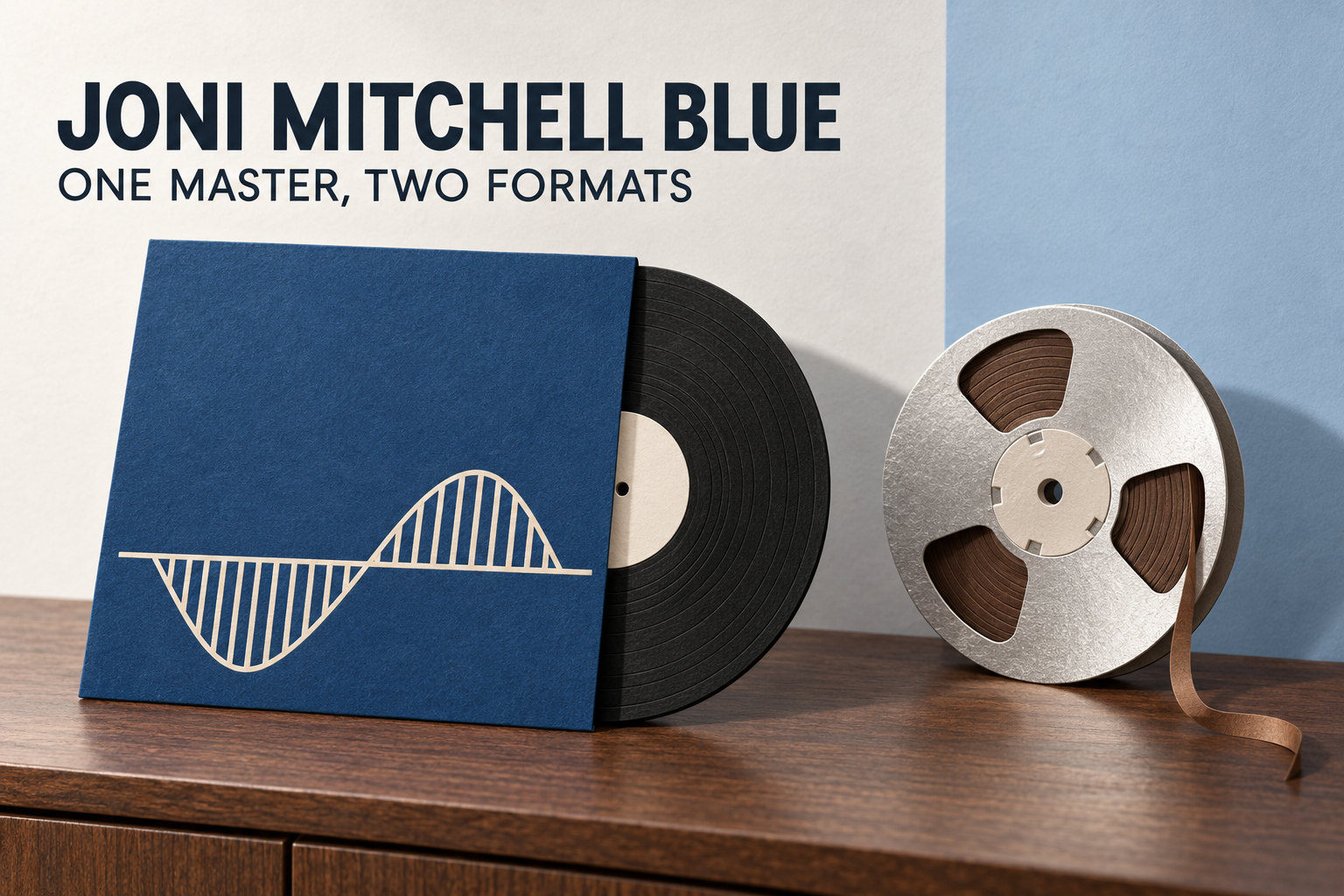
Fifty-five years to the day, Rhino announced a new Joni Mitchell Blue vinyl edition, an all-analogue Kevin Gray cut in 5,000 numbered copies, and beside it something rarer: a 350-copy reel-to-reel. That day Michael Fremer ran the news in Tracking Angle with an editor's note asking what the tape really is. The short answer, at July 2026 prices: the $40 Kevin Gray LP is the one to buy; collectors should hunt an early US copy with Bernie Grundman's BG in the runout; the $300 tape suits owners of a 15 ips half-track deck who accept a copy of a copy.
Why Blue is the record collectors protect
Rolling Stone ranks Blue third of the 500 greatest albums of all time. NPR's 2017 list of the 150 greatest albums made by women put it first. Even a writer championing The Hissing of Summer Lawns in Stereophile's 2020 Records To Die For asked whether it was better than Blue, and answered: "Probably not."
Reputation is half of it; exposure is the rest. Mitchell produced the record herself, with Henry Lewy engineering, at A&M Studios in Hollywood. She plays guitar, piano and the Appalachian dulcimer she bought for $200 at the 1969 Big Sur Folk Festival. The guests are few and placed like furniture in an empty room: Stephen Stills, James Taylor, Sneaky Pete Kleinow on pedal steel, Russ Kunkel on drums. A record that bare hides nothing: not a worn stamper, not a hot top end, not a squeezed voice.
1971 originals: how to identify an early Reprise pressing
The US original is Reprise MS2038 in a gatefold jacket, and Discogs entries give four checks:
- A runout matrix such as 31218(RE-2), on many copies with BG for Bernie Grundman, who cut the lacquers.
- A plant letter: P for Columbia's Pitman plant, S for Santa Maria, T for Terre Haute.
- No Warner Communications logo in the label rim text.
- A plain deep-blue inner sleeve on the earliest copies.
The UK original, K 44128, followed about a month later in a dark blue hessian-textured gatefold, according to Hi-Fi News. New to runouts? KD's Daily shows how to read the dead wax.
Hi-Fi News notes that audiophiles still appreciate the US original, and Goldmine's Tone Scott wrote in February 2026 that the 1971 Reprise "has always sounded pretty damn great". Two cautions. Steve Hoffman's 2006 notes for his own reissue claim no added compression, "unlike the original 1970's pressings". And a 55-year-old record is only as good as its last owner's stylus: buy on play grade, never on the label.
Before 2026: Hoffman and Gray, Grundman, MoFi
Three modern cuts define the argument. Steve Hoffman and Kevin Gray made the first at AcousTech, issued by Rhino in 2007 as Reprise 74842: 180-gram vinyl pressed at RTI, "KPG&SH@ATM" in the runout. Hoffman's 2006 notes say they used "the actual 1971 Reprise master tape", bypassed the usual "EQ'd and Compressed Cutting Master" and cut most songs "without ANY equalization at all". Hi-Fi News calls it the version that "tends to get the most enthusiastic thumbs-up from Joni obsessives".
Bernie Grundman cut the second, a 2021 remaster made under Mitchell's supervision for the box The Reprise Albums (1968–1971): four 180-gram LPs pressed at RTI in 10,000 copies, followed in 2022 by a single Blue LP pressed at Optimal. Grundman had also cut the 1971 original, a symmetry Fremer marked with a nod to "The Circle Game" in his September 2021 AnalogPlanet review. His verdict went against the obsessives' favourite: the new Blue "beats multiple originals" he compared and is "markedly superior" to the Gray and Hoffman edition, in which he heard "a lower midrange excess" that "kind of muffled" Mitchell's voice. The Absolute Sound rated the box 5/5 for music and sonics in October 2021.
Mobile Fidelity's UltraDisc One-Step arrived in January 2024: two 45 rpm discs on 180-gram SuperVinyl, 12,000 numbered copies, $125 at release. MoFi prints the chain: the 15 ips Dolby A master "to DSD 256 to analog console to lathe", cut by Krieg Wunderlich. Positive Feedback's Tom Gibbs set it against a Reprise original, a mid-2000s repress and the 2021 Grundman, and wrote that it "bettered them all". Goldmine heard "an extremely quiet record" with "considerably greater bass extension" than the original. For all-analogue purists, the digital step in the middle is the catch.
The Rhino High Fidelity edition: Kevin Gray, Optimal, 5,000 copies
The LP was released on 10 July 2026 through Rhino.com and select Warner Music Group stores abroad; Mitchell's official store listed it at $39.98 as of July 2026. Rhino and the obi give the essentials: cut from the original analogue master tapes by Kevin Gray at Cohearent Audio, 180-gram vinyl pressed at Optimal Media, a heavyweight gatefold, an insert with a new Q&A with Mitchell, and a numbered edition of 5,000. The runout carries "KPG@CA", Gray's initials and studio.
Three things make it the edition to watch. It is all-analogue, so there is no DSD step to argue about. It sends Gray back to Blue's original master tapes, nearly twenty years after he and Hoffman first cut from them. And it is pressed at Optimal Media, one of the four plants KD named as premium in The Sound Lab's April 2026 film on modern pressing defects, alongside Quality Record Pressings, RTI and Pallas.
That is a reason for confidence, not a guarantee. In the same film, three of KD's four test albums came from one upper-tier plant. One album was clean on side four and defective on sides one and two. The worst was an $80 premium anniversary edition, the story of KD's Daily Four albums, and the dearest was the worst. The variable was the stamper, and KD's verdict on a worn one was blunt:
You are not unlucky. The entire run is compromised.
Play every side on arrival; return a defective copy for a refund, because another from the same stamper carries the same fault.
| Edition | Released | Source | Cut by | Plant | Format, run and price | Runout tell |
|---|---|---|---|---|---|---|
| US original, Reprise | June 1971 | 1971 tapes, compressed (per Hoffman) | Grundman | Pitman, Santa Maria or Terre Haute | LP, gatefold | P, S or T; often BG |
| Rhino/Reprise 74842 | 2007 | 1971 master tape, cutting master bypassed | Gray and Hoffman | RTI | 180 g LP | KPG&SH@ATM |
| The Reprise Albums box | 2021 | 2021 remaster supervised by Mitchell | Grundman | RTI | 4 x 180 g LP, 10,000 copies | n/a |
| Reprise single LP | 2022 | Same 2021 remaster | Grundman | Optimal | 180 g LP | BG |
| MoFi UltraDisc One-Step | January 2024 | 15 ips Dolby A master to DSD256 | Krieg Wunderlich | RTI (early copies) | 2 x 45 rpm, 12,000 numbered, $125 (January 2024 list) | KW @ MoFi |
| Rhino High Fidelity LP | 10 July 2026 | Original master tapes, all-analogue | Gray | Optimal | 180 g LP, 5,000 numbered, $39.98 (July 2026) | KPG@CA |
| Rhino High Fidelity R2R | 10 July 2026 | Copy of a 1:1 copy of the flat master | No lacquer | Tape duplication | 15 ips half-track, 350 copies, $299.98 (July 2026) | None |
Seven editions from 1971 to July 2026: source, cutting engineer, plant, format, run, price as of the date shown, and the runout marks that identify each. Sources: Discogs, Rhino, MoFi, Mitchell's official store, Steve Hoffman's 2006 notes and Fremer's AnalogPlanet review.
The reel-to-reel and the third-generation argument
Rhino describes the tape as "duplicated in real time from a 1:1 copy of the original flat analog master tape": 15 ips, half-track, quarter-inch RTM LPR90 stock on a 10.5-inch metal reel, announced as a Rhino.com exclusive. Mitchell's official store listed it at $299.98 as of July 2026.
A flat transfer adds no equalisation or compression: the mix as it sits on the master, before a mastering engineer's touch-ups. Generations count copies: the master is the first, Rhino's 1:1 copy the second, the reel you buy the third. Gray's all-analogue lacquer is cut while the master itself plays.
Read every label as live text
- Master tape (generation 1)
- Rhino High Fidelity LP (2026)
- Lacquer cut while the master plays (Kevin Gray, Cohearent Audio)
- Pressed at Optimal Media
- 180 g LP, 5,000 numbered
- MoFi UltraDisc One-Step (2024)
- 15 ips Dolby A master
- DSD256
- Analogue console
- Lathe (Krieg Wunderlich)
- 2 x 45 rpm, 180 g SuperVinyl, 12,000 numbered
- Rhino High Fidelity R2R (2026)
- 1:1 copy of the flat master: generation 2
- Real-time duplicate, 15 ips half-track, 10.5-inch reel: generation 3
- 350 copies
Fremer's note asked why the announcement stressed vinyl's "surface noise" and "groove wear" but not the hassle and expense of tape, or "that it's a 3rd gen tape versus lacquer cut from master tape". He questioned whether flat transfers suit tape-era pop and rock, music "that often requires 'touch up' EQ and moderate compression". In a reply to readers on 14 July he wrote "I am not 'anti-tape'!", cited John Curl, ex-Ampex, who "says he'd prefer a record made directly from the master over a 3rd generation tape", and said he had bought the tape to play on a restored Otari and review.
The irony: Blue's most loved modern LP was close to a flat cut by design, and Fremer heard too much lower midrange in it. Flatness is a decision, not a virtue. Both camps have a point: the tape removes stylus, stamper and groove; the lacquer skips two tape copies.
Which Joni Mitchell Blue vinyl to buy for your system
KD's rule from his April film, research first and stop buying blindly, sorts the field.
- First serious copy: the Rhino High Fidelity LP at about $40 as of July 2026, cut by an engineer who already knows this tape and pressed at a plant KD rates as premium; no research can vet your copy's stamper, so check every side on arrival. If it sells out, the 2022 single LP carries the Grundman remaster Fremer preferred.
- The collector who wants the document: an early US Reprise with BG and a plant letter in the runout, or a UK K 44128 in its hessian jacket.
- The quiet-surface chaser on a revealing system: the MoFi One-Step ($125 at its January 2024 release), if a DSD256 step in the chain does not trouble you.
- The tape owner: the reel, about $300 as of July 2026, only with a 15 ips half-track deck already in the rack.
- The digital listener: the CD was remastered for HDCD in 1997, per Hi-Fi News, and MoFi's 2024 hybrid SACD gave Goldmine "noticeably sharper and more detailed imaging" than a 2011 Japanese SHM-CD. KD's October 2025 vinyl-versus-digital film puts it plainly: choose the format by the job, digital for casual listening and a curated pressing for critical listening.
Fifty-five years ago Mitchell stopped the presses to get Blue right. The least a buyer can do is read what the presses left in the dead wax: a plant letter and BG, KPG&SH@ATM, or KPG@CA.
Frequently asked questions
Which pressing of Joni Mitchell's Blue sounds best?
No single pressing wins in print. Hi-Fi News says Joni obsessives give the 2007 Hoffman and Gray cut the most enthusiastic thumbs-up; Fremer preferred the 2021 Grundman, Positive Feedback's Tom Gibbs the MoFi One-Step.
How do I identify a first pressing of Blue?
Look for a gatefold Reprise MS2038 with a P, S or T plant letter in the runout, often BG, no Warner Communications logo in the rim text and, ideally, a plain deep-blue inner sleeve.
Is the Blue reel-to-reel worth $300?
Only to owners of a 15 ips half-track deck, and only if a third-generation flat transfer is what they want.
More from the Journal
Keep exploring.
Loading articles…