

The Journal / Articles & reviews
Integrated Amplifier or Separates? What $40,000 More Bought Me: McIntosh MA9500 vs C12000 and MC611
The MA9500 controlled my Wilsons admirably and the C12000 with two MC611 monoblocks commands them, yet below $20,000 of speakers the integrated is still all you need.
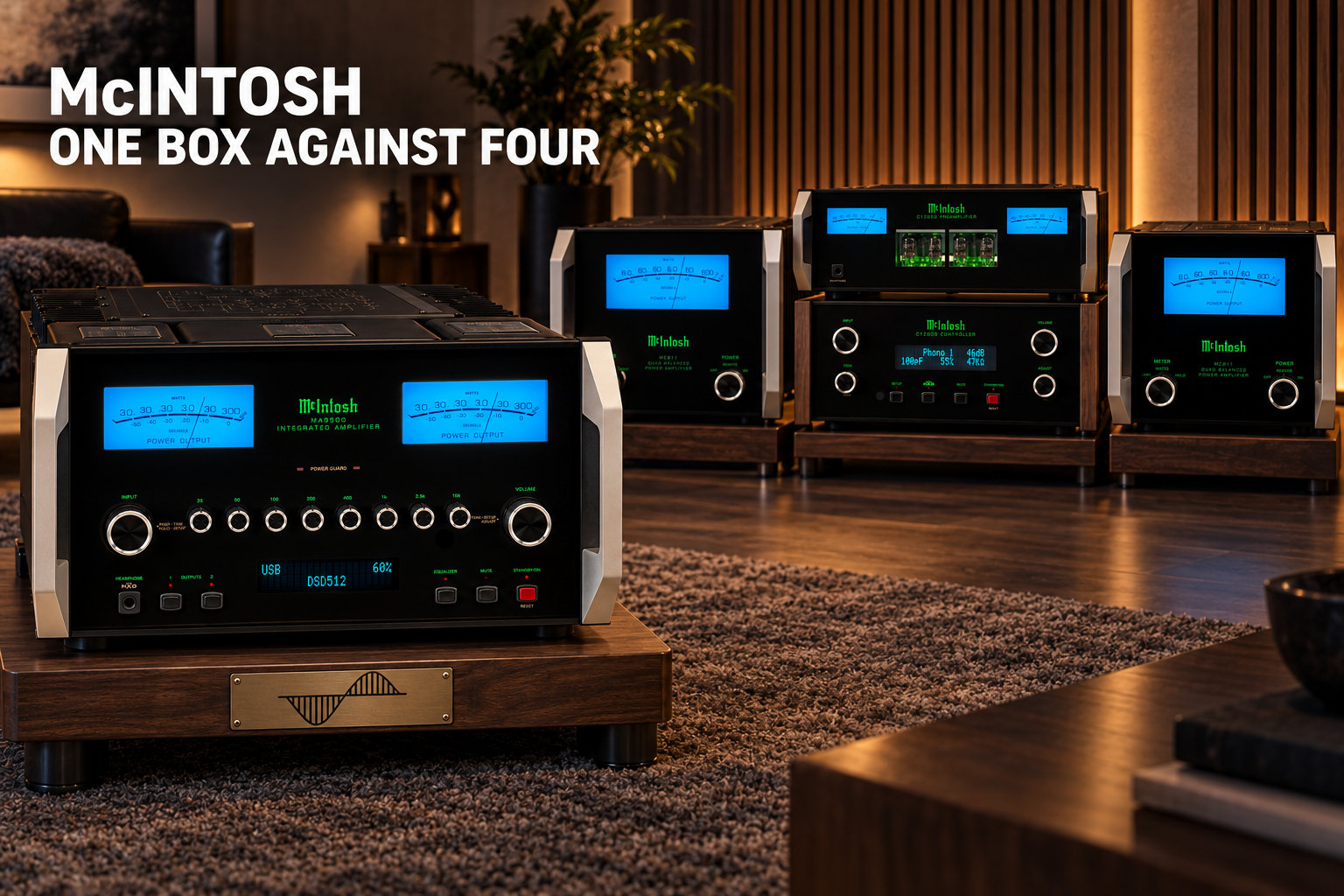
At 95 decibels the band materialises in my room. That is where my Wilson Audio Yvettes bend time, space and reality, then rebuild it however they want, and where, for the first time in years, I felt my McIntosh MA9500 working harder than it ever had. Not struggling. McIntosh doesn't struggle. But pushing its limits. Before I blamed the amplifier, I put the uncomfortable question to myself: did I just have another upgrade fever?
I answered it with an extra $40,000: the MA9500 out, the McIntosh C12000 preamplifier and two MC611 monoblocks in. I expected 5 to 10%, if I was lucky. From the very first session it was hard to believe what I was hearing, and below I show you where, attribute by attribute. I will also tell you why most of you should keep your integrated. If your speakers cost under $20,000, that is the whole verdict. The rest is for those above that line, and for anyone who wants to know what the line is made of.
Upgrade fever at 95 dB: when the MA9500 started pushing
Don't misunderstand me: this is not a story about a bad match. When the Yvettes arrived, the synergy was exceptional. The MA9500 and the Wilsons coexisted peacefully and gave me some of the most amazing musical moments I have ever experienced. But there was something, a feeling I could not quite articulate, and it lived near the top of the volume dial: the sense that the speakers had more muscle than the amplifier.
The specifications explain the feeling. Wilson specifies the Yvette at 86 dB sensitivity and a nominal 4 ohms, dipping to 2.94 ohms at 90 Hz: a speaker that asks for current, not compliments. And the MA9500 is no weakling. McIntosh rates it at 300 W per channel, delivered in full into 2, 4 or 8 ohms through its Autoformers. When Hi-Fi News measured it for its July 2022 review, the lab found more than the badge promises: 430 W per channel continuous into 8 ohms, and 1,020 W into 1 ohm on dynamic peaks.
On paper, then, the MA9500 had power in reserve, and in my room it was still delivering jaw-dropping performance. That is exactly why I questioned myself before I questioned the amplifier. The difference between an amplifier that struggles and one that pushes has its own Daily, Not struggling. Pushing its limits., and it matters.
Years with the McIntosh MA9500 integrated amplifier
Let me say it the way I said it on camera: the MA9500 was and still is one of the best integrated amplifiers ever made. Period. And it came into my life through a mistake.
I had connected new Bowers & Wilkins 800-series Diamond floorstanders to my flagship Yamaha receiver. They sounded more detailed than my Klipsch, and hollow on every song. I called my dealer, shouting that they were defective. They were not; my electronics were not a match. So I ordered the MA9500 for same-day delivery, solid state, because I did not want the complexity of tubes. It arrived box-in-a-box, bolted to a wooden base, and it took four people to carry it.
The first song was "Giorgio by Moroder", streamed from my Eversolo A6 Master Edition through AudioQuest Yukon XLR cables, and I was overwhelmed. This was the sound I had been chasing since my very first audio shows. Bold, authoritative, full of energy, with a colossal soundstage and exceptional realism, and above all musical: you can listen for hours without fatigue. I hugged my dealer and broke down in tears. The whole story is in my single best purchase, and I stand by that title.
For years the MA9500 was my constant. As I upgraded speakers, cables and sources, it unfolded every detail I needed to evaluate, compare and choose. I auditioned systems costing far more and kept coming back thinking: why would I ever need anything else? It was built like a tank, weighed as much as one (McIntosh lists it at 101 lb), and never, ever failed me.
Expecting 5 to 10%: the case I made against myself
Upgrading to the C12000 and the MC611 monoblocks was genuinely difficult, and not only because of the money. I had no complaints. Zero. My dealer warned me I would never want to go back. My friends thought the upgrade was overkill. Tens of thousands of dollars more, for what exactly?
In the end I decided to trust Charlie Randall and his team at McIntosh. Their engineering behind the C12000, and behind upgrading their best-selling monoblocks to the MC611 generation, suggested something I could not ignore: this was what Wilson speakers wanted. Not to beat them into submission, but to tame them, if that is even the right word for speakers this capable.
The numbers on paper tell part of the story. The MA9500 gives 300 W per channel from one chassis; each McIntosh MC611 gives 600 W to a single channel. Doubling the power is worth about 3 dB of headroom, which on paper reads like a footnote. But specifications have never told the whole story of McIntosh.
I'd convinced myself the upgrade would be marginal, maybe 5 to 10% if I was lucky. That's what justified the price in my mind.
One more confession before the verdict. In my February 2026 film on snake oil I listed five biases, and for sunk cost I used myself as the example: I have invested $40,000 into McIntosh separates, and if someone tells me a $15,000 integrated sounds identical, my brain physically resists that information. That line has its own Daily too, $40,000 of sunk cost in my own head. Hold me to it.
Control against command: what the McIntosh C12000 and MC611 changed
The C12000 and the two MC611s arrived together, so what follows is the sound of all three. Within the first few days I caught myself asking out loud: how do these people at McIntosh do this? How is this even possible? It was not subtle, not marginal, not something I had to strain to notice or convince myself was there. After a week it was impossible to deny. The separates do everything the MA9500 does, but more, much more, in all the ways that made me love the integrated. I made the full case in my October 2025 film, MA9500 vs C12000 + MC611.
Part of the difference is visible before you press play. The MA9500 does the whole job in one chassis: inputs, volume and two 300 W channels. The separates spread that job across four. The McIntosh C12000 is itself two chassis: a controller that holds all the power control, data ports and external control connections, and a preamplifier module that houses the audio connections and circuitry, joined by shielded umbilical cables. McIntosh calls the result the "absolute isolation" of a preamplifier's two main functions, control and sound. The preamplifier module offers both vacuum-tube and solid-state output, your choice, and with its phono stage it carries ten tubes. So the buyer who chose solid state to avoid tubes now owns a McIntosh preamp with ten of them, and a switch. Then each MC611 drives one speaker and nothing else: 600 W, one channel, McIntosh's Quad Balanced design.
Read every label as live text
- Integrated
- Source
- MA9500
- Inputs + volume
- Power: 2 x 300 W (Autoformer)
- L
- R
- 1 chassis, 101 lb
- Separates
- Source
- C12000 Controller
- power control, data, control connections
- shielded umbilical
- C12000 Preamplifier
- audio connections and circuitry; tube or solid-state output, user selectable
- MC611 (L) 600 W, 1 channel
- L
- MC611 (R) 600 W, 1 channel
- R
- 4 chassis, 247 lb
Start with the soundstage. I thought the MA9500 created a huge soundstage. I was wrong. The separates took that same stage and made it truly three-dimensional: wider, yes, but with depth and layering that involve you differently.
You are not watching the performance; you are in it.
Instrument positioning became surgical, each musician in an exact space with air around them. And the separates find micro details in recordings I have heard hundreds of times, not in a fatiguing, hyper-analytical way, but naturally. You notice them because they are simply there.
Dynamics are where the extra power matters most, and where those 3 dB on paper stopped reading like a footnote. The Yvettes are demanding speakers. The MA9500 controlled them admirably; the MC611 monoblocks command them. Dynamic swings happen effortlessly. Crescendos build without any compression. The speakers finally have the authority behind them that they were designed for.
But the most important thing, and this is classic McIntosh, is silence. The system is dead quiet, so quiet that you forget you are listening to a system. You are just there, in the venue, with the artists. And the only thing I care about is the next song, and the next song, and the next song, for hours. Only the ecstasy remains, song after song.
| What I listen for | MA9500 integrated | C12000 + two MC611 |
|---|---|---|
| Overall | "No complaints. Zero." | "Everything the MA9500 does, but more, much more" |
| Soundstage | "Huge", "colossal" | "Truly three-dimensional", with depth and layering |
| Imaging and separation | The baseline | "Surgical" positioning; separation "transformative" |
| Detail | "Every detail I needed" to compare gear | Micro details in familiar recordings, found "naturally" |
| Grip on the Yvettes | Controlled them "admirably" | "Command them"; crescendos without compression |
| Fatigue | "Hours without fatigue" | "The next song, and the next song", for hours |
| Rated power | 300 W per channel, two channels | 600 W per monoblock, one channel each |
| Chassis and weight | 1 chassis, 101 lb | 4 chassis, 247 lb in total |
Attribute by attribute, in KD's words from his October 2025 film, with McIntosh's published power ratings and the sum of its published unit weights.
Listening words from my October 2025 film; power ratings and unit weights from McIntosh's published specifications, summed for the separates.
Speakers and room first: why separates need something to show
The sentence "$40,000 of amplification changed everything" is exactly the one that sells the wrong upgrade to the wrong person. The separates worked because the Yvettes could show what they were doing. I learned the same lesson from the other side years earlier, with B&W Diamonds on a receiver that could not drive them: a balanced system always beats one where a single component outclasses the rest, and that lesson cost me years and a lot of money. Separates on modest speakers are the same mistake turned around.
The room taught me the rest. In February 2026 I filmed the new listening room, and nothing in my signal chain had changed. Same Wilson Audio Yvettes. Same McIntosh C12000 preamplifier. Same monoblocks. Same Transparent cables. Same sources. The only things that changed were the room and the power. The improvement was not subtle. It was transformative. I thought I knew what my Yvettes and my McIntosh separates could do, and I was wrong. They had more to give, a lot more. I just never gave them the room to prove it.
So part of what I paid for sat locked away, waiting for a room. If you are about to spend $5,000, $10,000 or $20,000 on a component and your room has obvious problems, stop. Fix the room first. The return on investment is not even comparable.
Are separates worth it under $20,000 of speakers?
No: if your speakers cost under $20,000, a flagship McIntosh integrated amplifier like the MA9500 is more than enough. I said it on camera in October 2025 and I say it again in July 2026. Integrated amplifier vs separates is not really a question about amplifiers; it is a question about everything around them. Do not upgrade if:
- your speakers cost under $20,000;
- you are happy with how your system performs now;
- you do not have the physical space, because one 101 lb chassis becomes four boxes and 247 lb;
- the $40,000-plus difference matters significantly to your finances. It is a hefty price.
Consider it if you own a highly revealing speaker line, Wilson Audio, Focal Utopia or something similar; if your front end and cables are maxed out and you still want more; if you understand that you are chasing not only percentages but micro and macro elements; if you can afford it without financial stress; and if you are ready to commit to the system for years. The short version lives in the Daily When not to buy separates.
If you do go separates: what to prioritise, in order
- Speakers that can show it. A highly revealing line above the $20,000 mark; without it, separates have nothing to prove.
- The room, before any electronics. My own system sounded like a different system once the room was right.
- Front end and cables, matched and maxed out. $50 cables on a $50,000 system hold it back, and no monoblock rescues a mismatched chain.
- Power for the monoblocks. In my new listening room it was non-negotiable: each MC611 has its own dedicated 40-amp circuit.
- Balanced connections. If your equipment has XLR, use it: a blacker background, better noise rejection, more punch. That can matter more than the cable brand.
- Money and time you can spare. Buy without financial stress, and expect to live with it for years. I lived with the MA9500 for years, and with the separates for months, before I filmed the comparison.
The MA9500 remains extraordinary. I could have lived with it forever and been completely satisfied, and for most of you that is the most useful sentence in this piece. For the few above the line, the upgrade delivered exactly what McIntosh promised. In that October 2025 film I told McIntosh I had looked through their catalogue and found nothing left to upgrade to. The gear serves the music, not the other way around.
Frequently asked questions
Is the McIntosh MA9500 enough for Wilson Audio speakers?
Yes, it drives them well: the MA9500 controlled my Yvettes admirably and never struggled. Only at around 95 dB did I feel it pushing its limits, and with speakers that revealing the separates showed there was more to get.
How much more power do the MC611 monoblocks give than the MA9500?
Each MC611 gives 600 W to one channel, against the MA9500's 300 W per channel. On paper that is about 3 dB of extra headroom; what I heard was command, with crescendos that build without compression.
Does the McIntosh C12000 preamp use tubes?
Yes, but you choose: the C12000 preamplifier module offers vacuum-tube and solid-state output, user selectable, and carries ten tubes including its phono stage.
Integrated amplifier vs separates: which should I buy?
Below $20,000 of speakers, buy the integrated. Separates make sense only with revealing speakers, a sorted room, a maxed-out front end and money you can spend without stress.
More from the Journal
Keep exploring.
Loading articles…