

The Journal / Articles & reviews
From Krell to D'Agostino: The Amplifier Designer Who Built Two Legends
One engineer, two companies and a reputation built on current: how Dan D'Agostino's ideas traveled from Krell to the amplifiers that bear his name.
At three in the morning, early in January 1981, a Saab 900 Turbo crossed the Hoover Dam with a new company's first trade show packed in the back. Rondi D'Agostino listed the load for Stereophile two decades later: "three KSA-100 amps, a pair of speakers Dan whipped up, a last-second preamp, a Technics turntable, demo records, and our clothes." Below lay the lights of Las Vegas, and the Consumer Electronics Show they had driven two and a half days to reach. Krell had moved into its factory on 1 December 1980, and the first Krell amplifier was about to meet the trade.
Forty-five years later, the man who designed that amplifier has launched a 500-watt monoblock under his own name in Arizona, while the company he named after a science-fiction film is not building amplifiers at all. This is the story in between: how Dan D'Agostino made the Krell name a byword for current, how he was forced out at the end of 2009, how he rebuilt the same idea in copper, and what is actually known about Krell today. The short version: Krell closed in June 2024, reopened its service department in March 2025, and as of September 2026 its own website still describes production as paused.
The first Krell amplifier: 100 watts of Class A for $2,500
The KSA-100 began as a gift. Rondi, who had joined Mark Levinson in 1976 and was working for Mitchell Cotter when she met Dan at a CES, mentioned that she had accidentally killed her old Fisher tube amplifier. Dan gave her a 25-watt Class A amplifier. "It was an ugly little one-off amp," she told Steve Guttenberg in 2002, "but when I hooked it up to my system, I thought I'd died and gone to heaven!" Dan built a 50-watt version, Peter Aczel of The Audio Critic loved it, and that encouragement was enough. The partners kept their own names off the door in case the venture failed. Dan suggested Krell, after Rondi's favorite old science-fiction film, Forbidden Planet.
The arithmetic was aggressive. Levinson's ML-2, the Class A benchmark of the day, made 25 watts per monoblock and sold for around $4,000 a pair. The KSA-100 made 100 watts of Class A per channel in one chassis and retailed for $2,500: four times the power for less money. Dan explained the power to David Lander of Stereophile in 2003 by recalling a Julian Hirsch article on how much power a piano demands: "it occurred to me that the tips of musical material, the peaks, got clipped off. We may not consciously hear it, but some part of us does, and it's the difference between what's real and what's not."
Class A was not even the original plan. Dan changed the design after early listeners talked it up, heard the center image stop drifting and "more air around the music", and committed. The price was heat. The heatsinks ran at 75 to 80°C, "just a bit cooler than a clothes iron", so the amplifier got tall feet and a quiet fan. The competition's reply was commercial, not sonic: Levinson's company told its dealers that selling Krell would cost them the Levinson line. "It was no contest," Rondi said; "we were nobody."
The Krell sound: current, bias and a grip on the woofer
Krell's reputation was power, and its designer spent decades insisting that power was the easy part.
"Anyone can build a very powerful amplifier. The point is building one that sounds good, and one that sounds good at low volume levels." Dan D'Agostino, Stereophile, 2003
The engineering followed. In the 1990s Krell introduced Sustained Plateau Bias, which Dan explained with a piano's sustain pedal: raise the Class A bias to what the music demands, hold it there, step higher if a louder signal arrives, and fall back only after 60 to 90 seconds. The output stage stops changing with every note, and Krell got "huge amounts of class-A power for short periods of time". By 2003 he could say that every Krell product of the previous ten years was a "really serious current-mode" design. When the industry's standard output transistor proved too slow, Krell persuaded Motorola to make its own: the same 25 amps at 250 volts, but 30 MHz of bandwidth instead of 5 MHz. The goal was to buy a million of them. Asked whether Krell had, Dan said: "Oh yeah."
Take the Full Power Balanced line. Martin Colloms reviewed the FPB 600 for Stereophile in April 1997: 600 watts per channel, $12,500, fully regulated output-stage supplies that he called "probably the world's first at this high a power level", and "a serious two-man lift".
The treble is where listeners part company. On AudioKarma, an owner who replaced Adcom 565 monoblocks with an FPB 600 described the mids and highs turning lush, almost tube-like. On Audiogon, one owner dismissed the older KSA models as grainy and unreliable, and another poster in the same thread pushed back. For Jason Victor Serinus, later a Stereophile reviewer, there was no argument: a KSA-50S's imaging "blew me away", and Dan's work led him "from the harsh sound of my first high-end amp into another dimension".
The 2009 split: how Dan D'Agostino left Krell
The money came before the exit. By 2009, according to TNT-Audio editor Lucio Cadeddu, a New York private equity fund held 40 percent of Krell Industries and was clashing with the D'Agostinos. At the end of 2009, Stereophile reported, Dan and Rondi were forced out of the company by what Dan called a "hostile takeover". He was blunter with Hifi Pig in January 2020: "I was forced out of my own company by a minority investor, who had no idea what he was doing."
It was not the end of the D'Agostino name at Krell. By September 2018, Copper reported, Rondi had regained the company and Krell had hired industry veteran Walter Schofield as chief operations officer; she remained Krell's owner and CEO until her death in June 2024. Until a non-competition clause expired, Dan could not launch a competing product. Michael Fremer opened his 2013 Stereophile review of the first D'Agostino amplifier with the sharpest line of the episode: "What better way to celebrate the expiration of a noncompetition clause than to debut a product that has no competition?"
Read every label as live text
- Krell
- Dan D'Agostino Master Audio Systems
- 1980
- 1985
- 1990
- 1995
- 2000
- 2005
- 2010
- 2015
- 2020
- 2025
- 2026
- The split
- End of 2009
- 1 Dec 1980 - Krell moves into its factory
- Jan 1981 - KSA-100, 100 W Class A, shown at CES
- Apr 1997 - FPB 600 reviewed, 600 W per channel
- End of 2009 - Dan and Rondi forced out
- Mar 2014 - iBias launched
- 2018 - XD with the K-300i
- 18 Jun 2024 - Krell closes
- 19 Mar 2025 - service resumes
- Jan 2011 - Momentum monoblock debuts at CES (company founded 2011)
- 2017 - Progression in production
- May 2018 - Relentless launched in Munich
- 2024 - Pendulum shown at Munich High End
- 12 Jan 2026 - Momentum Z announced (15th anniversary)
Dan D'Agostino amplifiers: copper, a watch-face meter and the Momentum
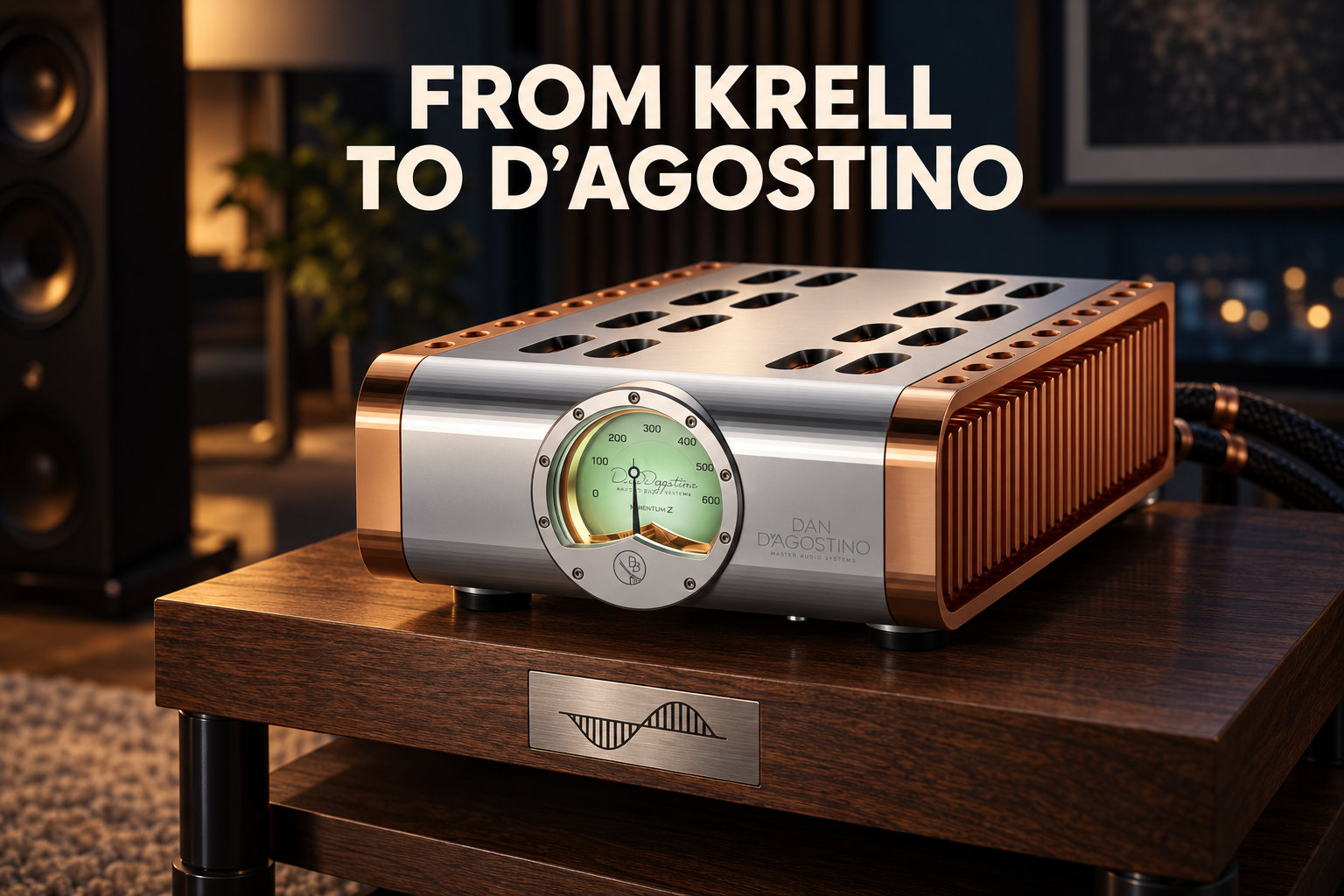
Dan D'Agostino Master Audio Systems dates its founding to 2011, and its first product appeared that January. At CES 2011, Stereophile's Erick Lichte found the new D'Agostino Momentum monoblock, at $42,000 a pair, driving Wilson Sasha loudspeakers: 300 watts into 8 ohms, 600 into 4 and 1,200 into 2, "in the tradition of Krell". Almost everything else broke with Krell. The sides were copper, doubling as heatsinks for the output transistors, 28 of them by Lichte's report. The circuit boards were stuffed in-house with through-hole parts only. The faceplate was dominated by a round meter "visually inspired by Swiss watch design". Lichte heard a sound that was "warm, fast, open and generous".
Fremer's 2013 review priced the pair at $55,000 and described the object as carefully as the sound: 5 inches high, 95 pounds, thick copper side panels bolted to a chassis machined from a single aluminum billet, and venturi-shaped holes in place of fins. The CES buzz, he wrote, had been "Dan is back!"; his own verdict was a paradox: "How can so distinctive- and memorable-sounding a pair of amplifiers have no discernible sonic character?"
Note the reversal. The KSA-100 bought its sound with heat; the Momentum bought its size with copper. Dan's own explanation to Hifi Pig: "The original idea for the Momentum Mono was a high-powered amplifier in a relatively small package," and "Copper is considerably more thermally conductive than conventional Aluminum." The aim had not moved since 1981. Only the route had.
The D'Agostino range today: Pendulum to Relentless, and the Momentum Z
Fifteen years on, the catalog climbs in four steps. Pendulum, the entry point, made its US debut at AXPONA 2025 at $16,000 and is now listed by US dealers from $18,000. Progression, in production since 2017, is what Serinus called the "less expensive but hardly plain-Jane" line, and his review pair gave him "far more believable air and sense of hall boundaries than any other amps I've heard in my reference system". Momentum, the original line, now carries the suffix MxV, physics shorthand for mass times velocity; the update draws over 50 percent more current from the same transformer footprint, and original Momentum amplifiers can be upgraded to it. Relentless sits on top, launched at Munich in May 2018 at $250,000 a pair and now crowned by the Epic 1600, which weighs 570 pounds a side and wears a power meter more than eight inches across.
Announced from Cave Creek on 12 January 2026 for the company's fifteenth anniversary, the Momentum Z is the first D'Agostino power amplifier with a JFET input stage, a circuit the Pendulum integrated had already borrowed from the Momentum C2 preamplifier. Each monoblock makes 500 watts into 8 ohms and 2,000 into 2, weighs 100 pounds and wears heat sinks five-axis machined from a single 42-pound slab of copper. The meter is now "dual domain": a 3.5-inch LCD replaces the printed meter face while the traditional wand still indicates power, and an Ethernet port lets the owner read voltages, temperature, bias and DC offset in a web browser. At $62,500 per amplifier, or $125,000 a pair, it was announced for spring 2026 availability.
The US line-up as of September 2026, at US dealer list prices (the Momentum Z and Relentless figures are for a pair):
| Series | Model | Type | Rated power, 8 / 4 / 2 ohms | US price (about) |
|---|---|---|---|---|
| Pendulum | Pendulum Integrated | Integrated | 120 / 240 W per channel (2 ohms not specified) | $18,000 base |
| Progression | S350 | Stereo power | 350 / 700 / 1,400 W per channel | $30,000 |
| Progression | M550 | Monoblock | 550 / 1,100 / 2,200 W | $50,000 (dealer listing) |
| Momentum | S250 MxV | Stereo power | 250 / 500 / 1,000 W per channel | $50,000 |
| Momentum | MxV Integrated | Integrated | 250 / 500 / 1,000 W per channel | $72,500 without modules |
| Momentum | M400 MxV | Monoblock | 400 / 800 / 1,600 W | $90,000 (dealer listing) |
| Momentum | Momentum Z | Monoblock | 500 / 1,000 / 2,000 W | $125,000 per pair |
| Relentless | Relentless 800 | Monoblock | 800 / 1,600 / 3,200 W (4 and 2 ohms on 220 V) | $225,000 per pair |
| Relentless | Relentless Epic 1600 | Monoblock | 1,600 / 3,200 / 6,400 W (4 and 2 ohms on 220 V or higher) | $385,000 per pair |
Rated power from the manufacturer and US dealer list prices as of September 2026; Momentum Z and Relentless prices are for a pair, M550 and M400 MxV prices are as listed by a US dealer; Relentless 4- and 2-ohm figures need 220-volt mains.
Is Krell still in business?
Krell still services its amplifiers, but as of September 2026 it is not building new ones. On 18 June 2024 Krell Industries closed following the unexpected death of its owner and CEO, Rondi D'Agostino. In February 2025 TNT-Audio reported worried customers with equipment in for repair, a promise from the head of technical service that "all requests for assistance will still be honoured", and an unsettled question of ownership. On 19 March 2025 Krell's service operations resumed.
Krell's website tells the rest: a leadership transition in November 2024, factory retooling from January 2025 and an April 2025 promise of limited production "in the coming months with full production to be completely operational by 2026". The same page says: "We have temporarily paused production operations. Resumption timeline is still being determined." Until a new Krell ships, the 2026 restart is a plan, not a product. For buyers that leaves a used market of KSA, FPB, Evolution and XD amplifiers, a factory service desk and, for now, nothing new to order.
Two philosophies after the split: Krell and D'Agostino compared
Since 2009 the two companies have answered the KSA-100's question in different ways. Krell, without its founding engineer, kept the conventional box and chased efficiency and impedance. In March 2014 it launched iBias, which it said "uses the Class A circuitry yet consumes far less energy than a traditional Class A amplifier does", in a range from the 175-watt Duo 175 to monoblocks of more than 500 watts. XD followed in 2018 with the K-300i integrated and spread across every Krell amplifier through 2019. Walter Schofield told Copper that the gains came from "lowering the output impedance below traditional norms", one advantage being that the amplifier "exerts more control over the loudspeaker drivers". D'Agostino turned the amplifier into an object and kept a generous Class A window inside Class AB designs: the Progression M550, for one, stays in Class A up to 70 watts.
| Krell, after 2009 | Dan D'Agostino Master Audio Systems | |
|---|---|---|
| Base | Orange, Connecticut | Cave Creek, Arizona |
| Founded | 1980 | 2011 |
| Bias idea | iBias (2014): Class A circuitry, less energy | Class AB with a wide Class A window (M550: 70 W) |
| Latest technology | XD (2018): lower output impedance | Momentum Z (2026): LCD meter, Ethernet monitoring |
| Status, September 2026 | Service open since March 2025; production paused | Range on sale; Momentum Z new for 2026 |
Base, founding year, bias approach, latest technology and status in September 2026 for Krell and Dan D'Agostino Master Audio Systems.
The real argument is about measurements, and it lands on D'Agostino. When Stereophile's John Atkinson measured the Progression M550 in 2021, SoundStage! Ultra's Diego Estan read the results as an output impedance of 0.37 ohm at 1 kHz, a damping factor of 21.6 into 8 ohms, and THD+N of 0.15 to 0.25 percent between 1 and 20 watts, "at least an order of magnitude worse than what the competition would typically offer". In the same piece, Jeff Fritz drew the line: "I'd pass on a product that didn't produce excellence in both the measured and the listening test results." Dan's position, as he told Serinus: "At D'Agostino, we listen a lot. Listening is the most important thing, not how it measures." Two reviewers side with him: Serinus, and The Absolute Sound's Jacob Heilbrunn, who heard in the Momentum M400 "a remarkable degree of control" while conceding it "isn't quite as refulgent as tube gear". The bench has moved too: the Hi-Fi News lab report on the second-generation Progression S350 found "worthwhile gains in performance, in all key areas, over the 'mk1'". Krell has its own footnote: on Stereophile's bench the K-300i almost completed the one-hour, one-third-power preconditioning test, turning itself off after 55 minutes with an over-temperature warning.
Our reading: the D'Agostino sound is a deliberate choice. Buyers who want the lowest distortion per dollar have cheaper routes. Buyers who want the control Heilbrunn heard, in a chassis finished like a Swiss watch, are the ones it was built for.
Who these amplifiers are for: speakers, rooms and budgets
Start with the speaker, not the badge. Every amplifier in this story was built for loads that punish weak power supplies, and the demos show it: Lichte first heard the Momentum on Wilson Sashas, Serinus first heard the Progression on Wilson Alexx. Low sensitivity and low impedance are what turn 2-ohm ratings from brochure numbers into audible control. KD's own numbers from his Klipsch La Scala against Wilson Yvette film show the stakes: the Yvette's 86 dB sensitivity sits 19 dB below the La Scala's 105 dB, which he translates as roughly a hundred times the power, into a 4-ohm load that dips to 3 ohms. The La Scala, by contrast, reaches concert levels from a 10-watt tube amplifier. A pair of Relentless monoblocks in front of horns buys headroom the speaker will never request.
What the current buys is control. In KD's film on moving from the McIntosh MA9500 to C12000 and MC611 separates, the step on his Yvettes came down to two verbs: the integrated controlled the speakers admirably; the monoblocks commanded them, with crescendos building without compression. Dan wrote the same ambition into the Progression manual: "it is the control of the speaker drivers I was after." Krell's Schofield used almost the same words for XD. The same film draws the line the other way. KD's rule: do not move from a flagship McIntosh integrated to separates if your speakers cost under $20,000 or you are already happy with the sound. Overbuying, in KD's phrase from his streamer review, "is like installing a Formula 1 engine in a conventional car."
Plan the room and the wiring too. The Relentless Epic 1600 reaches its 3,200-watt rating into 4 ohms only on 220-volt or higher mains, idles at 480 watts and can draw up to 10 kilowatts per monoblock. The budget ladder, as of September 2026:
- Under $18,000: no new D'Agostino or Krell; a used Krell, with factory service available again.
- About $18,000: Pendulum, the entry ticket.
- $30,000 to $50,000: Progression, where the S350 delivers the most watts per dollar in the range.
- $50,000 to $125,000: Momentum, which the company itself calls "the greatest value in genuine high-end audio".
- $225,000 to $385,000: Relentless, for very large speakers, very large rooms and dedicated mains.
Forty-five years after three amplifiers crossed the Hoover Dam in a Saab, the question Dan D'Agostino asked about piano peaks still decides the purchase: does your speaker need the current? If it does, the answer Dan gave in 1981 is still being built, in copper, in Cave Creek. The company he named after a film is, for now, only repairing the amplifiers it already made.
More from the Journal
Keep exploring.
Loading articles…