

The Journal / Articles & reviews
Rega Planar 3 Review: Why the Benchmark Turntable Still Earns Its Place
Light, rigid and stubbornly simple: the evidence on a turntable that has been many listeners' first serious deck for decades.
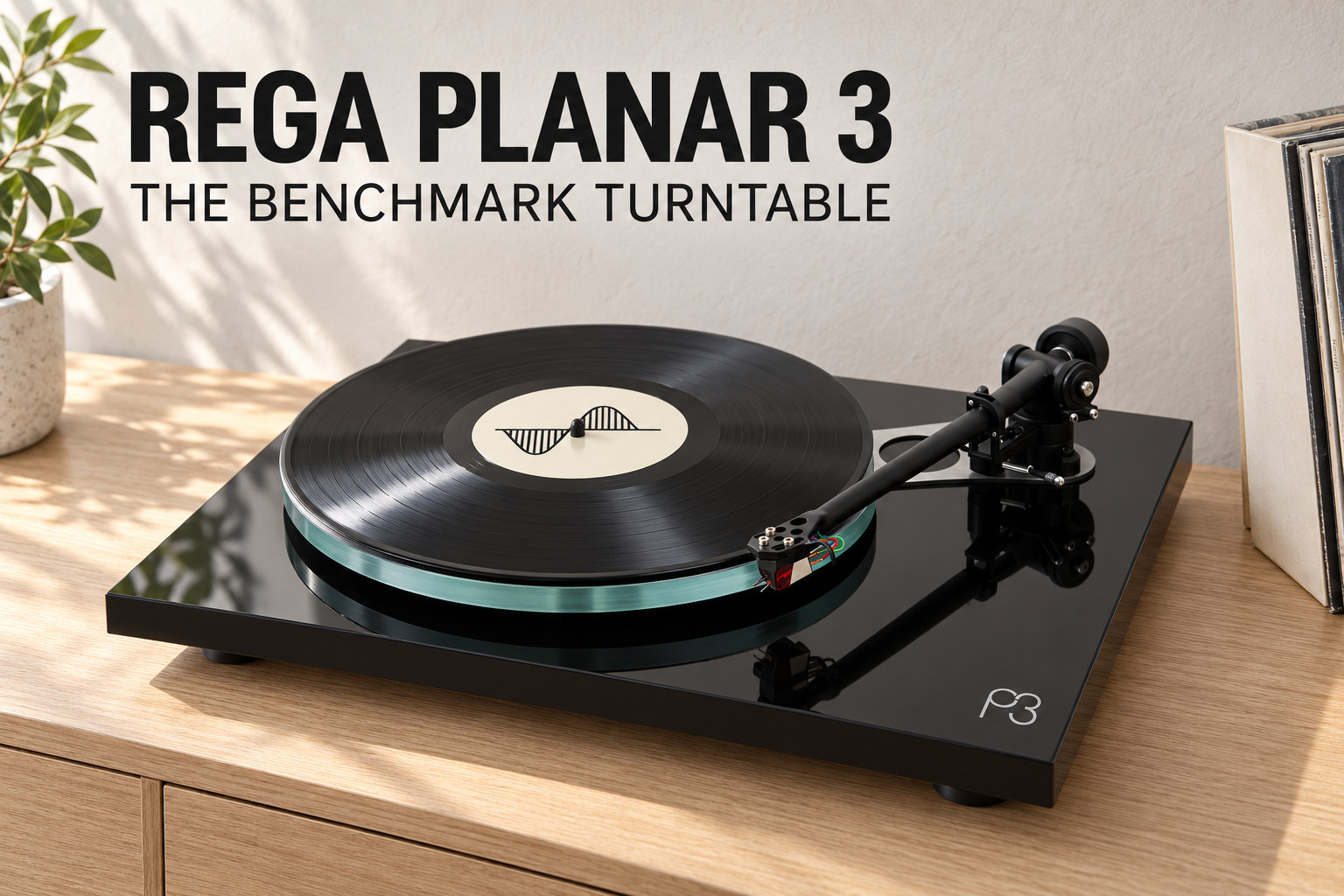
The Rega Planar 3 turns fifty in 2026, and it has never tried to win an argument by weight. Six kilograms of laminated plinth, phenolic bracing and a 12 mm disc of float glass, sold for about $1,395 with Rega's Nd3 cartridge (US price, October 2026), it is still the deck its rivals are measured against. SoundStage! Hi-Fi, reviewing Rega's RP8, called the Rega 3s from the first Planar 3 to the RP3 "the de facto standard against which other sub-$1000 turntables are judged." The price has since cleared $1,000. The standard has not moved.
What follows weighs reviews, measurements and owner reports, then the cartridges, phono stages and rivals, from the Technics SL-1500C to Rega's own Planar 6. The short answer: the standard Planar 3 remains one of the safest first serious turntables money can buy, provided the system around it is equally capable. If the budget stretches by $400, buy the RS Edition.
Why the Rega Planar 3 still matters
Rega Research was formally founded on 1 July 1973, when Roy Gandy and Tony Relph each put a thousand pounds into a pot. After the Planet, which carried the record on three rotating pods, Gandy met Clifford Rankin of Rankin Glass, whose precision platters made the Planars possible; by one product history, the Planar 3 followed in 1976 with an Acos-derived R200 arm. It was no instant hit: Sound+Image was told it "sold like cold cakes."
The reputation rested on price. Stereophile's Herb Reichert called the original "the poor man's Linn Sondek LP12", and Michael Trei, then a college student with limited funds, recalled the late-1970s British press steering him to a Planar 3 at about a quarter of an LP12's cost. The RB300 of 1983, the first tonearm built in Rega's own factory, turned a bargain into a reference point.
The name has since tracked the engineering: P3 in 2000, P3-24 with a lower-noise 24 V motor in 2007, RP3 in 2012, and the current Planar 3 in 2016, "truly a new turntable" in Gandy's words, "carrying over just two components from the previous model." In 2024 the Nd3 replaced the Elys 2 at no extra cost and the package won back What Hi-Fi?'s Product of the Year; the $1,795 RS Edition followed that November.
Light and rigid: how the Planar 3 is built
Gandy treats a turntable as a vibration-measuring machine. Mass, in Rega's view, absorbs energy and releases it slowly as coloration, so the goal is stiffness without weight. The Planar 3's light, MDF-cored laminated plinth is stiffened by a double phenolic brace that spans main bearing and arm mount like a stressed beam. The 12 mm Optiwhite glass platter turns on a brass main bearing, and the 24 V low-noise motor is bolted straight to the plinth, because Gandy wants an inflexible link between bearing, arm and motor. The line even gets lighter as it gets dearer: the Planar 6 weighs 5.2 kg to the Planar 3's 6.0 kg.
The hand-assembled RB330 tonearm completes the argument: a one-piece casting bolted straight to the plinth, with no height-adjustable collar to flex. That buys rigidity at the cost of adjustability. Reichert rated the RB330 "probably a 6 or 7" out of ten, where the SME M2-9 scored 4 or 5, and called arm quality "the No.1 reason" Rega record players "continue to make so many people happy."
What reviewers and owners report
Since the late 1970s the consensus has barely moved: the Planar 3 plays rhythm and timing better than its price suggests and keeps attention on the music. What Hi-Fi?'s 2024 Planar 3/Nd3 review gave it five stars for sound and build, three for features, and called it "a class-leading entertainer" with an "articulate, fluid and substantial" midrange. Reichert, in Stereophile: "It rocked, it swung, it slipped and slid." Jason Kennedy of The Ear called the RS Edition "a stonkingly good turntable." The praise carries one asterisk, and Reichert put a number on it.
Measurements: smooth, but a touch fast
On a 3,150 Hz test tone, Reichert's Planar 3 played 3,159.8 Hz, about 0.3% fast; Rega's external supply of the time nudged it to 3,158.2 Hz, while a Technics SL-1200GAE read 3,150.2 Hz. The speed was nonetheless "exceptionally smooth and consistent." Owners have noticed; StereoNET's forum even has a thread titled "Planar 3 too fast".
Reichert's stethoscope test was stranger. Motor vibration in the plinth was "shockingly loud" on the stock supply, about 6 dB quieter on the external one. With the phono stage off and a Gregorian chant LP playing, he pressed the stethoscope to the plinth and could make out the words the choir was singing. He wondered whether that mechanical "playing along" is the "secret sauce" behind Rega's reputation for pace.
The dissent
Reichert also heard a "slight punchy opacity". In March 2026 a What Hi-Fi? forum member went after the foundations: "The weakest part has always been the board on which everything sits." On AudioKarma, a member weighing it against the Technics decided either "could be seen as better than the other", depending on which sonic attributes matter most. The fair summary: the Planar 3 trades ultimate silence for engagement.
Weaknesses: no suspension, manual speed change, a fussy shelf
Four limitations recur. For isolation, What Hi-Fi? notes, the deck doesn't offer "much more than a trio of rubber feet", so the support does the work: a light, rigid table well away from the speakers or, on a suspended wooden floor, Rega's own wall shelf. With no adjustable feet, Kennedy points out, the rack itself must be level. On the standard deck, every change to 45 rpm means lifting off a 12 mm slab of glass and nudging the belt to the other pulley step. And the arm has no height or azimuth adjustment: only spacers or shims correct for a cartridge of a different height, and azimuth stays where Rega set it. None of the four is a build fault. They are what a light, rigid, six-kilogram deck costs you.
Rega Planar 3 upgrades worth the money
Three Rega parts do most of the work, starting with the power supply: the Neo PSU Mk2 adds push-button speed change and a cleaner motor feed, and What Hi-Fi? heard "more body, stability and muscle." The Reference belt tightens speed accuracy; the Nd5 brings a nude elliptical stylus.
| Upgrade | US price, October 2026 | What it adds | In the RS Edition |
|---|---|---|---|
| Neo PSU Mk2 power supply | $445 | Push-button 33⅓/45 rpm, cleaner motor feed | Yes |
| Reference EBLT drive belt | $75 | Better speed accuracy than the EBLT Advance | Yes |
| Rega Nd5 cartridge (replaces the Nd3) | about $545 | Nude elliptical stylus | Yes |
| High-pressure-laminate plinth skin | Not sold separately | The plinth finish of the Planar 6, 8 and 10 | Yes |
The Neo PSU Mk2, Reference belt and Nd5 total $1,065; the RS Edition costs $400 more than a Planar 3/Nd3, includes all three and adds a laminate plinth not sold separately (US, October 2026).
Sources: What Hi-Fi?, Rega, Upscale Audio. US prices as of October 2026.
The RS Edition reviews make the case on arithmetic first. Bought separately, the three parts cost $1,065; the RS Edition costs $400 more than a Planar 3/Nd3, includes all three and adds a laminate plinth that cannot be retrofitted. Then on sound: What Hi-Fi? tried both routes, and the upgraded standard deck "just can't quite match" the RS Edition. Upgrade piece by piece only if you already own a Planar 3.
Best cartridge for the Rega Planar 3, and the phono stage behind it
For most owners, the best cartridge for a Rega Planar 3 is one of Rega's own Nd moving magnets, which bolt into the RB330's three-point mount without alignment fuss. All track at 1.75 g with 5 to 6 mV of output and differ mainly in the stylus: Nd3 ($345, polycrystalline elliptical), Nd5 (about $545, nude elliptical) and Nd7 ($795, fine-line nude). What Hi-Fi? found the Nd3 "tells us more about the recording" than the outgoing Elys 2, which Reichert had heard as "hard and opaque" in the top five octaves.
KD runs a McIntosh MT5, but his advice for newcomers to vinyl is pure Planar 3 territory. In the channel's film on moving magnet versus moving coil cartridges, he recommends a good moving magnet at $200 to $300, such as the Audio-Technica VM95SH or Ortofon 2M Blue, and living with it; a moving coil at $500 to $900 waits until the records and the phono stage justify it. And because an excellent moving magnet beats a poor moving coil, the Nd5 or Nd7 is where a Planar 3 owner can sensibly stop.
The deck has no phono stage. Rega's Fono MM Mk5 ($445), What Hi-Fi?'s Award-winning favourite affordable phono stage, offers just over 41 dB of gain for moving magnets only. The channel's systems rule applies at every price: a flagship turntable into a $500 amplifier will not perform, and neither will a Planar 3 feeding a poor phono stage.
Planar 3 vs Technics SL-1500C vs Planar 6: which to buy
| Turntable | Drive and speed change | Tonearm | Cartridge supplied | Phono stage | US price, October 2026 |
|---|---|---|---|---|---|
| Rega Planar 3 | Belt, 24 V motor; 33⅓/45 rpm, manual belt move | RB330, fixed height | Rega Nd3 MM | No | $1,395 with Nd3; $1,125 without |
| Rega Planar 3 RS Edition | Belt, Neo PSU Mk2 included; 33⅓/45 rpm, electronic | RB330, fixed height | Rega Nd5 MM | No | $1,795 |
| Technics SL-1500C | Coreless direct drive; 33⅓/45/78 rpm, electronic | S-shaped, height-adjustable, removable headshell | Ortofon 2M Red MM | Yes, switchable | about $1,500 |
| Rega Planar 6 | Belt, Neo PSU Mk2 included; electronic | RB330, fixed height | None in base price (Nd5, Nd7 or Ania Pro optional) | No | about $1,875 to $1,925 without cartridge |
Drive, arm, supplied cartridge, phono stage and US price as of October 2026; the Technics is the only one with a built-in phono stage.
Sources: Rega, Technics US, What Hi-Fi?, The Absolute Sound, Upscale Audio. Prices are US list or retail as of October 2026.
The Technics is the practical alternative. Direct drive, 78 rpm, auto-lift, a removable headshell, a height-adjustable arm and a switchable phono stage answer most of the Rega's weaknesses in one box at about $1,500. Add a $445 Fono MM Mk5 to a $1,395 Planar 3 and the Rega route comes to about $1,840, some $340 more. In its SL-1500C review, What Hi-Fi? set the Technics against the Planar 3 of the Elys 2 era and found the Rega "even subtler and more insightful", the Technics "crisper". The Absolute Sound heard "crisp, sharp, and focused" sound but rated the built-in preamp "somewhat lifeless, but acceptable." And in a three-way test What Hi-Fi? reported on 2 October 2026, the RS Edition was still judged "the more transparent and insightful performer" against Technics' newer $1,799.99 SL-1500CS.
The Planar 6 adds a foam-core laminate plinth, a dual-layer glass platter, and the Neo PSU Mk2 and Reference belt as standard. In The Ear's RS review, Kennedy set a Planar 6 with an Nd5 alongside and called the differences "quite large", mainly "a much lower noise floor." By our arithmetic from list prices, that Planar 6 and Nd5 cost roughly $625 to $675 more than the RS Edition.
In the channel's March 2026 ranking of the best turntables, the Rega Planar 10 placed second on the value list at $6,500 with its RB3000 arm, and KD likened it to finding "a Corneliani suit at 70% off." The pattern the ranking kept surfacing, in his words:
"The best value turntables are almost always the ones borrowing technology from a manufacturer's flagship and bringing it down to a more accessible price." KD, March 2026
The RS Edition is that pattern in miniature: its laminate plinth skin was previously reserved for the Planar 6, 8 and 10.
- Buy the Technics SL-1500C if you lack a phono stage, play 78s or rank convenience above the last degree of insight.
- Buy the Planar 3/Nd3 ($1,395) as a first serious deck if your amplifier has a good phono input, or the RS Edition ($1,795) if the budget allows.
- Buy the Planar 6 if the system is already revealing and the deck must last a decade, then fit a cartridge to match.
Verdict: still the benchmark, on its own terms
The Rega Planar 3 does not earn its place by measuring perfectly. It runs a fraction fast, its arm barely adjusts and its plinth sings along with the record. It earns it because, across nearly five decades of revisions, reviewers and owners keep reporting the same thing: the music comes first and the machinery second. Its weaknesses are known. The $445 Neo PSU cures the belt-swapping speed change, a light, level, rigid shelf handles most of the rest, and the fixed arm geometry you simply accept. For a first serious turntable at about $1,400, nothing in the evidence displaces it; the Technics wins on convenience, the Planar 6 on silence. If $1,795 is within reach, the RS Edition beats the upgrade path. Then spend as carefully on the phono stage and the shelf as on the deck, because a Planar 3 is only as honest as the system it feeds.
Frequently asked questions
Is the Rega P3 still worth buying in 2026?
Yes. At about $1,395 with the Nd3 (US, October 2026), it won back What Hi-Fi?'s Product of the Year in 2024 and remains the benchmark for rhythm and build at its price.
Is the Planar 3 RS Edition worth the extra $400?
For a new buyer, yes. Its Neo PSU Mk2, Reference belt and Nd5 cost $1,065 bought separately, and its laminate plinth cannot be added later.
What is the best cartridge for the Rega Planar 3?
Rega's own Nd3 or Nd5 moving magnets fit the RB330 without alignment fuss. The Ortofon 2M Blue, one of KD's two starter recommendations, is the obvious third-party alternative.
More from the Journal
Keep exploring.
Loading articles…