The Journal / Articles & reviews
Do Expensive DACs Sound Better? What I Heard From $1,000 to $100,000
Price does not rank DACs in a straight line; implementation does, and the system around it decides whether you can hear it.
Friends would come over, and I would force them into A/B tests. The Apple TV, then my new Eversolo. Listen to this. Guess which is which. Once you hear it, you cannot unhear it. I was that guy. This piece, like the film before it, is partly an apology to the friends who tolerated me.
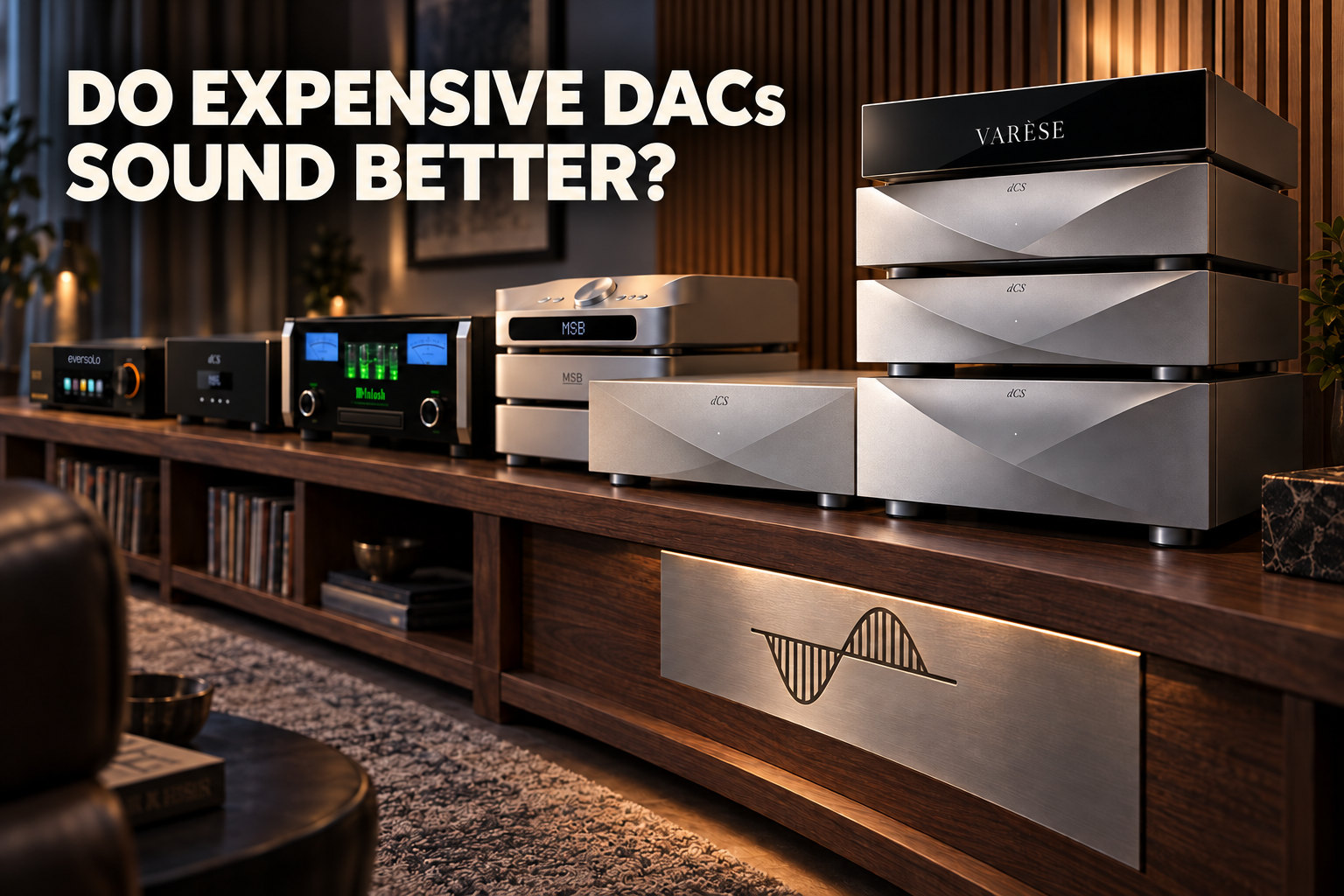
Is a high end DAC worth it? That question took me from an Apple TV 4K to an Eversolo A6 Master Edition at around $1,000, an Eversolo A8 at about $2,000 and the McIntosh MCD12000 that now anchors my digital chain. Then it took me into auditions of dCS and MSB, from an MSB Select at about $100,000 to a dCS Varese in what I called a quarter-of-a-million-dollar system. My film on it went up in November 2025. Price does not rank DACs in a straight line. Implementation does, and the system around the DAC decides whether you can hear any of it. For my own digital chain, the returns flattened at about $25,000.
Apple TV to a proper DAC: and then I became insufferable
My DAC journey started where most people's does: streaming from an Apple TV 4K. It sounded fine to me. I had no complaints, which in this hobby is the most dangerous state of all.
Then my dealer convinced me to buy the Eversolo A6 Master Edition. His pitch was that it was the next best thing, a box that sells out before the new stock even arrives. Around $1,000 for a streamer and DAC built on dual ESS chips. I heard it, and the Apple TV never sounded fine to me again.
That is when I became the man in the opening scene, a story I have also told in my Daily, And then I became insufferable. My friends tolerated it; the lesson was mine.
In my February 2026 film on snake oil, I put the whole DAC curve into three steps: cheap to good is massive, good to great is noticeable, great to cost-no-object is subtle. The Apple TV to the Eversolo was the massive one. What came after cost far more and moved less, and that is where the money starts to behave strangely.
The DAC ladder: Eversolo A6, A8 and McIntosh MCD12000
HiFi Rose caught my eye in a showroom next: gorgeous full-size boxes with the best touchscreens in the industry. A glorified LCD, I thought, priced like an 85-inch OLED television. I auditioned the RS150 anyway, and my jaw dropped. It was not about the screen any more. That liquid, analogue quality, the detail, the organic-ness. But I was not ready to spend $5,000, so I stayed with the memory instead, and a memory like that keeps knocking at your door for days, weeks, even months.
So I dressed up as the cheap Rose man and bought the Eversolo A8 for about $2,000, double the A6. I was fascinated by its new AKM chipset, back after a fire at AKM's factory in Nobeoka, Japan, in October 2020 had disrupted the supply of the company's DAC chips. StereoNET's review names the pair as AKM's AK4499EX and AK4191EQ: after the dual ESS chips of my A6, a change of camp. The A8 was a clear win over the A6 Master Edition on every front: more detail, better imaging, more refinement. It even settled a dilemma I had been living with, the McIntosh DA2 against the A6 Master Edition. And yet, at $5,000, the Rose was still better.
Being a true McIntosh fanboy, I took my chances and auditioned the MCD12000. I already owned the MCD350, and I was intrigued that McIntosh was pushing this one as its flagship DAC, with the transport almost as a complement. McIntosh's own words are "a reference level DAC that includes a reference level CD Player". Two ESS chips, one per channel, a tube output stage, and a solid-state option for special circumstances. The price is enough to trigger a vertigo.
I fed it from Rose's flagship transport and compared it with the RS150, both into the same McIntosh electronics and Sonus faber Amati speakers. The McIntosh stack expanded the soundstage and added a natural vividness, that tube organic-ness, without colouration. Everything just sounded right, or more convincing. Separates beat the all-in-one devices every day. But at five times the price, plus cables, plus rack space, plus complexity. I bought the MCD12000, and it anchors my system today.
| Step | Component | Owned or auditioned | Price as I gave it in the film (Nov 2025) | What changed |
|---|---|---|---|---|
| Start | Apple TV 4K | Owned | Not stated | Sounded fine to me |
| 1 | Eversolo A6 Master Edition | Owned | Around $1,000 | The jump that made me insufferable |
| 2 | Eversolo A8 | Owned | $2,000 | Clear win: more detail, better imaging, more refinement |
| 3 | HiFi Rose RS150 | Auditioned | $5,000 | Liquid, analogue-like; still better than the A8 |
| 4 | McIntosh MCD12000 with Rose transport and interconnects | Owned | About $25,000, or 25 times the A6 | Bigger soundstage, natural vividness, tube organic-ness without colouration |
| 5 | dCS Lina, dCS Varese system, MSB Select | Auditioned | MSB about $100,000; Varese system about $250,000 | The closest to master tape I have heard |
What I owned and what I auditioned, with prices as I gave them in the November 2025 film.
Closest to master tape: what a high end DAC does at $100,000
This is where you have to ask yourself whether this is a hobby or an obsession. The Rose RS150 was five times the price of the A6 Master Edition. The MCD12000 with the Rose transport and interconnects was five times the RS150, or twenty-five times the Eversolo. So what happens if you go five times again?
You arrive where the cost-no-object makers live, the ones whose DACs claim to go beyond realism in the presentation. dCS, MSB and CH Precision are the most popular examples. I auditioned the dCS Lina with and without its clock, then the Varese in what I described on air as a quarter-of-a-million-dollar system, and the MSB Select DAC at about $100,000. Were they different from my cheap $25,000 system?
These systems are extraordinary. The closest thing to analogue master tape I have ever heard: the realism, the space, the texture. They sound nothing like a digital system, and they do not sound like each other either. At this level it is all preference. But do not confuse different with coloured. MSB and dCS do not paint their own story. They keep the original story as it is and present it convincingly, each in its own way, and miles ahead in realism of anything else I have heard.
Which is the best high end DAC, then? At the summit there is no single winner. dCS tells the truth one way, MSB another, and you choose the one you want to live with.
Not a hundred times better: where the returns flatten
I sat there listening, trying to find words for what these systems are and whether they are worth their price tags. And here is the truth, my truth.
It is not a hundred times better than the Eversolo at this stage. It's not about a multiple any more.
At this level, the DAC is what does justice to your front end and lets it show how close to reality it can take the sound. If your speakers cannot reveal it, if your room is not treated, if your amplification is not up to the task, you are simply wasting your money, and you will still be talking about snake oil in front of a quarter-of-a-million-dollar DAC.
Where did diminishing returns hit for me? Honestly, at about $25,000 for my digital chain, the MCD12000 you can see in my film on DACs from $1,000 to $100,000. Everything beyond it was wonderful, special, sometimes even magical. Was it worth the money? Only you can answer that, for your system, your budget and your objectives.
That curve is steeper than anywhere else in my system, and I say it as the man who called a $25,000 speaker a bargain. With the Wilson Yvette, twice the price of a Klipsch La Scala bought a different category of performance; with cartridges above $1,000, diminishing returns did not apply. Digital does not behave like that. The first lesson I took from all these auditions was that diminishing returns in DACs are more aggressive than in other components.
The chip is not the sound: power supplies and analogue stages
The most useful thing the climb taught me came between the A8 and the Rose. Different DACs with different power supplies and different analogue stages sound different. As you move up to more serious implementations, different also becomes better. And better, at The Sound Lab, has one definition: more convincing to what live sound sounds like.
Now look at what you are paying for. Off-the-shelf DAC chips do not cost more than $100. My A6 Master Edition ran on dual ESS chips; the MCD12000 runs on two ESS ES9038PRO, each set, in McIntosh's words, in octal-balanced mono mode. Both are ESS silicon, and the price gap between those boxes is not in the chips. You pay for the implementation: the power supply that feeds the chip, the clock that times it, and the analogue stage that turns its output into a signal your amplifier can use. Even the A8 splits its supplies, switched-mode for the digital sections and linear for the audio circuit, by StereoNET's account. The MCD12000 lets you choose the analogue stage itself: a tube output with one 12AT7 and one 12AX7A per channel, or a discrete balanced op-amp.
Once you understand that, you start dismissing the logic of every all-in-one device. You also understand why some makers go one step further and design the conversion themselves. MSB, for one, left commercially available chips behind for DACs it designs and builds in-house, a ladder design known as the Sign Magnitude Ladder DAC.
Read every label as live text
- Digital input
- streamer or transport
- Clock
- times every sample
- DAC chip
- off-the-shelf chips: no more than $100
- matters less
- Analogue output stage
- tubes or solid state
- shapes the sound
- Output to preamp or amplifier
- Power supply
- shapes the sound
- Some makers, such as MSB with its in-house ladder DAC, design the conversion themselves
Is a DAC worth it? The rule by system value
A DAC is worth it when its price fits the system around it, not your ambition. This is the rule card from the film, built on total system value rather than on the DAC's own price tag.
| Total system value | DAC budget | Why |
|---|---|---|
| Under $5,000 | $1,000 maximum | Fantastic value; the rest goes on better speakers or room treatment |
| $5,000 to $10,000 | $1,000 to $2,000 | The sweet spot: a noticeable upgrade, still a reasonable investment |
| $10,000 to $50,000 | About 20% of the front end's value | Now the system can appreciate it, and separates make sense |
| $100,000 and up | Discrete DAC territory | Your own preference decides |
My DAC budget by total system value, from the November 2025 film.
The card has no row for $50,000 to $100,000, and I gave none in the film. Above $100,000 I left it to preference; that was not the topic of the film.
One rule needs no table at all. Do not buy a $5,000 DAC to feed $5,000 speakers. If you have these thoughts, you seriously need to ask someone to come to your home and help you rearrange your priorities.
Before you upgrade: is the DAC really the bottleneck?
Usually not: in most systems the speakers, the electronics and the room hold you back first.
I have proved it to myself twice. For my WiiM Ultra against Eversolo A6 Master Edition comparison, published in October 2025, I lived with both boxes side by side for over three months on my reference system. At October 2025 prices, the $329 WiiM and the Gen 2 Eversolo, about $1,400, sat $1,070 apart, and they sounded far closer than that gap suggests. The Eversolo's advantage was real but subtle, the last 3 to 5% of performance, and that was on Wilson speakers and flagship McIntosh in a treated room.
Then I put my own DAC upgrade on hold. In my new-room film of 18 February 2026 I explained why: the biggest problem in my system was not a component, it was the room. In the new listening room nothing in my signal chain changed. Same Yvettes, same C12000, same monoblocks, same Transparent cables, same sources. The only things that changed were the room and the power infrastructure. The improvement was not subtle. It was transformative. So if you are about to spend $5,000, $10,000 or $20,000 on a component and your room has obvious problems, stop. Fix the room first. The return is not even comparable.
The five lessons I took from auditioning DACs from $1,000 to over $100,000 still carry the whole story:
- Diminishing returns are more aggressive in DACs than in other components.
- System matching is everything.
- Cables matter. If you cannot come to terms with that, you do not need to move an inch; you are already in denial.
- Implementation beats specs. You do not pay for the chip; you pay for the implementation.
- The target is realism. As I put it in late 2025, the digital chain can achieve it, at a hefty cost.
Do DACs make a difference? Yes. Does a $100,000 one make a hundred times the difference? No. Your number sits somewhere between, and the system you already own tells you where. Mine was about $25,000.
Frequently asked questions
Do DACs make a difference?
Yes. Different power supplies and analogue stages make DACs sound different, and the step from an Apple TV 4K to an Eversolo at around $1,000 was big enough that I forced my friends into A/B tests.
Does a DAC improve sound quality in a modest system?
Yes, within limits. In a $5,000 to $10,000 system, $1,000 to $2,000 is the sweet spot; spend more and the speakers and the room usually limit you first.
Is a high end DAC worth it?
Only when the speakers, the room and the amplification can reveal it. For my digital chain the returns flattened at about $25,000; what lay beyond was sometimes magical, but not a hundred times better.
What is the best high end DAC?
The best I have heard were auditions of the dCS Lina and Varese and the MSB Select: the closest to master tape I know, different from each other, and at that level the choice is preference.
More from the Journal
Keep exploring.
Loading articles…